Airbnb reported its third quarter 2026 results on November 5, 2026. On the surface, it was the strongest quarter the company has posted in years: revenue up 19% to $4.9 billion, Gross Booking Value up 21% to $27.7 billion, and Nights and Seats Booked up 16% to 155 million.
That is a real acceleration. Last quarter, nights grew 10%.
But headline growth is not underwriting data. If you own short-term rentals or are evaluating one, the useful parts of this report are underneath the top line: where the growth came from, what it is doing to your calendar, and where Airbnb says it is going next. That last part matters most, because Airbnb just told the market its next big growth lever is price.
Here is what the quarter actually means for STR investors.
The demand number, read honestly
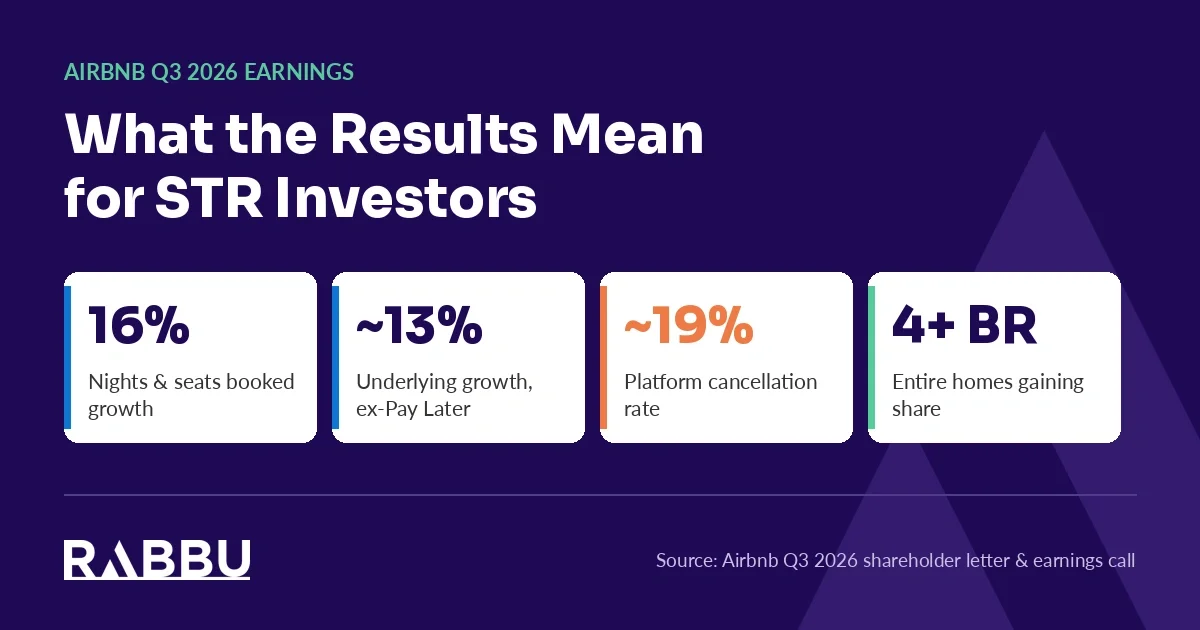
Airbnb's 16% nights growth is not all organic demand. On the earnings call, management said roughly 3 points came from Reserve Now, Pay Later (RNPL), net of cancellations. Strip that out and underlying growth was closer to 13%.
Thirteen percent is still a strong number, and still an acceleration from Q2. But the distinction matters for two reasons.
First, Airbnb itself expects the RNPL lift to shrink in Q4 as those deferred bookings work through their cancellation windows. Q4 guidance calls for nights growth of "at least low double digits," a step down from Q3.
Second, if you are using platform growth to justify an occupancy assumption, use the 13%, not the 16%. The extra 3 points came from a payment feature, not from more travelers.
The good news for U.S. investors: North America posted low double-digit nights growth, its fastest in four years, driven by demand across market types and an improvement in inbound travel to the U.S. This is not just an international story.
Bigger homes are winning
The most useful single line in the shareholder letter for investors is easy to miss. In North America, Airbnb said growth in short-term stays and entire homes, particularly listings with four or more bedrooms, continued to outpace monthly stays and private rooms. That mix shift has now held for more than a year.
That is a durable signal, not a one-quarter blip. Group and family travel on Airbnb is growing faster than solo and long-stay travel. It lines up with what Airbnb shared about how guests book: an average of three guests per booking, and most decisions made together.
For investors, the translation is straightforward:
- Bedroom count is a demand lever, not just a price lever. Larger homes are capturing a growing share of platform nights.
- Private-room and medium-term strategies face a softer tailwind. They are still growing, just slower than whole-home stays.
- Sleeping capacity and group amenities deserve real weight in your comps. A four-bedroom and a two-bedroom in the same zip code are not competing for the same guest.
Rates rose, but price is where Airbnb is headed next
Average daily rate was $179 in Q3, up 4% year over year (5% excluding currency effects). In North America, ADR rose 6%, which Airbnb attributed to both price appreciation and mix, including that shift toward larger homes.
Before you pencil in another year of rate growth, read what management said about the future.
Airbnb now describes pricing and affordability as one of its largest remaining growth opportunities. On the call, management suggested its pricing initiatives could ultimately matter more than RNPL. Several pieces are already live:
- A single 15.5% host service fee. Airbnb has moved nearly all hosts off the old split-fee model. Guests now see the full price upfront, and Airbnb says this makes listings more price-competitive, especially against the same property listed on other platforms.
- Dynamic pricing for hosts. Hosts can set a price range and let Airbnb recommend nightly rates based on local demand and availability.
- Discounts and incentives. Airbnb's new multi-listing calendar recommends last-minute discounts and minimum-stay changes to fill open nights, and the company's higher spend on incentives and credits showed up in a lower take rate this quarter.
Here is the tension investors need to understand. Airbnb makes money on volume. Its goal is more booked nights at guest-facing prices that convert. Your goal is net revenue per property. Those goals overlap, but they are not the same.
A platform pricing tool optimizes for filling the calendar. It does not know your debt service. If you hand your rates to Airbnb's recommendations, you may get higher occupancy at a lower ADR, which can be a fine trade or a bad one depending on your cost structure.
What to do with this: Underwrite new deals with flat to modest ADR growth, not a continuation of this year's increases. Airbnb's own Q4 guidance calls for only a modest ADR increase, driven mostly by mix and price appreciation. And if you use platform pricing tools, set your floor based on your numbers, not the algorithm's.
Cancellations are up, and your calendar is a weaker promise
RNPL lets guests book with nothing paid upfront. During Q3, it was available on more than 40% of Airbnb's booking value, after being extended beyond flexible and moderate listings to Limited and Firm cancellation policies.
It works for Airbnb. Guests book earlier and book more expensive listings. But on the call, management said the platform-wide cancellation rate has risen to roughly 19%, up from roughly 16% a year ago.
Three points of cancellation rate does not sound dramatic. Across a portfolio, it is meaningful. It means a larger share of the nights on your calendar are held by guests who have not paid and face little cost to walk away.
For investors, the practical translation:
- Booked occupancy and realized revenue are drifting further apart. When you review a seller's trailing numbers, ask for realized revenue, not forward bookings.
- Longer lead times mean cancellations land later. A guest who booked three months out and cancels three weeks out leaves a gap that only active repricing can fill.
- Your cancellation policy is now a revenue decision. Stricter policies may reduce RNPL eligibility and some booking volume, but they protect calendar certainty. Test it in your market rather than assuming either default is right.
- Carry a cancellation buffer in your model. If your pro forma assumes every booked night gets stayed, it is overstating revenue.
Supply is growing, and some of it is hotels
Active listings grew at a high-single-digit rate, consistent with recent quarters. Airbnb also said nights available are growing faster than listings, as it pushes existing hosts to open more of their calendars and focuses new supply on markets where demand is strongest.
Read that carefully if you own in a high-demand market. Airbnb is deliberately steering new supply toward exactly the places where returns have been best. Strong demand attracts competition, and the platform is helping it arrive.
Hotels are the other piece. Airbnb now lists thousands of boutique and independent hotels across more than 60 destinations, up from 20-plus last quarter. Hotels are still a single-digit percentage of total nights, but they are growing faster than homes, and Airbnb is specifically targeting short, last-minute, and urban stays. It also said roughly 35% of guests whose first Airbnb booking was a hotel later came back to book a home.
Hotels are not a threat to a four-bedroom lake house. They are a real competitor for a one-bedroom downtown condo. If your strategy depends on urban, short-stay, or last-minute demand, factor in more competition than your current comps show.
AI search changes how guests find your listing
Airbnb rolled out AI-powered search, AI-generated listing summaries in search results, and side-by-side AI comparisons of wishlisted homes. It plans to launch a full AI travel agent to guests in the first half of 2027.
This matters for operators because AI summaries are built from what is already on your listing: your description, your amenities, your photos, and your reviews. Airbnb noted that more than 90% of guests browse multiple listing photos and 70% read reviews before booking.
In an AI-driven search experience, a thin listing gets summarized as a thin listing. Complete amenity data, accurate descriptions, strong photos, and consistent reviews become inputs to how the platform represents your property, not just how a guest scrolls past it.
Airbnb is also reaching new guests through partnerships. Its exclusive deal with American Express, launched October 22, puts more than a million Airbnb listings on Amex Travel. That is a new demand channel, particularly for higher-end inventory.
Watch your event-year comps
Q3 2026 included the back half of the World Cup summer. As we flagged in our Q2 breakdown, a property in a host city that posted a huge summer did so in an unusual year.
If a seller shows you trailing twelve-month revenue that includes June and July 2026 in a host market, normalize those months before you use them as a baseline. Event years make good properties look great and average properties look good.
What this report does not tell you
Every number in Airbnb's report is a platform aggregate.
North America growing at its fastest pace in four years tells you nothing about whether a specific Smoky Mountains cabin market is oversupplied, whether Gulf Coast rates are compressing, or whether the property you are looking at will clear its mortgage. Airbnb's earnings tell you the category is healthy. They do not tell you whether a deal is.
Platform growth and market-level returns are two different things. That gap is where STR investors get hurt.
Where Rabbu comes in
The quarter gives you a direction. Market-level data gives you a decision.
See where investor interest and yield line up. Our STR Investor Demand Index (STRIDI) tracks where buyers are searching each month and what those markets actually return, so you can see where attention and economics agree, and where they do not.
Compare markets on the fundamentals. Rabbu's Market Finder lets you filter markets by gross yield, occupancy, and active listing counts.
Pressure test a specific property. The Airbnb Calculator models revenue potential for an address, so you can run the downside case, with flat rates and a cancellation buffer, before you make an offer.
Look at real inventory. Browse active Airbnbs and STR-ready homes for sale, including properties with operating history attached.
All of it is free and open.
The bottom line
Airbnb's Q3 confirms that STR demand is healthy, including in the U.S. Bookings accelerated, first-time bookers grew at the fastest pace since early 2022, and Airbnb raised its full-year outlook.
But the quarter also points to four things that should shape how you buy and operate:
- Strip out the payment-feature lift. Underlying nights growth was about 13%, and Airbnb expects it to moderate in Q4.
- Larger homes are winning. Four-plus-bedroom entire homes keep taking share from private rooms and monthly stays.
- Price is Airbnb's next lever. Expect more pressure toward lower guest-facing prices, and underwrite ADR conservatively.
- A booked night is not a stayed night. With cancellations near 19%, model the gap.
A stronger platform lifts the category. It does not lift your listing. That still depends on the property you pick and how you run it.