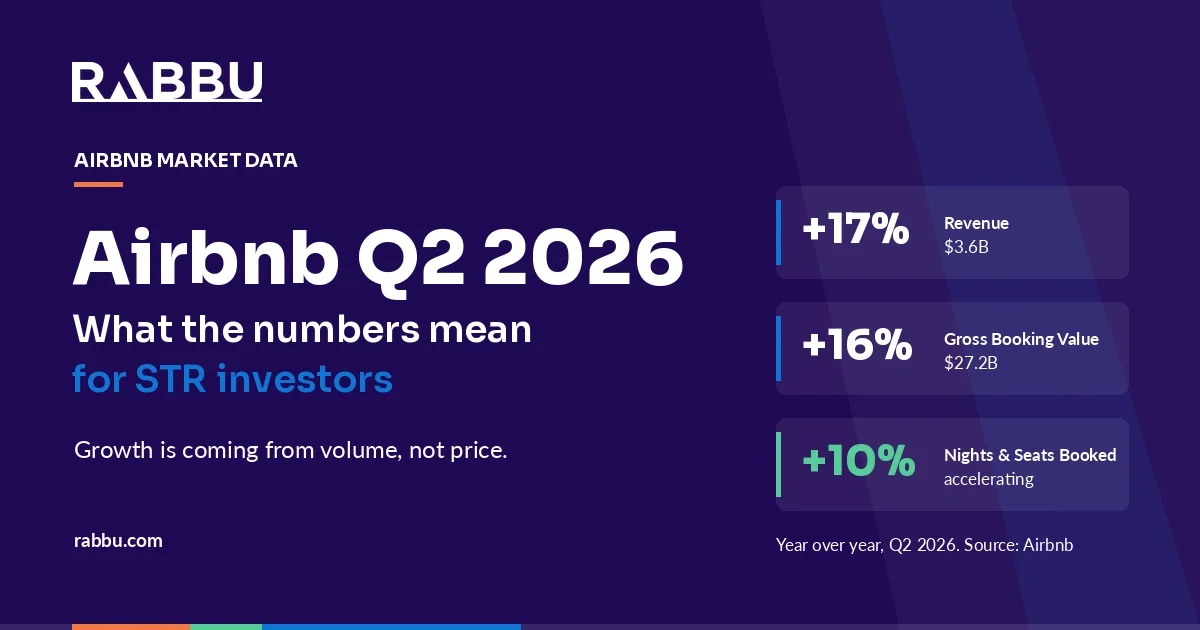
Airbnb reported its second quarter 2026 results on August 6, and the headline is a good one for the category: revenue grew 17% year over year to $3.6 billion, and management raised full-year guidance.
That is the version you will read everywhere else.
The version that matters if you own a short-term rental, or you are about to buy one, is buried in the detail. Airbnb told you three things this quarter about where demand is coming from, where supply is going, and how the platform decides which listings get seen.
Here is what the quarter actually says, and what to do with it.
The headline numbers
All figures below are from Airbnb's own Q2 2026 release, reported as of August 6, 2026.
| Metric | Q2 2026 | Year over year |
|---|---|---|
| Revenue | $3.6 billion | +17% |
| Gross Booking Value | $27.2 billion | +16% |
| Nights and Seats Booked | Not disclosed in dollars | +10% |
| Net income | $816 million | Not disclosed |
| Adjusted EBITDA | $1.3 billion | +21% |
| Adjusted EBITDA margin | 35% | Expanded |
Airbnb also raised its full-year outlook, guiding to at least mid-teens revenue growth for 2026 and an adjusted EBITDA margin of at least 35.5%. For Q3, it guided to revenue of $4.69 billion to $4.77 billion.
Critically for hosts: Airbnb said it expects its implied take rate to stay roughly in line year over year. No fee shock is coming in the back half of 2026.
Growth is coming from volume, not price
This is the single most useful line in the release for anyone underwriting a deal.
Nights and Seats Booked grew 10%, and Airbnb noted that pace accelerated from Q1. Gross Booking Value grew 16%. The gap between those two numbers is average daily rate and mix, and Airbnb characterized the ADR movement as a moderate increase.
We are deliberately not putting a precise ADR growth number on that gap. "Nights and Seats Booked" blends home nights with experiences seats, and those carry very different price points, so anything derived from the spread is contaminated by mix. Anyone publishing a clean per-night rate from these two figures is guessing.
What you can say confidently is this:
The engine of Airbnb's growth right now is more bookings, not higher nightly rates.
Airbnb also called out that net origin nights booked accelerated in the United States, France, the UK, and Australia. Growth is not just coming from emerging travel markets. It is showing up in the mature ones too, including the market most Rabbu investors are buying in.
What this means for your underwriting
- Do not model ADR expansion as your growth lever. If your pro forma needs a 10% rate increase in year two to work, the deal does not work.
- Occupancy assumptions are doing the heavy lifting. Stress test them. A property that clears at 65% occupancy and breaks even at 58% is a different asset than one that breaks even at 63%.
- Volume-led growth means demand is real but price-sensitive. Guests are booking more, and they are comparing all-in cost across listings while they do it.
Supply is expanding on three fronts at once
Demand grew. So did the number of things competing for it.
1. More homes
Airbnb reported that more than 150,000 homes across FIFA World Cup host cities were listed on the platform for the first time during the tournament. That is one event, in one summer, in a limited set of cities.
Some of that inventory will churn out. A meaningful share will not. Event-driven listing spikes have a way of becoming permanent supply.
2. Hotels
This is the one most STR investors are not tracking, and it is the most structurally interesting.
Airbnb added thousands of boutique and independent hotels across more than 20 top destinations, including New York, Paris, London, Madrid, Rome, and Singapore. Hotels remain a single-digit percentage of nights booked. But Airbnb disclosed that hotel nights booked grew roughly three times as fast as its homes business.
Airbnb also noted that approximately 35% of first-time guests who book a hotel on the platform come back to book a home. So the strategy is not purely competitive with hosts. It is a funnel.
Still, if you own a one- or two-bedroom urban condo in a major metro, your listing is now competing for impressions against a price-matched boutique hotel room on the same search results page. That is a new competitive dynamic and it is concentrated in exactly the market type where STR economics were already thinnest.
3. Experiences and services
Airbnb grew Experiences supply by nearly 80% year over year and expanded Services into grocery delivery, car rentals, airport pickups, luggage storage, and resort day passes.
This does not compete with your listing directly. It matters for a different reason: it changes what "Nights and Seats Booked" measures, and it means platform-level growth numbers will increasingly reflect things that have nothing to do with home nights. Read future Airbnb metrics with that in mind.
Airbnb is now ranking on quality, and saying so
Buried in the guest experience section is a sentence with real operating consequences: Airbnb said search results now prioritize higher-quality homes that are a better fit for each trip.
Pair that with what it rolled out for hosts this quarter:
- Personalized recommendations on listings, calendar availability, and pricing
- Quality insights that give hosts specific improvement suggestions drawn from recent guest reviews
- An updated earnings dashboard with year-over-year performance tracking
- An improved listing editor for surfacing details like sleeping arrangements
Airbnb is telling hosts exactly what it grades on, and then grading on it.
The investment implication is not subtle. Distribution is now a function of operating quality. A poorly run listing does not just convert worse. It gets fewer impressions to convert in the first place.
If your model assumes a property performs at market-median revenue with minimal active management, that assumption is getting harder to defend every quarter.
Booked calendars are getting less reliable
Two changes this quarter push in the same direction.
Airbnb expanded Reserve Now, Pay Later to more listings in more countries, and surfaced it more often through the booking journey. It also migrated eligible listings from Strict to Firm cancellation policies, framing the change as helping hosts attract more bookings.
Both of those things do what Airbnb says they do. They reduce friction and they generate more bookings.
They also mean a growing share of your calendar is held by guests who have not yet committed financially and who face a lower cost to walk away.
For investors, the practical translation:
- Occupancy on the calendar and realized revenue are drifting further apart. A 90% booked June is not 90% of June's revenue in the bank.
- Cancellation and rebooking gaps need a line in your model. If you are not carrying a buffer, you are carrying the risk instead.
- Active repricing matters more. A cancellation 12 days out is recoverable revenue if someone is watching. It is a vacant night if nobody is.
The events playbook cuts both ways
Airbnb described major events as a repeatable growth engine and listed the partnership roster: the International Olympic Committee, Tour de France, Art Basel, Lollapalooza, La Liga, and most recently NASCAR.
If you own in a market that hosts one of these, you get a demand spike. You also get a supply spike, because that is precisely what the 150,000 new World Cup listings represent.
The trap is underwriting a property using an event-year comp. A Miami or Dallas or Seattle property that posted a huge summer in 2026 did so in a year with a global tournament in town. Normalize event years out of your comps before you use them. If a seller is showing you trailing twelve month revenue that includes a World Cup window, that number is not your baseline.
What this release does not tell you
Every number in Airbnb's report is a global aggregate.
Nights up 10% worldwide tells you nothing about whether Gatlinburg is oversupplied, whether Scottsdale rates are compressing, or whether the specific three-bedroom you are looking at will clear its debt service. Airbnb's earnings tell you the category is healthy. They do not tell you whether a deal is.
The gap between platform-level growth and market-level reality is where most STR investors get hurt. Airbnb grew 17%. Plenty of individual markets did not.
Where Rabbu comes in
The quarter gives you a direction. Market-level data gives you a decision.
Find markets where investor interest and actual yield line up. Our STR Investor Demand Index tracks where buyers are searching each month and what those markets actually return, so you can see where attention and economics agree and where they do not.
Compare markets on the fundamentals. Rabbu's Market Finder lets you filter markets by gross yield, occupancy, and active listing counts.
Pressure test a specific property. The Airbnb Calculator models revenue potential on an address so you can run the downside case before you write an offer.
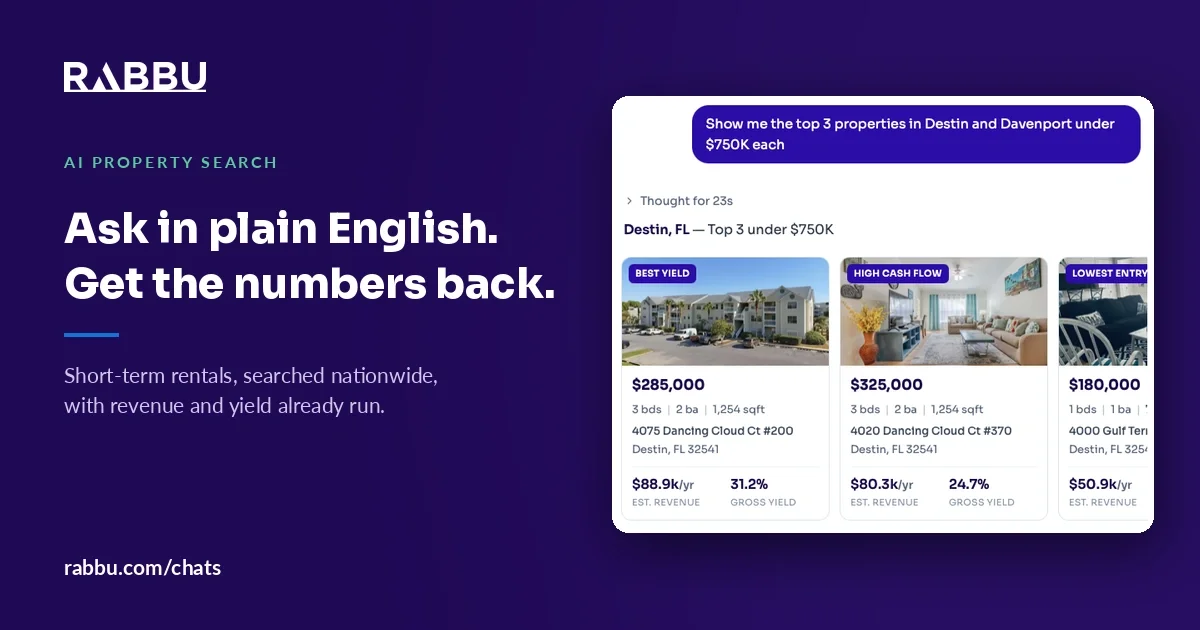
Look at real inventory. Browse active Airbnbs and STR-ready homes for sale, including properties with operating history attached.
All of it is free and open. That is the point.
The bottom line
Airbnb had a strong quarter, and the demand side of the STR category is in good shape. Bookings are accelerating in mature markets, including the U.S. Fees are stable. Guidance went up.
But the quarter also confirms three things that make individual property selection harder, not easier:
- Growth is volume-led. Do not underwrite rate increases you are not going to get.
- Supply is expanding on multiple fronts, including a hotel inventory that competes directly with urban listings.
- Quality now drives distribution, and softer cancellation terms mean a full calendar is a weaker promise than it used to be.
The category is growing. That does not make every property a good buy.
A rising platform lifts the market. It does not lift your listing. That part is still on the property you pick and how you run it.