
Most investors either overanalyze a short-term rental deal for weeks, or barely analyze it at all and buy on gut feeling. Neither approach holds up well once the mortgage payment is due.
The good news: you don't need a finance degree or a 40-tab spreadsheet to properly vet an Airbnb deal. You need the right five numbers, pulled from real data instead of guesswork, in roughly the order below.
Here's the framework we walk investors through before they ever submit a scenario to us.
Step 1: Confirm the Property Can Legally Operate as an STR
Before a single revenue number matters, confirm short-term rentals are actually permitted at this address, not just in the city broadly, but at the specific municipality, county, and HOA level.
This step gets skipped constantly, and it's the single most common reason an otherwise great-looking deal falls apart after closing. Regulations can differ block-to-block in the same city. One of the clearest examples is Nashville, where core-zone licensing is strict but nearby areas outside the county are far more workable for the same tourism demand.
Two minutes. Non-negotiable. Do this first.
Step 2: Pull Real Comparable Revenue Data, Not a Guess
This is where most first-time analysis goes wrong. New investors often estimate STR income by taking the nightly rate they'd want to charge and multiplying it by 365 days. That number is fiction.
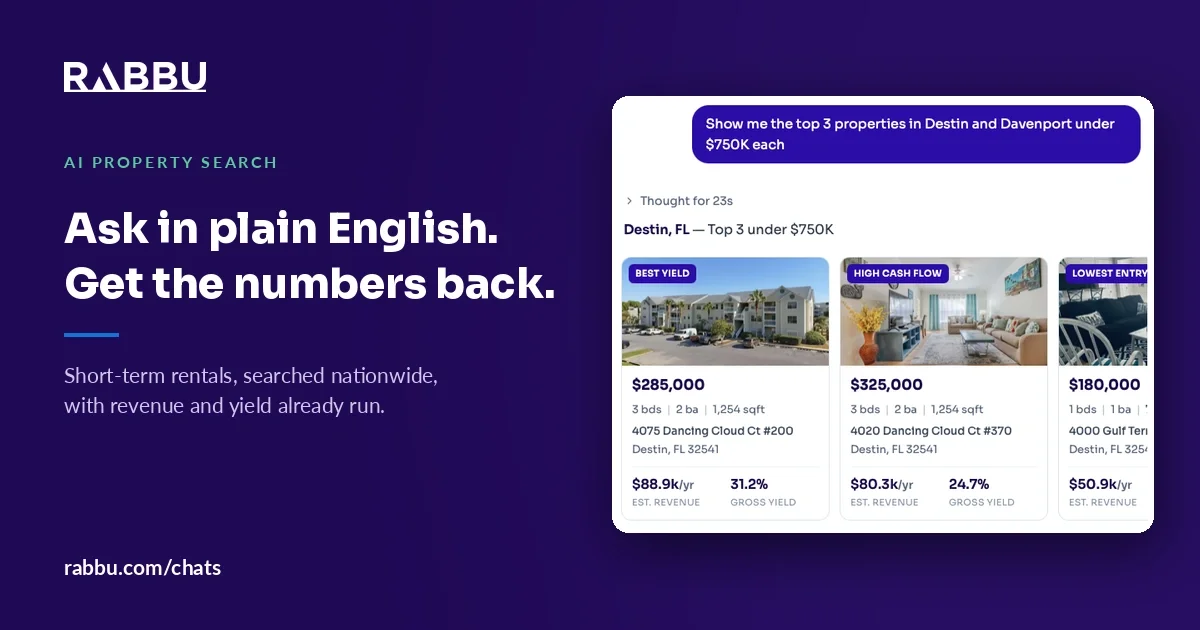
Instead, pull actual comparable performance data for similar properties in the specific submarket. Bedroom count, property type, and proximity all matter. Rabbu surfaces property-level and market-level revenue data drawn from real listings, which is a meaningfully different (and more honest) number than a hopeful nightly-rate estimate.
Look specifically for:
- Average monthly revenue for comparable properties, not just nightly rate
- Occupancy rate across a full 12-month period, not just peak season
- Seasonality curve. Is demand steady, or concentrated in a few months?
Step 3: Calculate Gross Rental Yield
With a realistic revenue number in hand, calculate gross yield:
Annual Projected Revenue / Purchase Price = Gross Yield
Example: Purchase price: $380,000. Projected annual STR revenue: $62,000. Gross yield: 16.3%.
This number alone doesn't tell you whether the deal works. It's a screening tool. A gross yield under roughly 8 to 10% is worth scrutinizing further before moving forward; above that range, it's worth continuing to the next step.
Step 4: Estimate Real Operating Expenses
This is the step that separates a deal that looks good from a deal that actually is good. STR operating costs typically run 30 to 50% of gross revenue, covering:
- Property management or self-management time
- Cleaning fees between guests
- Furnishing, restocking, and maintenance
- Higher STR-specific insurance premiums
- Utilities (usually landlord-paid on STRs, unlike most long-term rentals)
- Platform fees (Airbnb/VRBO commissions)
- Property taxes
Using the example above: if expenses run 40% of the $62,000 projected revenue, that's roughly $24,800 in annual operating costs, before the mortgage payment.
Step 5: Calculate Net Cash Flow and DSCR
Now bring the financing into the picture.
Net Operating Income (Revenue - Operating Expenses) / Annual Mortgage Payment (PITIA) = DSCR
Continuing the example: Net operating income: $62,000 - $24,800 = $37,200. Annual mortgage payment: $31,000. DSCR: 1.20.
A DSCR of 1.0 means the property breaks even against the mortgage payment. Most lenders look for 1.0 or above, though some programs, including TQL's Investor Hybrid Program, allow qualification with a DSCR below 1.0 in select scenarios.
Step 6: Stress-Test the Downside
Before calling the analysis finished, run the numbers again using a more conservative occupancy assumption, 15% to 20% below your baseline projection. If the deal still cash flows, or at minimum still covers the mortgage payment, you have real margin for error. If a moderate dip in bookings breaks the deal entirely, that's important to know before closing, not after.
Putting It Together: The 10-Minute Version
Once you've pulled real comparable data, the actual math takes minutes:
- Confirm STR legality at the address (2 min)
- Pull comparable revenue and occupancy data (3 min)
- Calculate gross yield (30 sec)
- Estimate expenses at 30 to 50% of revenue (1 min)
- Calculate DSCR (1 min)
- Stress-test at reduced occupancy (2 min)
The hardest part isn't the math. It's resisting the urge to skip straight to "does this feel like a good deal" without running the actual numbers first.
Where Financing Fits
Once a deal clears this analysis, the next question is how to finance it in a way that doesn't erase the margin you just calculated. TQL's Investor Hybrid Program qualifies borrowers using projected STR income, the same kind of data pulled in Step 2, at up to 85% LTV, without requiring personal income documentation or a DTI calculation. That leverage difference can meaningfully change the return profile on a deal that already checks out on paper.
Find a Lender that Specializes in Short-Term Rentals
Connect with lenders who actually understand short-term rental cash flow and offer DSCR loans, portfolio financing, and investor-friendly terms.
Frequently Asked Questions
What's a good gross rental yield for a short-term rental?
There's no universal number, but many investors use roughly 8 to 10% gross yield as an initial screening threshold before digging into expenses and financing. Markets, property types, and management style all affect what's realistic.
How much should I budget for STR operating expenses?
Operating expenses on a short-term rental typically run 30 to 50% of gross revenue, covering management, cleaning, furnishing, insurance, utilities, platform fees, and property taxes.
Where can I find real Airbnb revenue data instead of guessing?
Rabbu provides property-level and market-level projected revenue data based on actual comparable listings, which is more reliable than estimating from a desired nightly rate.
What is DSCR and why does it matter for STR deals?
DSCR (Debt Service Coverage Ratio) measures whether a property's net income covers its mortgage payment. A DSCR of 1.0 means the property breaks even; most lenders look for 1.0 or higher, though some STR-focused programs allow qualification below that threshold.
Should I analyze a deal using peak-season revenue or year-round average?
Always use a full 12-month average, not peak-season numbers alone. Relying on peak season overstates the property's realistic performance and can lead to overpaying or over-leveraging.
Can I qualify for financing using projected STR income instead of my personal income?
Yes. TQL's Investor Hybrid Program qualifies borrowers using projected short-term rental income, supported by an accepted third-party rental projection report or STR income narrative, without requiring personal income documentation or a DTI calculation.
Have a Deal You're Evaluating?
If you've run the numbers and want a second set of eyes, or want to know what financing actually looks like on a specific scenario, Total Quality Lending is happy to take a look.
View TQL's lender profile and submit a scenario
Total Quality Financial, Inc. | NMLS #1933377. This communication is intended for informational and educational purposes only and is not a commitment to lend or an offer to extend credit. Loan products, rates, terms, qualification requirements, and program availability are subject to change without notice and underwriting approval. Not all applicants will qualify. This is not intended as tax, legal, accounting, or investment advice. Please consult your financial, tax, and legal advisors regarding your specific situation. Equal Housing Lender. For licensing information, visit www.nmlsconsumeraccess.org.