Regulation is the variable most STR investors underestimate.
You can find a great market, underwrite a solid property, and still watch your returns evaporate because the local rules changed. That is why staying current on short-term rental regulation news is not optional for serious investors — it is part of the job.
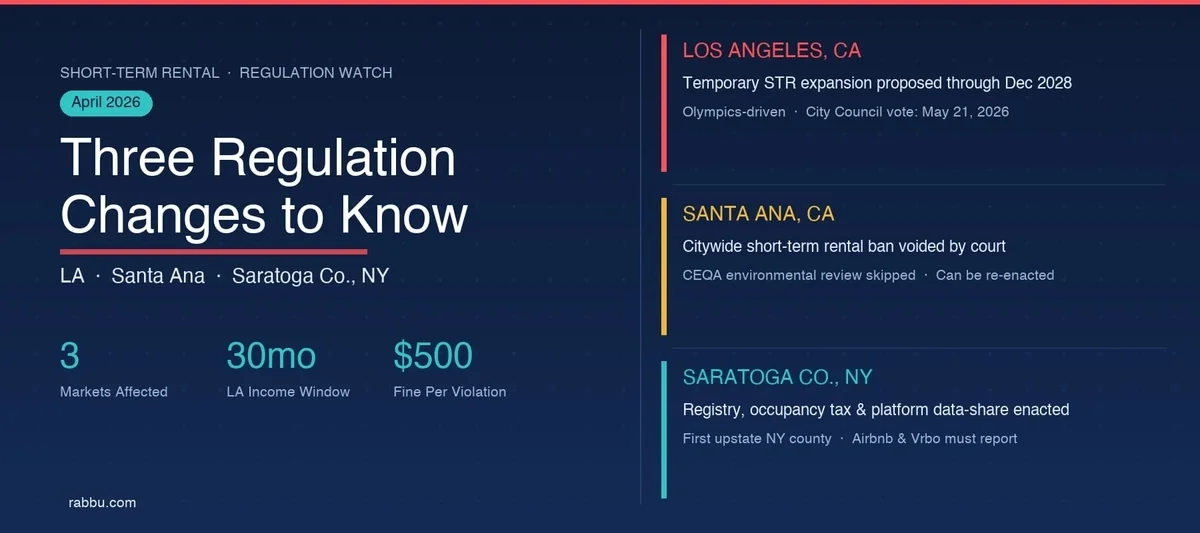
April 2026 brought three major regulatory developments across Los Angeles, Santa Ana, and Saratoga County, New York. Each one tells a different story about how cities are thinking about STRs right now.
Los Angeles Is Considering a Temporary STR Expansion for the 2028 Olympics
Los Angeles has some of the strictest short-term rental rules in the country. Since 2018, the city has limited STR hosting to primary residences only - meaning investment properties and second homes cannot legally operate as Airbnbs.
That may be about to change temporarily.
Mayor Karen Bass's proposed FY2026-27 budget directs city departments to study a time-limited program that would allow second homes and investment properties to operate as short-term rentals through December 31, 2028. The goal is to boost accommodation capacity ahead of the LA28 Olympics.
A few key details:
- The first scheduled program vote in the City Council is May 21, 2026
- Airbnb projects the rule change could generate $100M or more in additional annual tax revenue for the city
- The same budget includes a mechanism for Airbnb to pre-pay the transient occupancy tax ahead of the Games
- LA currently has roughly 5,500 legal STR listings plus an estimated 7,500 operating illegally
What this means for investors:
If the temporary program passes, it would open a roughly 30-month income window for property owners in LA who currently cannot legally operate a short-term rental.
That is a meaningful opportunity. But the word "temporary" matters. The December 31, 2028 sunset date is real. Any investment strategy built on this program needs to account for what happens the day after the Olympics closing ceremonies. Underwrite it like a time-limited play and not a permanent rule change.
Watch the May 21 council vote. Opposition from UNITE HERE Local 11 and the LA Hotel Association means this is not guaranteed to pass.
A California Court Threw Out Santa Ana's STR Ban — Here Is Why It Matters
In Orange County, property owners scored a major win in April 2026.
An Orange County Superior Court judge voided Santa Ana's 2024 ordinance that had banned all stays under 30 days citywide. The ruling found the city skipped the environmental review required under CEQA — California's Environmental Quality Act — before adopting the ban.
The ruling sided with SASTRA (the Santa Ana Short Term Rental Alliance), the host advocacy group that filed the lawsuit.
What CEQA means for cities:
Any California city adopting a "major decision", including a sweeping STR ban, is typically required to study its environmental impacts before passing the ordinance. Santa Ana skipped that step. The court said that was not legal.
What happens next:
The city can pass the ban again, but only after completing a full environmental study, a process that typically takes months and includes public review. SASTRA and host advocates are expected to challenge the thoroughness of any new study.
For STR operators in Santa Ana, this is not a clean win yet. The city has real options: appeal the ruling, rerun the environmental study, or do both. Operators who paused during enforcement now face a decision about whether to resume or wait to see if a re-enacted ban follows.
The bigger signal:
The CEQA angle could become a legal template for host advocacy groups in other California cities. Any city that passed an STR ban without a full environmental review is now a potential target for a similar challenge. San Bernardino, which passed its own citywide ban on April 15, is one market worth watching.
If you are evaluating California STR markets, regulatory exposure at the city level is a real underwriting variable, not just noise. Use Rabbu's Airbnb Market Data to compare supply trends across California markets and identify where regulatory risk is lower.
Saratoga County, NY Just Built the Blueprint for Regional STR Oversight
Saratoga County, New York became the first major upstate county to enact under New York's statewide short-term rental framework.
The Saratoga County Board of Supervisors voted unanimously on April 21 to:
- Impose an occupancy tax on STRs, treating them the same as hotels
- Establish a county-wide registry requiring all STR operators to register in two-year cycles
- Require booking platforms to share data - including dates, guest counts, total cost, property address, and registration number for every booking
Unregistered listings face fines of $500 per violation.
The platform data-share is the most consequential piece of this. Once Airbnb and Vrbo are reporting booking data directly to the county, the registry becomes a live audit system — not just paperwork. The county can see every booking in near-real time, regardless of whether a host filed at year-end.
What investors in the region should know:
Saratoga County is now a layered market. Saratoga Springs city banned non-owner-occupied STRs outright in early 2025. The surrounding county is now taxing and registering all STRs. The rules diverge sharply within a few miles.
If you own or are considering a property in the Saratoga area, a property-by-property compliance review is more useful than a regional read.
The pattern to watch: Saratoga's registry-plus-tax-plus-data-share structure is likely to spread. The Catskills, Finger Lakes, and Hudson Valley could see similar county-level action within the next 12 months if other upstate boards follow Saratoga's lead.
What This Regulation Wave Means for STR Investors
Three markets, three very different regulatory moves. But the pattern across all of them is consistent.
Cities and counties are not backing away from STR oversight — they are getting more sophisticated about it. The tools are getting sharper: tax systems, data-sharing requirements, registry frameworks, and legal challenges to non-compliant bans.
For investors, the practical takeaway is straightforward:
- Regulation is a market variable — underwrite it the same way you underwrite occupancy and ADR
- Know what rules apply property-by-property — regional generalizations will get you in trouble
- Watch legislative calendars — the LA vote on May 21 could meaningfully change what is legal in one of the country's largest markets
Before investing in any STR market, research its regulatory environment alongside the financial data.
Explore STR Opportunities With Real Market Data
Regulation shapes where you should and should not be investing right now.
Use Rabbu's Airbnb Calculator to estimate how much any address could earn as a short-term rental based on live Airbnb data.
Browse Airbnbs for sale across all 50 states, with each property underwritten as if it were already operating as an Airbnb.
And use [Rabbu's Market Data to compare revenue trends, occupancy rates, and supply growth across markets before you make a move.
The Bottom Line
Regulation is moving faster than most investors track it. A court ruling, a budget proposal, and a unanimous county vote — all in the same month — changed the calculus in three different markets.
The investors who outperform over time are the ones who treat regulatory research as non-negotiable. Not because it is interesting, but because it determines whether the investment works at all.
Stay current. Underwrite the rules alongside the numbers. And if you are looking at California markets in particular, pay attention to what comes out of the Santa Ana ruling in the next 90 days.