A tax change quietly reset the math on short-term rental investing this year. With 100% bonus depreciation back in force for 2026, a short-term rental bought in a strong market can put tens of thousands of dollars back in an investor's pocket in the first year alone. At a 35% federal tax rate, a median-priced home in the markets below can save roughly $39,000 to $96,000 in first-year taxes, on properties that still hold double-digit yields.
This article is educational, not tax advice. The figures below are illustrative estimates that depend on your tax situation. Talk to a CPA before acting on any of it.
What changed for 2026
For 2026, investors can once again deduct 100% of qualifying short-life property in the first year. The One Big Beautiful Bill Act, signed in July 2025, permanently restored 100% bonus depreciation for property acquired after January 19, 2025, reversing a phase-down that would have dropped the 2026 rate to just 20%. For short-term rental buyers, that turns a slow, decades-long deduction into a large day-one one.
Deduction versus tax savings: the number that matters
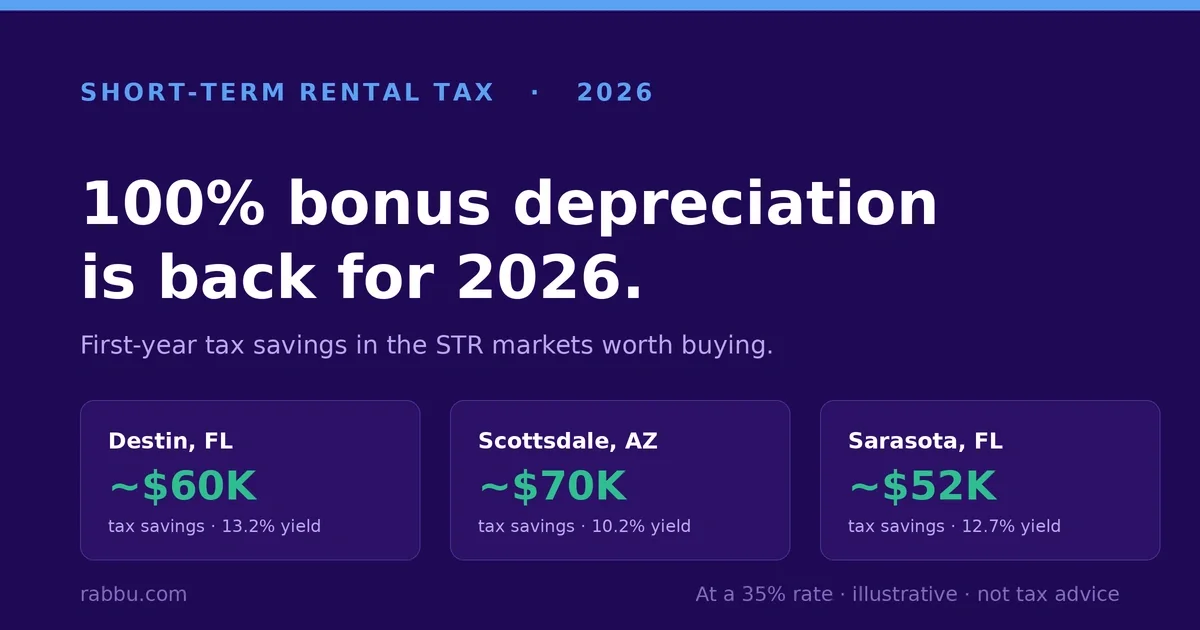
There are two numbers here, and it is easy to confuse them. The deduction is how much you subtract from your taxable income. The tax savings is how much you actually keep, and it equals the deduction multiplied by your tax rate. A $172,000 deduction is not $172,000 in your pocket. At a 35% federal rate, it is about $60,000 in real first-year tax savings. That savings figure is what this analysis leads with, because it is what an investor actually captures.
How the write-off works
Bonus depreciation lets you deduct the short-life components of a property, the fixtures, appliances, flooring, and land improvements, all at once instead of over decades. A cost segregation study identifies those components, and they typically add up to somewhere between 20% and 30% of the purchase price. Pair that with the short-term rental tax treatment, where a property averaging stays of seven days or fewer can be treated as a business rather than a passive rental, and those deductions can offset ordinary income, including W-2 wages, for owners who materially participate.
Twelve strong markets for a 2026 STR purchase
We ranked markets that are actually worth buying in, not just the most expensive. Every market below clears a real yield bar and has deep, liquid inventory, then we show the first-year tax savings at a 35% rate. The deduction assumes a cost segregation study reclassifies 25% of the purchase price. Prices and yields are Rabbu data as of June 2026.
|
Market |
Median STR price |
Est. first-year deduction |
Est. tax savings at 35% |
Median gross yield |
|---|---|---|---|---|
|
Santa Rosa Beach, FL |
$1,095,000 |
~$274,000 |
~$96,000 |
10.2% |
|
Palm Springs, CA |
$977,000 |
~$244,000 |
~$85,000 |
11.6% |
|
Scottsdale, AZ |
$800,000 |
~$200,000 |
~$70,000 |
10.2% |
|
Sevierville, TN |
$699,900 |
~$175,000 |
~$61,000 |
10.2% |
|
Gatlinburg, TN |
$699,900 |
~$175,000 |
~$61,000 |
10.9% |
|
Destin, FL |
$689,000 |
~$172,000 |
~$60,000 |
13.2% |
|
Gulf Shores, AL |
$627,000 |
~$157,000 |
~$55,000 |
13.2% |
|
Sarasota, FL |
$599,900 |
~$150,000 |
~$52,000 |
12.7% |
|
Saint Augustine, FL |
$549,000 |
~$137,000 |
~$48,000 |
11.1% |
|
New Orleans, LA |
$466,399 |
~$117,000 |
~$41,000 |
14.4% |
|
Panama City Beach, FL |
$459,900 |
~$115,000 |
~$40,000 |
12.3% |
|
Kissimmee, FL |
$450,000 |
~$113,000 |
~$39,000 |
11.9% |
A closer look at each market
Santa Rosa Beach, FL. The heart of Florida's upscale 30A corridor, home to Seaside and WaterColor, where high nightly rates and strong seasonal demand support the largest first-year deduction on this list. At a median around $1.095 million, it can generate roughly $96,000 in first-year tax savings while still holding a 10.2% yield. Browse Airbnbs for sale in Santa Rosa Beach.
Palm Springs, CA. A year-round desert resort market fed by festivals and events, with strong nightly rates and an 11.6% yield. A median near $977,000 supports about $85,000 in first-year savings. Palm Springs caps and permits short-term rentals, so confirm permit availability for any specific property before you buy. Browse Airbnbs for sale in Palm Springs.
Scottsdale, AZ. One of the Southwest's deepest STR markets, powered by golf, spring training, and group travel, in a relatively STR-friendly state. A median around $800,000 translates to roughly $70,000 in first-year tax savings at a 10.2% yield. Browse Airbnbs for sale in Scottsdale.
Sevierville, TN. A gateway to the Great Smoky Mountains with more than 1,500 active for-sale listings, one of the most liquid cabin markets in the country. A median near $700,000 supports about $61,000 in first-year savings at a 10.2% yield. Browse Airbnbs for sale in Sevierville.
Gatlinburg, TN. The Smoky Mountains cabin capital and one of the most established drive-to STR markets in the U.S., with a 10.9% yield. At a median around $700,000 the first-year savings land near $61,000. Browse Airbnbs for sale in Gatlinburg.
Destin, FL. An Emerald Coast beach market with premium nightly rates and a 13.2% yield, tied for the highest on this list. A median near $689,000 supports roughly $60,000 in first-year tax savings. Browse Airbnbs for sale in Destin.
Gulf Shores, AL. The value play on the Gulf Coast, pairing a lower entry price with a 13.2% yield. A median around $627,000 translates to about $55,000 in first-year savings. Browse Airbnbs for sale in Gulf Shores.
Sarasota, FL. A Gulf Coast market anchored by Siesta Key, with year-round and snowbird demand and a 12.7% yield. A median near $600,000 supports roughly $52,000 in first-year savings. Browse Airbnbs for sale in Sarasota.
Saint Augustine, FL. A historic coastal town with steady year-round tourism and a more accessible entry price. At a median around $549,000 the first-year savings land near $48,000 at an 11.1% yield. Browse Airbnbs for sale in Saint Augustine.
New Orleans, LA. The highest yield on this list at 14.4%, driven by festivals, conventions, and year-round events. A median near $466,000 supports about $41,000 in first-year savings. New Orleans regulates short-term rentals tightly, so check the permit rules for the specific address and neighborhood. Browse Airbnbs for sale in New Orleans.
Panama City Beach, FL. A high-volume Panhandle beach market with an affordable entry point and a 12.3% yield. A median around $460,000 translates to roughly $40,000 in first-year savings. Browse Airbnbs for sale in Panama City Beach.
Kissimmee, FL. The Disney-area market and the deepest STR inventory in the country, with more than 2,000 active for-sale listings in purpose-built vacation communities zoned for short-term rental. A median around $450,000 supports about $39,000 in first-year savings at an 11.9% yield. Browse Airbnbs for sale in Kissimmee.
What about the ultra-luxury markets?
The absolute largest deductions come from trophy markets like Anna Maria Island or Key West, where median prices run from $1.5 million to $2.5 million and first-year savings can reach $130,000 to $220,000. Those numbers are eye-catching, but the yields are often lower and the buyer pools are thinner, which makes resale harder. The tax deduction should be a bonus on top of a property that already works as an investment, not the reason to buy one. That is why the markets above lead with strong yields and deep liquidity first.
An important caveat on how this really works
Bonus depreciation is largely a timing benefit. You are pulling forward deductions you would otherwise take slowly over decades, and part of the write-off is recaptured as taxable income when you sell. The lasting advantages are the time value of the money you keep now and the chance to offset high-rate ordinary income today. It is a powerful tool, but it is acceleration, not permanent free money, and how much of it survives to your bottom line depends on your full tax picture.
Who actually qualifies
The property generally needs to average guest stays of seven days or fewer to escape passive-loss treatment, and you need to materially participate in running it, which usually means being genuinely involved rather than handing everything to a manager. A cost segregation study is not legally required to claim bonus depreciation, but as a practical matter, it is what identifies the deductible components. Some states also do not conform to federal bonus depreciation, so your state tax picture may differ.
Frequently asked questions
How much can bonus depreciation actually save me on a short-term rental in 2026? At a 35% federal rate, a median-priced STR in a strong market can generate roughly $39,000 to $96,000 in first-year tax savings, based on a 25% cost-segregation assumption. Your actual savings equal the deduction times your tax rate, so a higher bracket or state income tax increases it. This is the money you keep, which is different from the much larger deduction figure.
What is the bonus depreciation rate for short-term rentals in 2026? For 2026, the bonus depreciation rate is 100%. The One Big Beautiful Bill Act permanently restored the full rate for property acquired after January 19, 2025, so qualifying short-life components identified through cost segregation can be fully deducted in the first year rather than spread over decades.
Can bonus depreciation offset my W-2 income? It can, if the short-term rental qualifies as non-passive. That generally requires an average guest stay of seven days or fewer and material participation by the owner. When those tests are met, losses created by cost segregation and bonus depreciation can offset ordinary income, including W-2 wages. Confirm your situation with a CPA.
Compare prices and yields across markets in Rabbu's market data before you buy.