

A cost segregation study can turn a short-term rental into a six-figure first-year deduction. Two rules decide whether that deduction offsets your wages this year or sits as a passive loss:
- The average guest stay is 7 days or less.
- You Materially Participate in running the property.
Meet both, and you do not need Real Estate Professional Status. Miss either and the loss is passive. The rest of this article covers how each rule works, how to document it, and when to order the study.
The clock matters. Both requirements are measured over the calendar year. To use the deduction on your 2026 return, you need to close, have the property ready to rent and log more than 100 operating hours by December 31, 2026. Every week you wait to close, leaves less time to log those necessary Material Participation hours.
The Two Requirements
Rental losses are passive by default. Passive losses offset only passive income, such as income from other rentals. However, if the goal is to use the losses from a cost segregation study to offset active income – such as W2 wages, business income and/or investment income – those would be ‘off-limits’… UNLESS, the property qualifies for the following 2 requirements, which are also known as the Short-Term Rental Tax Loophole:
- Short-Term Rental status: the average guest length of stay is 7 days or less.
- Material Participation: requires 1 of 7 IRS tests. Most owners choose test #3, which requires 100 hours of participation in the rental activity & more than anyone else.
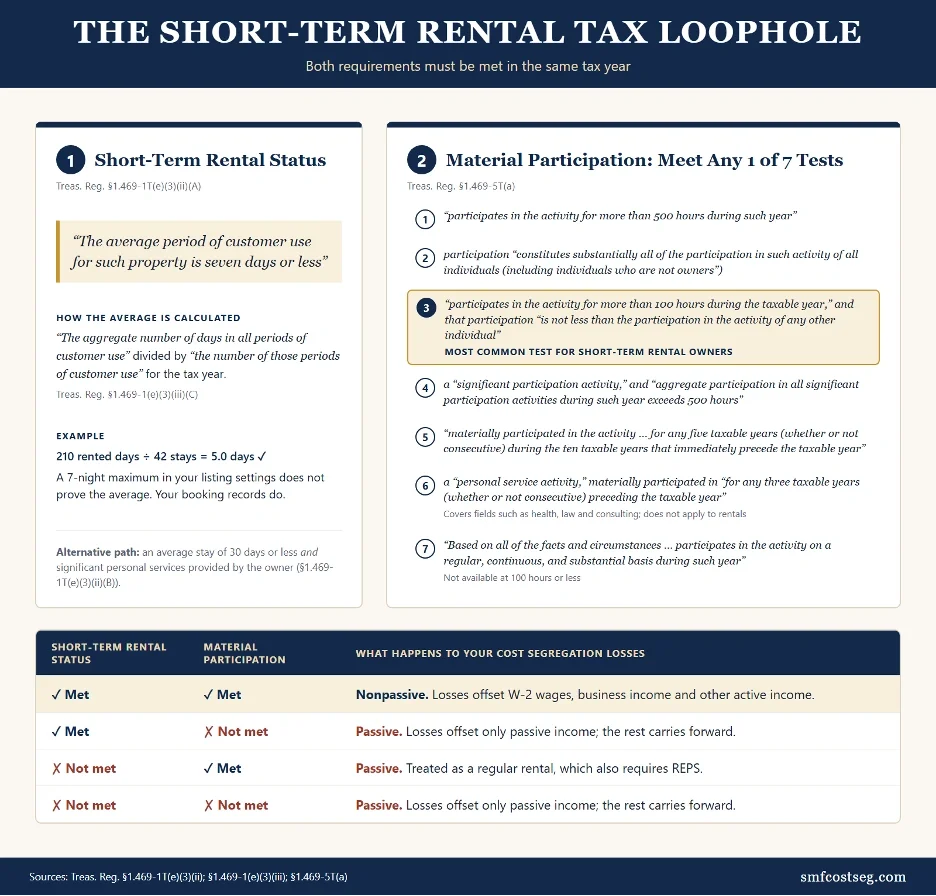
With both requirements met, the losses from the study’s accelerated depreciation are reclassified from passive to active. They can then offset active income, such as W-2 wages and business income, as well as other income on your return, such as capital gains and retirement account withdrawals.
A long-term rental can also have its losses reclassified, but the bar is much higher. In addition to Material Participation, the owner needs Real Estate Professional Status (REPS): more than 750 hours in real estate during the calendar year, and more than half of their total working time.
Requirement 1: Average Stay of 7 Days or Less
The seven-day exception1 looks at the average period of customer use across all stays in the tax year. Divide total rented days by the number of separate stays.
Requirement 2: Material Participation
The IRS has seven Material Participation tests, laid out in Treasury Regulation §1.469-5T(a)2. You only need to meet ONE of the tests to qualify:
- 500 hours. You participate for more than 500 hours during the year.
- Substantially all. Your participation is substantially all of the participation by anyone, including people who are not owners, such as cleaners and contractors.
- 100 hours and more than anyone else. You participate for more than 100 hours, and no other individual participates more than you.
- Significant participation activities. You participate more than 100 hours in this activity, and your hours across all such activities total more than 500.
- 5 of the last 10 years. You Materially Participated in the activity in any 5 of the 10 preceding years.
- Personal service activity. You Materially Participated in any 3 prior years. This covers fields such as health, law and consulting and does not apply to rentals.
- Facts and circumstances. You participate on a regular, continuous and substantial basis. This test is not available at 100 hours or less.
Tests 5 and 6 depend on prior years, so they rarely help a new owner. Most short-term rental owners use test 3: more than 100 hours, and more than anyone else. Compare yourself to each person separately. If you log 160 hours, your cleaner logs 140 and your co-host logs 80, you pass. Their combined 220 hours do not matter. If your cleaner logs 200 hours, you fail test 3 and need another one.
The tests run on the calendar year, January 1 through December 31, and they are not prorated. Rather, a late-year purchase must clear the same bar in less time. Close on November 15 and you have about six and a half weeks to log more than a total of 100 hours for the calendar year.
Your spouse’s hours count toward your total so log each person’s time separately so the same work is not counted twice. A full-service property manager usually works more hours than the owner, which is why the choice of manager matters.
Which Hours Count
The same regulation spells out which hours count towards Material Participation.2
- Operating work counts. Guest communication, pricing and calendar management, hiring and scheduling cleaners and repair vendors, and turnovers and maintenance you do yourself.
- Investor work does not, unless you also run day-to-day operations. The IRS regulation, Treas. Reg. §1.469-5T(f)(2)(ii), names three examples: studying financial statements or operating reports, preparing summaries or analyses for your own use, and monitoring finances or operations in a non-managerial capacity. An owner who handles day-to-day operations can count this time; an owner who only reviews a manager’s statements cannot.
Records can be “any reasonable means.” Daily logs are not required, and appointment books, calendars and narrative summaries are acceptable.2 Hour estimates reconstructed after the year ends carry the least weight. Log the date, task and time as you go, and back it up with guest messages, invoices and booking platform records. If you rely on test 3, it’s recommended to record your cleaner’s and co-host’s hours, too. If you need help keeping the log, helpful tools like REPSLog exist to help automate hourly tracking required.
What Cost Segregation Adds
A cost segregation study moves parts of the purchase price onto much shorter depreciation schedules:
- 5-year (and 7-year) property: personal property, such as appliances, chandeliers, carpeting and removable cabinets.
- 15-year property: land improvements, such as driveway paving, fencing, landscaping, outdoor pools and concrete patios.
Under the One Big Beautiful Bill Act3, signed July 4, 2025, 100% bonus depreciation is back for 5-, 7- and 15-year property, if the property was both acquired and placed in service after January 19, 2025. Those components are deducted in full in the first year.
If the property was acquired before January 20, 2025, even if it was placed in service later, the phase-down schedule from the 2017 Tax Cuts and Jobs Act applies instead: 80% for property placed in service in 2023, 60% in 2024, 40% in 2025, 20% in 2026 and 0% in 2027. This means a contract signed in December 2024 that closed in February 2025 falls on the old schedule (40% bonus, not 100%).
The IRS sets out what a reliable study includes in its Cost Segregation Audit Techniques Guide4. Examiners use it to review studies, so ask any cost segregation provider whether their study follows it.
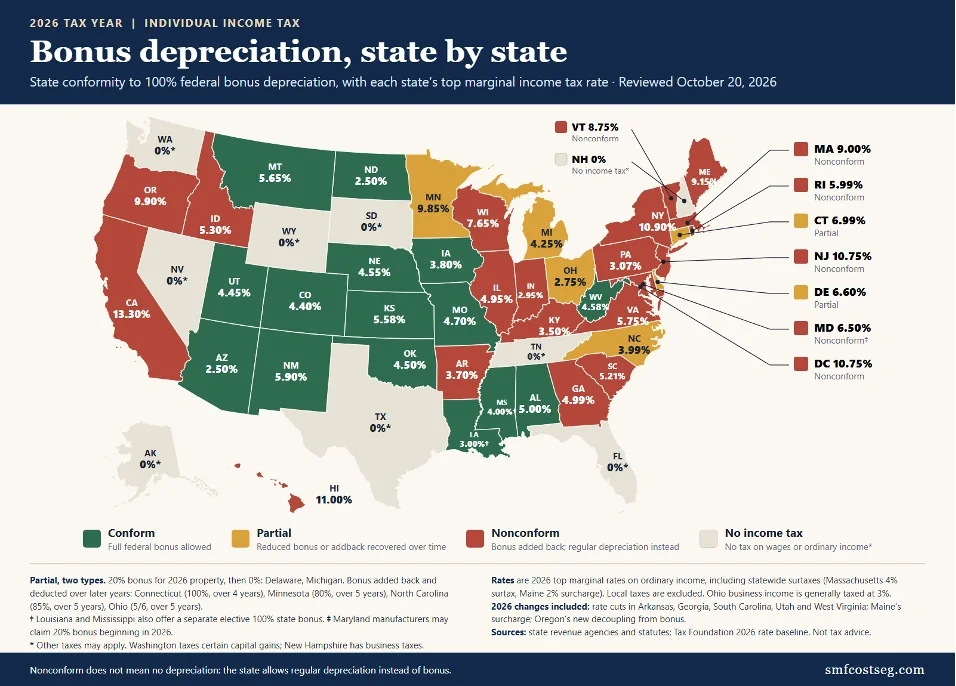
What about state taxes? Each state has jurisdiction over whether to follow federal bonus depreciation. In a nonconforming state, you still claim 100% bonus depreciation on your federal return, but the state return depreciates the same components over their regular schedules. The map below shows each state’s 2026 status next to its top income tax rate. Three patterns stand out:
- In states with no individual income tax - including Florida, Texas and Tennessee - only the federal return matters, so state conformity is not an issue.
- Several high-tax states - including California, New York and New Jersey - do not conform, so owners there get all of the cost seg benefit on the federal return.
- Six states - including Connecticut, North Carolina and Ohio - conform only in part. See notes below for more detail.
Timing: The December 31 Deadline
Material Participation is tested in the year the deduction is claimed. For avoidance of doubt, the hours from a prior year cannot be carried into a later year. So, for a 2026 cost seg study, a real estate owner will need Material Participation and STR status in 2026 to use the losses to offset W2 wages or other active income. This applies even if the property was purchased in a year other than 2026, which just requires a supplemental form (Form 3115) to capture the additional depreciation (via a 481(a) adjustment).
To use 2026 depreciation to offset your W2 and other active income, 4 things must happen by December 31, 2026:
- Close on the property. You must purchase & place the property in-service before 12/31/2026 to apply the depreciation to your 2026 tax return. Otherwise, waiting until 2027 means you will not get to apply the depreciation until the 2027 tax return.
- Place the property in service. The property must be ready and available to be rented by December 31. So, a property undergoing a gut renovation that is not ready to be rented by 12/31/2026 would not qualify to use the losses in 2026 (however would be able to use them in 2027, if the property was then placed in-service).
- Log the STR bookings & your involvement for Material Participation. Keep track of supporting documents and activity logs to verify the 7-day or less average stay requirement as well as Material Participation.
- Order the Cost Seg Study. The ideal time to get a cost segregation study is right after closing and ideally before any planned improvements. That way, you can ensure accuracy between the opening day balance sheet and the improvements spent post-closing as well as maximize deductions via strategies such as Partial Asset Dispositions.
Case Study: A $500,000 Florida Short-Term Rental
Here is the math on a typical purchase. The owner meets both requirements, bought the home under a contract signed after January 19, 2025, and placed it in service in January 2026. Florida has no state income tax, so only the federal return is affected.
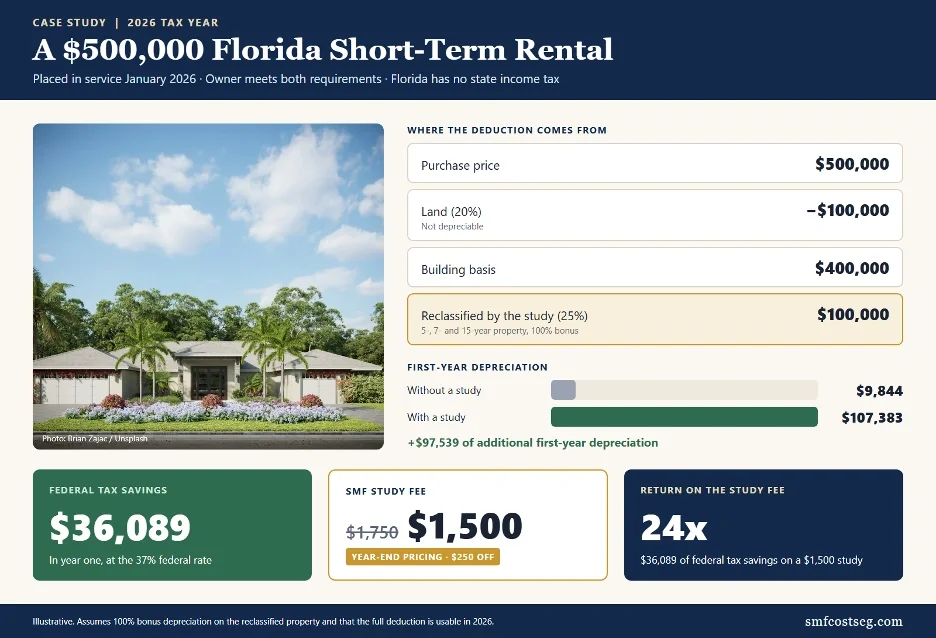
At SMF’s year-end price of $1,500 ($250 off the standard $1,750), the study returns about 24 times its cost: roughly $36,000 of federal tax savings in the first year. The study fee is also deductible as a business expense.
Who Does What
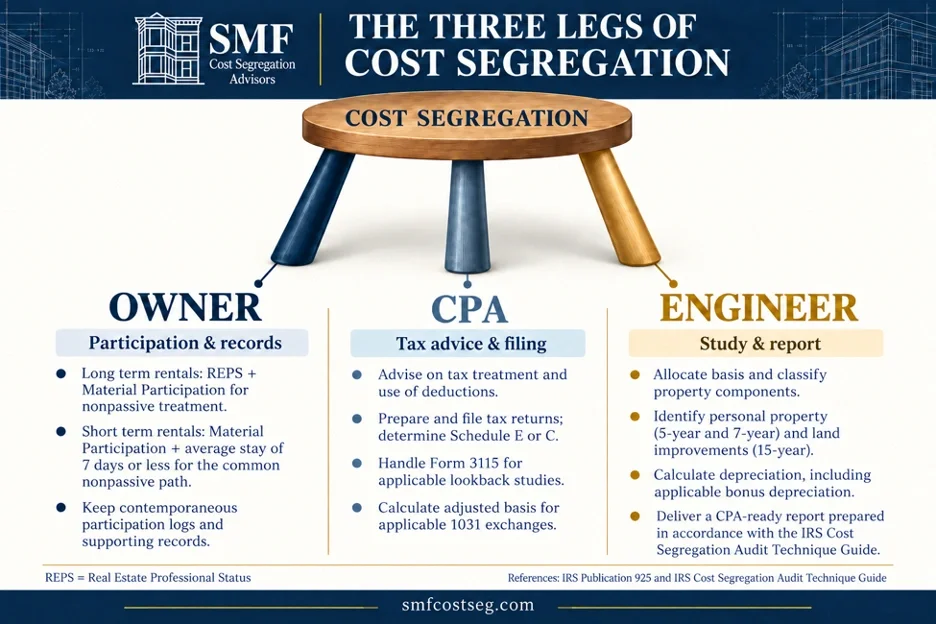
The team is made up of three members: the owner, the CPA and the Cost Seg Engineer. The owner purchases the property and is responsible for satisfying STR & Material Participation requirements. The Cost Seg Specialist is responsible for taking the building basis and classifying every building component to applicable bucket: Personal Property (5-Yr & 7-Yr) vs. Land Improvements (15-Yr) vs. Structural Components (27.5-Yr for a LTR and 39-Yr for a STR). The CPA is responsible for providing formal tax advice and preparing the tax return & supplemental filings, as applicable.
If you are looking to apply the depreciation to your 2026 tax return, then the window is closing to get your deal done by year end. Use Rabbu’s Airbnb calculator to evaluate operating potential, then check whether your property qualifies for cost segregation with SMF. Review both with your CPA.
Frequently Asked Questions
Do I need Real Estate Professional Status for a short-term rental? No. If the average guest stay is 7 days or less and you Materially Participate, losses are nonpassive without it. The REPS requirement is specifically for long-term rentals.
Can I use a property manager and still Materially Participate? Yes, but it is harder. Under the 100-hour test, no individual, including the manager’s staff, can work more hours than you. Owners who handle pricing and guest communication themselves are in a stronger position. There is always the 500-hour test as an alternative as well…
I bought the property with a partner. Do we both need to qualify? Yes. Each owner’s share of the loss is passive or nonpassive based on that owner’s own participation. Spouses are the exception: their hours are combined.
Does the furniture that came with the property count? Only if the closing documents assign it a separate value, which is rare. Otherwise, there is $0 value ascribed to it and so there is no additional depreciation to take. However, amounts spent post-closing on any furniture or other personal property would likely be eligible for bonus depreciation as 5-Yr property (or if below $2,500 then eligible to be expensed via the IRS De Minimis Safe Harbor Provision).
Sources and Methodology
Sources were reviewed Oct. 20, 2026. Short-term rental status and material participation rules are quoted from the Treasury regulations under Section 469. Bonus depreciation dates follow IRS guidance on the One Big Beautiful Bill Act.
The case study assumes a $500,000 purchase price with 20% allocated to land and 25% of the building basis reclassified to 5-, 7- and 15-year property, all eligible for 100% bonus depreciation. The remaining building basis is depreciated over 39 years using the IRS mid-month convention for property placed in service in January (2.461% in the first year). Tax savings use the 37% top federal rate and assume the owner can use the full deduction in the first year. Actual reclassification percentages, land values and tax rates vary by property and taxpayer. The state map reflects each state’s 2026 top marginal rate on ordinary income and its conformity to federal bonus depreciation, based on state revenue agencies and statutes. The return on the study fee uses SMF’s year-end price of $1,500.
- Treas. Reg. §1.469-1T(e)(3)(ii), exceptions to the definition of rental activity, including the seven-day exception. Electronic Code of Federal Regulations.
- Treas. Reg. §1.469-5T, material participation: the seven tests, which work counts, spouse participation and methods of proof. Electronic Code of Federal Regulations.
- IRS, Treasury and IRS guidance on the additional first year depreciation deduction amended by the One Big Beautiful Bill (Notice 2026-11), including when property is treated as acquired.
- IRS Publication 5653, Cost Segregation Audit Techniques Guide (February 2025).
This content is for educational purposes only and is not tax or legal advice. Your CPA determines eligibility, elections and how deductions apply to your circumstances.