
Investing & Finance

15 min read

Tax Loopholes for Short-Term Rentals: Maximize Your Deductions

Dec 02, 2025

By Emir Dukic

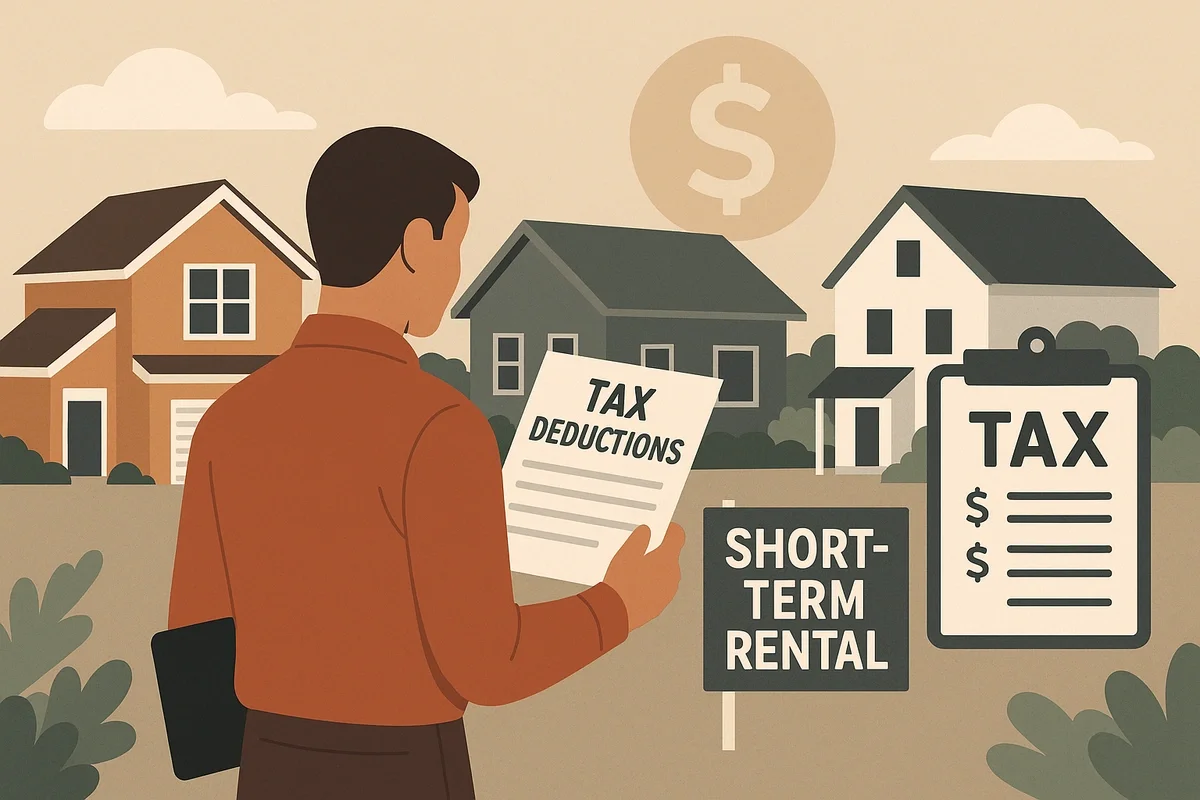
Investor reviewing tax deduction documents in front of short-term rental properties and tax icons, symbolizing strategies and tax benefits for Airbnb investors.

Most real estate investors discover their short-term rental tax obligations after they've already purchased the property, closed on financing, and welcomed their first guests—when their accountant starts asking questions they can't answer. By then, they've missed opportunities to structure ownership correctly, optimize depreciation strategies, and model after-tax returns that determine whether the investment actually makes financial sense.

This guide covers federal income tax rules including the 14-day rule and material participation requirements, deduction strategies that significantly improve after-tax returns, state and local occupancy tax obligations that vary by market. Using the right deduction strategy can dramatically increase after-tax returns, often boosting net profits by 15–30% compared to investors who overlook depreciation and available write-offs.

How the IRS Defines a Short-Term Rental

Short-term rental owners are responsible for federal and state income taxes and may also be subject to local occupancy/lodging taxes and self-employment taxes, depending on the duration of the rental and the services provided. The IRS classifies your property based on average guest stay length—typically 7 days or less qualifies as a short-term rental—and whether you provide substantial services beyond basic property access.

Substantial services include daily housekeeping, concierge assistance, meal service, or guided activities. If you only provide weekly cleaning, basic utilities, and Wi-Fi access, you're offering insubstantial services, which keeps your property in the passive rental category. This classification determines which tax forms you file, whether you owe self-employment tax, and which deductions you can claim.

Short-Term Rental Tax Rules You Must Know

Three key factors determine how the IRS taxes your short-term rental income: average guest stay duration, the level of services you provide, and your degree of material participation in the operation. Most investors discover the tax implications after purchasing their first property, when their accountant starts asking questions they can't answer.

Smart investors model tax treatment during property selection using tools like Rabbu's calculator, recognizing that after-tax returns matter more than gross revenue projections.

Average Stay of Guests

The IRS draws a line at 7 days of average guest stay. Properties where guests typically stay 7 days or less fall into one tax category, while those with longer average stays get treated as traditional rental real estate.

You calculate this annually by adding up all guest nights and dividing by the number of bookings. A ski cabin might see 3-day weekend stays in winter and 10-day family vacations in summer, but the annual average determines tax treatment. Properties in markets with shorter average stays may qualify for different tax advantages, particularly around material participation rules and self-employment tax treatment.

Substantial Services vs. Passive Rental

The services you provide determine whether you report income on Schedule C (business income) or Schedule E (rental income).

Substantial services include:

  • Daily housekeeping: Cleaning and tidying during guest stays, not just turnover cleaning

  • Meal service: Breakfast, snacks, or other food provided beyond coffee and tea

  • Concierge activities: Booking tours, arranging transportation, providing local guidance beyond a welcome binder

  • Tour services: Guided experiences or activities you personally provide

Insubstantial services keep you in rental territory:

  • Turnover cleaning: Cleaning between guest stays only

  • Basic utilities: Electricity, water, internet, cable

  • Amenity access: Pool, hot tub, game room without active supervision

  • Self-service check-in: Lockbox or keypad entry with minimal host interaction

Most STR investors operate with insubstantial services to maintain rental property status, which offers simpler accounting and potentially favorable tax treatment. Some luxury properties justify substantial services to command premium nightly rates despite the additional tax complexity.

Net Investment Income Tax Triggers

High-income investors face an additional 3.8% Net Investment Income Tax (NIIT) on rental income if their modified adjusted gross income exceeds $200,000 (single) or $250,000 (married filing jointly). This tax applies to passive rental income, but you can potentially avoid it through material participation.

If you materially participate in your STR operation, your rental income may be reclassified as non-passive business income, which escapes NIIT but might trigger self-employment tax instead. The optimal strategy depends on your specific income profile and tax situation.

Find a Lender that Specializes in Short-Term Rentals

Connect with lenders who actually understand short-term rental cash flow and offer DSCR loans, portfolio financing, and investor-friendly terms.

Get Matched with STR Lenders

The 14-Day Rental Rule and Minimal Rental Use Rule Explained

The IRS offers a tax loophole buried in the tax code: rent your property 14 days or fewer per year, and you pay zero federal income tax on that rental income. This "Masters Rule"—nicknamed after homeowners renting during the Augusta Masters golf tournament—creates opportunities for investors with properties in high-demand seasonal markets.

You cannot deduct any rental expenses under this rule—no cleaning costs, no utilities, no depreciation—but you also report zero income. For a property that generates $15,000 renting for two weeks during a major event, that's $15,000 of completely tax-free income. The minimal rental use rule operates differently: if you rent your property 15 days or more annually, all rental income becomes taxable.

Personal Use Days Calculation

The IRS counts personal use days separately from rental days, and the ratio between them determines your deduction limits. Personal use includes any day you, your family members, or anyone who doesn't pay fair market rent uses the property. Days spent on repairs and maintenance don't count as personal use, but days spent showing the property to potential buyers or conducting minor touch-ups between guests typically do count.

When personal use exceeds the greater of 14 days or 10% of total rental days, the IRS limits your deductible rental expenses to your rental income—you cannot create a loss to offset other income. This "vacation home" limitation significantly impacts investors who want to enjoy their properties personally while building rental income.

14-Day Rule Rental Scenarios

Consider these scenarios:

Scenario A: You rent your beach condo for 10 days during spring break at $500/night, generating $5,000. You use it personally for 30 days throughout the year. Result: Zero taxable income, zero deductible expenses.

Scenario B: You rent the same condo for 20 days generating $10,000, and use it personally for 25 days. Result: All $10,000 is taxable income, but personal use exceeds 14 days and 10% of rental days, so rental expense deductions are limited to rental income—you cannot create a loss.

Scenario C: You rent the condo for 180 days generating $90,000, and use it personally for 10 days. Result: All $90,000 is taxable, and you can deduct all ordinary rental expenses including depreciation, potentially creating a loss to offset other income.

Accurate tracking protects your deductions and helps you plan personal use strategically within tax-favorable limits.

Schedule E vs. Schedule C for Short-Term Rental Income

Where you report your STR income affects your tax liability, deduction opportunities, and future tax planning strategies. Schedule E (Supplemental Income and Loss) is designed for passive rental real estate activities. Most STR investors with minimal services report here, enjoying simpler accounting and avoiding self-employment tax.

Schedule C (Profit or Loss from Business) treats your STR as an active trade or business, which opens different deduction opportunities but may trigger self-employment tax.

When STR Income Stays on Schedule E

Your STR income remains on Schedule E when you provide only insubstantial services and operate as a passive rental activity. This classification works well for investors who hire property managers to handle day-to-day operations, provide only turnover cleaning and basic amenities, and limit personal involvement to major decisions and annual planning.

Schedule E reporting keeps your operation simple and avoids the 15.3% self-employment tax that Schedule C income might trigger. Passive rental losses face limitations—you can only deduct up to $25,000 in losses against other income if your modified adjusted gross income stays below $100,000, with the deduction phasing out completely at $150,000.

When STR Income Moves to Schedule C

Your income shifts to Schedule C when you provide substantial services that make your operation resemble a hotel or bed-and-breakfast more than a rental property. This classification typically applies when you offer daily housekeeping during guest stays, provide breakfast or meal service, arrange tours or concierge services, or maintain significant on-site presence and guest interaction.

Schedule C treatment allows you to deduct additional business expenses like advertising, professional development, and home office costs if you qualify. The tradeoff? Your net profit faces self-employment tax at 15.3% on the first $160,200 (2023 threshold, adjusted annually) and 2.9% above that amount. Some investors strategically choose Schedule C treatment to unlock the Qualified Business Income (QBI) deduction, which allows up to 20% deduction on qualified business income, though complex limitations apply.

Material Participation and Self-Employment Tax on STRs

Material participation rules determine whether your rental activity is passive (subject to passive loss limitations) or active (potentially subject to self-employment tax but exempt from NIIT). Proper material participation can save thousands in Net Investment Income Tax while potentially triggering self-employment tax—the optimal outcome depends on your specific income profile.

Seven IRS Material Participation Tests

You materially participate if you meet any one of these seven tests:

  • Test 1 (500-hour test): You participate more than 500 hours during the year in the activity

  • Test 2 (substantially all test): Your participation constitutes substantially all participation by all individuals, including non-owners

  • Test 3 (100-hour test): You participate at least 100 hours during the year, and no other individual participates more than you

  • Test 4 (significant participation activity): The activity is a significant participation activity (more than 100 hours), and your aggregate participation in all significant participation activities exceeds 500 hours

  • Test 5 (five-of-ten-years test): You materially participated in the activity for any five of the prior ten years

  • Test 6 (personal service activity): The activity is a personal service activity where you materially participated for any three prior years

  • Test 7 (facts and circumstances test): Based on all facts and circumstances, you participate on a regular, continuous, and substantial basis (at least 100 hours, with no management services by others)

For STR investors, Tests 1 and 3 are most commonly used. Tracking your hours spent on property management, guest communication, maintenance coordination, marketing, and financial management helps you meet the thresholds. Document your time contemporaneously—keep calendars, logs, or time-tracking apps showing dates, hours, and activities.

Avoiding Self-Employment Tax With Active Management

Even if you materially participate in your STR activity, you may not owe self-employment tax if your property qualifies as rental real estate rather than a business providing substantial services. The IRS generally doesn't subject rental real estate income to self-employment tax, even when the landlord materially participates.

This creates a sweet spot: material participation helps you avoid NIIT (if applicable) without triggering self-employment tax, as long as you maintain rental real estate classification through insubstantial services. Advanced investors pursuing real estate professional status can unlock even greater benefits—if real estate is your primary occupation (more than 750 hours annually and more than 50% of your working time), and you materially participate in your rental activities, you can deduct unlimited passive losses against other income.

Short-Term Rental Deductions, Loopholes and Depreciation Strategies

Proper deduction strategy significantly improves after-tax returns, often adding 15-30% to your bottom line compared to investors who miss available deductions or fail to optimize depreciation.

Operating Expense Deductions

You can deduct ordinary expenses directly related to your rental activity:

  • Direct expenses: Cleaning services, supplies, linens, toiletries, guest amenities, utilities during rental periods

  • Indirect expenses: Property insurance, property taxes, HOA fees, mortgage interest, property management fees

  • Marketing and booking: Airbnb service fees, professional photography, listing optimization services, paid advertising

  • Maintenance and repairs: Routine maintenance, minor repairs, landscaping, pest control, HVAC servicing

  • Professional services: Accounting fees, legal fees, property management software subscriptions

The key distinction: repairs are immediately deductible, while improvements that extend property life or add value get capitalized and depreciated over time. Fixing a broken dishwasher is a repair; replacing all appliances with high-end models is an improvement. Track expenses separately for each property using dedicated business accounts and credit cards.

Capital Improvements and Cost Segregation

Capital improvements—new roof, HVAC system, room addition, major renovations—get depreciated over 27.5 years for residential rental property. This slow depreciation schedule means you wait decades to recover improvement costs through tax deductions.

Cost segregation studies accelerate this timeline by identifying property components that qualify for shorter depreciation periods. A cost segregation engineer analyzes your property and reclassifies components into faster depreciation categories: 5-year property (appliances, furniture, carpeting, decorative lighting), 15-year property (landscaping, fencing, driveways, sidewalks), and 27.5-year property (building structure and permanent fixtures). We’ve partnered with the leaders in cost segregation studies so you can get a free benefit analysis on your STR. 

A $500,000 property might have $150,000 in components qualifying for 5-year depreciation instead of 27.5-year depreciation. This acceleration dramatically increases early-year deductions, improving cash flow during the property's first few years. Cost segregation studies typically cost $5,000-$15,000 depending on property value and complexity, but they often generate $30,000-$100,000 in additional first-year deductions.

Bonus Depreciation Opportunities

Bonus depreciation allows you to immediately deduct a large percentage of qualifying property costs in the year you place them in service, rather than spreading deductions over multiple years. Under current tax law, you can claim 60% bonus depreciation in 2024, decreasing 20% annually until it phases out completely in 2027.

Qualifying property includes furniture, appliances, electronics, and other personal property with depreciable lives of 20 years or less. When combined with cost segregation, bonus depreciation creates powerful first-year deductions. Example: You purchase a furnished STR for $600,000, and cost segregation identifies $180,000 in personal property. You claim 60% bonus depreciation on that $180,000, creating a $108,000 first-year deduction, with the remaining $72,000 depreciated over 5-7 years using regular depreciation schedules.

Find the Right Airbnb Investment Property

Search exclusive listings for both turnkey and potential Airbnb properties in one place.

Explore Airbnbs for Sale

State and Local Occupancy Taxes on Vacation Rentals

Beyond federal income taxes, STR operators face state and local occupancy taxes that vary dramatically by jurisdiction. These taxes directly reduce your net income and affect property profitability, yet many investors overlook them during property evaluation.

Lodging Tax Rates by State

The table below shows how occupancy tax rates range from 0% in a few jurisdictions to 18%+ in high-tourism areas when you combine state, county, and city taxes:

Market

Combined Tax Rate

Notes

Tennessee (Gatlinburg)

15.25%

State + county + city lodging taxes

Hawaii (Maui)

14.42%

State TAT + county TAT

California (Palm Springs)

13.5%

State + city tourism taxes

Florida (Orlando)

12.5%

State + county resort taxes

Arizona (Scottsdale)

12.05%

State + city + tourism taxes

Colorado (Breckenridge)

10.8%

State + county + town lodging taxes

North Carolina (Outer Banks)

6% + local

County occupancy taxes vary

These taxes reduce your effective nightly rate—a $300/night property with 14% occupancy tax generates only $258 in revenue to you, with $42 remitted to tax authorities. Factor these rates into your return projections using Rabbu's calculator, which accounts for local tax obligations in its market-specific data. Some jurisdictions exempt properties rented fewer than a certain number of days annually, while others apply occupancy taxes from the first rental night.

Marketplace Collection Rules

Many states now require booking platforms like Airbnb and Vrbo to collect and remit occupancy taxes directly, simplifying compliance for hosts. This marketplace collection isn't universal—some jurisdictions still require hosts to register, collect, and remit taxes independently.

Airbnb automatically collects and remits taxes in most major markets, but you remain ultimately responsible for compliance. Verify that your platform collects all applicable taxes in your jurisdiction, and register directly with tax authorities if required. Some areas require separate business licenses or STR permits beyond tax registration.

Record-Keeping and Compliance Checklist for STR Hosts

Good records from day one prevent costly mistakes, maximize deductions, and protect you during audits. The IRS expects contemporaneous documentation—records created at the time transactions occur, not reconstructed later.

Tracking Income and Expense Categories

Separate your STR income from other rental income and personal finances using dedicated business bank accounts and credit cards. This separation simplifies accounting, protects deductions during audits, and clearly demonstrates business purpose for expenses.

Create expense categories matching IRS schedules:

  • Advertising and marketing

  • Cleaning and maintenance

  • Commissions (platform fees)

  • Insurance

  • Legal and professional fees

  • Management fees

  • Mortgage interest

  • Repairs

  • Supplies

  • Taxes (property taxes)

  • Utilities

  • Depreciation

Connect accounting systems like QuickBooks or Stessa with your booking platforms for automated income tracking.

Documenting Personal Use vs. Guest Use

Maintain detailed calendars showing rental days, personal use days, and days spent on repairs or maintenance. The IRS scrutinizes STR properties for disguised personal vacation homes, making accurate day-counting essential.

Use four categories:

  • Rental days: Property rented at fair market value to unrelated parties

  • Personal days: You, family, or friends use the property without paying fair market rent

  • Repair days: Days spent primarily on maintenance, repairs, or property management (not personal use)

  • Vacant days: Property available for rent but unoccupied

Document your tracking method and maintain contemporaneous records.

1099-K and Form W-9 Requirements

Payment processors and booking platforms issue Form 1099-K when your transactions exceed $5,000 (threshold as of 2024, subject to change). This form reports your gross payments, not net income, so expect the reported amount to exceed your actual rental income after expenses.

Provide Form W-9 to platforms when requested to avoid backup withholding. Platforms withhold 24% of your payments if you don't provide valid taxpayer information, creating cash flow problems and requiring you to recover the withholding through your tax return. Reconcile 1099-K amounts with your records before filing—discrepancies between reported payments and your tax return trigger IRS matching notices.

After-Tax Cashflow and Rabbu Projections

Tax implications significantly impact investment returns, yet most investors analyze properties using pre-tax metrics. This oversight leads to disappointing actual returns when tax bills arrive.

Adjusting NOI With STR Taxes in Rabbu Analyzer

Rabbu helps investors model returns so that you can factor in your effective after-tax return using accuracy metrics. Input your property details into Rabbu's Airbnb Calculator to generate projected gross rental income based on comparable market data, operating expenses including management and cleaning, mortgage payments based on current interest rates, depreciation deductions and their impact on taxable income, and after-tax cash flow projections showing your actual spendable income.

A property showing 8% pre-tax cash-on-cash return might deliver 12% after-tax return when depreciation deductions offset other income, or drop to 5% after-tax if you're in high tax brackets without material participation benefits. Most investors discover tax implications after purchase, missing optimization opportunities.

Browse Our Marketplace and Find Profitable Turnkey Airbnb Investments and Conversion Opportunities

Rabbu's marketplace features turnkey Airbnb properties with actual historical income data, enabling more accurate tax projections than properties without operating history. Browse our marketplace and find profitable Airbnb listings.

You'll also find prospective STR properties—single-family homes, condos, and cabins with strong Airbnb potential—displaying projected annual revenue based on real market data, estimated operating expenses for complete cash flow analysis, comparable analysis showing similar properties' actual performance, and amenity breakdowns that impact nightly rates and tax deductions. Properties on Rabbu's marketplace move quickly—many transact within 48 hours of listing so inquire quickly if you see a property you like. 

The Best STR Deals Never Hit Zillow

Browse exclusive listings for turnkey Airbnbs with actual income data.

Search Exclusive Listings

FAQs About Short-Term Rental Taxes

How are short-term rental taxes handled for non-US residents?

Non-resident aliens face 30% withholding on rental income unless reduced by tax treaty provisions. You can elect to treat rental income as effectively connected with a US trade or business, allowing you to file a US tax return and claim deductions against gross income. This election typically results in lower overall tax than the 30% withholding rate, but it requires annual US tax return filing and potentially state tax returns as well.

Can I use a 1031 exchange with a short-term rental property?

STR properties may qualify for like-kind exchanges if they meet investment property requirements and aren't primarily personal residences. The key test: personal use cannot exceed the greater of 14 days or 10% of rental days during the 12 months before the exchange. Properties heavily used personally typically fail this test, while properties primarily held for investment qualify.

What happens to depreciation I've claimed when I sell my STR property?

Depreciation recapture requires you to pay taxes on previously claimed depreciation at ordinary income rates up to 25%, not capital gains rates. If you claimed $75,000 in depreciation deductions over five years, you'll owe approximately $18,750 in recapture tax when you sell (assuming 25% rate), plus capital gains tax on appreciation above your depreciated basis. This recapture applies even if you didn't claim depreciation—the IRS assumes you claimed allowable depreciation whether you actually did or not.

How do I track expenses for multiple STR properties?

Use separate business accounts for each property and maintain detailed records through property management software that integrates with accounting systems. Platforms like QuickBooks, Stessa, or Landlord Studio allow property-level tracking while consolidating reports for tax preparation. Avoid commingling funds between properties, which creates allocation headaches and weakens audit defenses.

Should I hire a tax professional for my STR investments?

Yes, especially for multiple properties or complex situations. STR tax rules are nuanced, and professional guidance can save significant money through proper entity structuring, depreciation optimization, and strategic tax planning. A qualified CPA experienced in real estate taxation typically costs $1,500-$3,500 annually but often identifies deductions and planning opportunities worth several times their fee.

Don't Let Financing Kill Your Deal

Most banks don't understand short-term rentals. These lenders do.

Find a Lender

Categories: Investing & Finance

About the author

Emir Dukic

CEO @ Rabbu.com

With a passion for real estate innovation and technology, Emir has transformed Rabbu into a go-to marketplace for real estate investors seeking high-yield opportunities in the short-term rental market. Drawing on his background in entrepreneurship and operational strategy, Emir has been instrumental in simplifying the complexities of the short-term rental industry, empowering investors to maximize their returns with data-driven insights and streamlined tools.

Join 120k+ investors getting exclusive Airbnb listings delivered via email

Sign up to receive investment-ready Airbnb listings and short-term rental deals from Rabbu.

Get curated active Airbnbs and STR‑ready homes sent to your inbox.

Airbnbs for sale in all 50 states