The headline number is not what matters most.
Airbnb reporting $2.7 billion in Q1 2026 revenue with 18% year-over-year growth is the kind of figure that makes headlines. But if you own short-term rentals, or are evaluating whether to buy one, there are more useful data points buried in this earnings letter. Things that tell you where demand is actually going, what guests are paying, and what Airbnb is doing to its platform that will affect your returns.
Here is the breakdown of what matters.
Q1 2026 by the Numbers
Airbnb's Q1 2026 results came in above the high end of their own guidance across nearly every metric.
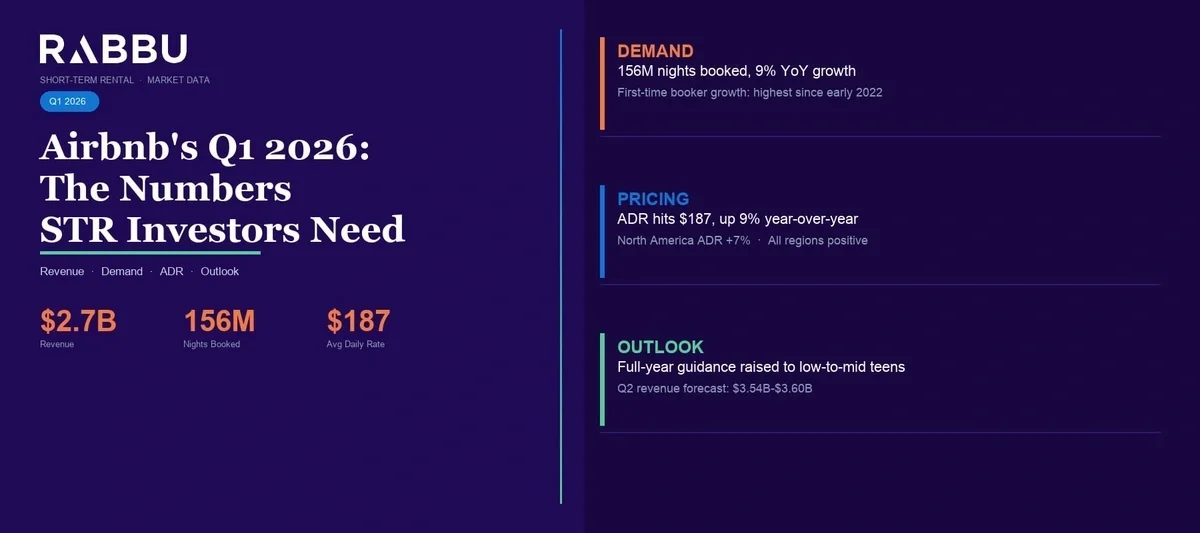
- Revenue: $2.7 billion Up 18% year-over-year. Up 15% excluding foreign exchange tailwinds. That gap matters for context: some of the growth was FX-driven, not demand-driven. Still, 15% organic growth is strong.
- Gross Booking Value: $29.2 billion Up 19% year-over-year (13% ex-FX). This is the total amount guests paid across stays and experiences in Q1 alone. That is nearly $30 billion flowing through the Airbnb platform in 90 days.
- Nights and Seats Booked: 156.2 million Up 9% year-over-year. Absent the Middle East conflict, Airbnb estimates this would have been approximately 10% — an acceleration from Q1 2025. This is the underlying demand signal.
- Average Daily Rate (ADR): $187 Up 9% year-over-year (+4% ex-FX). Price growth across all regions. Strong ADR appreciation in North America specifically.
- Adjusted EBITDA: $519 million Up 24% year-over-year. 19% margin. Profitability is growing faster than revenue.
- Free Cash Flow: $1.7 billion 64% FCF margin for the quarter. Trailing twelve month FCF is $4.5 billion, at a 36% margin. Airbnb is one of the most cash-generative companies in travel.
What This Tells You About STR Demand
Demand is healthy. That is the most important sentence in this earnings letter for STR investors.
156 million nights booked in a single quarter, growing at 9-10%, with all-region ADR growth, is not a demand story in trouble. It is a demand story that is broadening.
A few specifics worth noting:
- App bookings are accelerating. App nights grew 22% year-over-year in Q1, now representing 63% of all nights booked, up from 58% a year ago. When guests shift to booking on the app rather than search engines, it signals higher intent and stronger platform loyalty. That is good for host occupancy.
- First-time booker growth is back. New guest growth accelerated to 10% in Q1 — the highest rate since early 2022. New guests mean a larger overall pool of demand, not just repeat travelers.
- Lead times are lengthening. Across all regions, guests are booking further in advance. Reserve Now, Pay Later has been a key driver — roughly 20% of global GBV in Q1 came from RNPL bookings. When guests can reserve now and pay later, they book earlier and they book more. For STR operators, longer lead times mean more forward visibility on occupancy.
Geographic Breakdown: Where Is Demand Growing Fastest?
Understanding regional performance is more useful than the aggregate number for most STR investors.
- North America - High-single digit nights booked growth in Q1, modestly accelerating from Q4 2025. ADR increased 7% year-over-year, driven by both mix shift and price appreciation. Short-term stays and entire homes — particularly 4+ bedroom listings — outperformed long-term stays and private rooms. If you own a larger home in a North American leisure market, that data points your direction.
- Latin America - High-teens nights booked growth, the fastest-growing region in the Airbnb system. Brazil led it: origin nights up 20% for the third consecutive quarter, first-time bookers up 22% in Q1. Mexico also showed continued double-digit nights growth. Latin America is where Airbnb's expansion investment is paying off most visibly right now.
- Asia Pacific - High-teens growth in nights booked. India origin nights up approximately 50% year-over-year for the second consecutive quarter, with first-time booker growth over 75%. Japan domestic travel accelerating. Airbnb's hyper-local approach in APAC is gaining traction.
- EMEA - Mid-single digit nights growth, weighed down by elevated cancellations from the Middle East conflict. ADR grew 15% (4% ex-FX), so pricing held up. The underlying demand picture in Europe is still solid — the Middle East dynamic is creating a short-term drag, not a structural shift.
The Fee Structure Change Every Host Needs to Understand
Buried in the letter is a change with direct operational implications for hosts.
Airbnb has been rolling out a simplified fee structure, moving property management software hosts from a split fee model (hosts paid 3%, guests paid a separate service fee) to a single service fee of 15.5% for most hosts. The company said it is now testing expansion of this single fee structure in additional countries.
The motivation: simplified pricing is expected to lift Airbnb's full-year take rate. The implied take rate in Q1 was 9.2%, essentially flat year-over-year, but the fee simplification and the insurance programs are both expected to push it higher in the back half of 2026.
What this means for hosts: if you are in a market where this rollout is active, your pricing strategy may need to be revisited. The old math on split fees does not apply under the 15.5% single-fee structure.
AI Is Lowering Airbnb's Costs — And Changing How Guests Get Help
Two AI data points from Q1 that will shape the platform over the next 12 months:
- Customer support: Over 40% of guest issues contacted through Airbnb's AI assistant are now resolved without a human agent — up from roughly a third in Q4 2025. Cost-per-booking declined approximately 10% year-over-year. Airbnb expects this trend to continue.
- Engineering velocity: Nearly 60% of Airbnb's code is now co-authored with AI, which the company estimates is roughly twice the industry average. Features are shipping faster. Platform improvements are coming more frequently. This matters for hosts because the guest experience is improving at a pace the company could not sustain two years ago.
AI is not just cutting costs at Airbnb. It is compressing the gap between what the platform can do today and what guests expect.
The Events Play: A Demand Multiplier for Host Markets
Airbnb's events strategy is worth paying attention to if you are investing near a city that hosts major events.
The Milano Cortina Olympics this past quarter is the cleanest example. Nearly 200,000 guests stayed on Airbnb during the Games. Supply in the Milan region grew approximately 30%. Airbnb generated around 1 billion impressions through its marketing campaigns.
The important part: hosts who listed for the Olympics did not stop hosting after the Games ended. That is the flywheel. Events bring new hosts onto the platform at scale, and many of those hosts stick.
The next event on the calendar is the FIFA World Cup 2026 this summer, hosted across 16 cities. Since October 2025, over 100,000 homes have listed on Airbnb for the first time across World Cup markets. Airbnb says it expects to host more guests at the World Cup than at any event in company history.
If you own a property in one of the 16 host cities, your market is going to be flooded with demand this summer. Make sure your pricing reflects that.
What Experiences and Hotels Mean for Your Long-Term Yield
Airbnb is expanding beyond homes in two directions: experiences/services and boutique hotels.
The numbers from their pilot programs:
- Nearly 25% of guests new to Airbnb who book an experience go on to book a stay or a service
- Roughly 1 in 3 experience bookers books a stay within 90 days
- Approximately 55% of guests who book a hotel on Airbnb come back to book a home
These are demand-entry points. Airbnb is using experiences and hotels to pull in guests who might not have started their travel search on the platform — and then converting them to home bookings.
For hosts, this is a medium-term positive. A larger guest pool entering through experiences or hotels creates incremental demand for stays. More guests on the platform means better occupancy for well-positioned listings.
Airbnb's May 20 Summer Release will include more detail on how the company plans to scale all three categories.
Airbnb's Outlook: What They're Telling Investors
Airbnb raised its full-year 2026 guidance. That is the signal.
Q2 2026 guidance:
- Revenue: $3.54B-$3.60B (+14-16% year-over-year, including approximately 3% FX tailwind)
- GBV: low double digit growth year-over-year
- Nights booked growth: slight deceleration vs. Q1 (about 100 basis points of headwind from Middle East)
- Adjusted EBITDA Margin: up year-over-year
Full-year 2026 (raised):
- Revenue growth: accelerating to low-to-mid teens
- Adjusted EBITDA Margin: at least 35%
The company also repurchased $1.1 billion of its own stock in Q1, with $4.5 billion remaining in its authorization. Since the repurchase program launched in Q3 2022, the fully diluted share count has decreased approximately 9%.
Raising guidance against a backdrop of macro uncertainty and Middle East cancellations is a management team signaling real confidence in the back half of the year.
What This Means for STR Investors Right Now
Airbnb's Q1 2026 results are not just a corporate earnings story. They are a demand signal for every short-term rental market.
Here is what I take away:
- Demand is healthy and broadening. 156 million nights booked, 9-10% underlying growth, record first-time booker acceleration. The top of the funnel is growing.
- ADR is holding. At $187 average and up 4% ex-FX, there is no collapse in pricing power. North America ADR up 7% is particularly meaningful for most US-based investors.
- Larger homes are outperforming. Entire homes and 4+ bedroom listings are growing faster than private rooms and long-term stays. If you are evaluating property type, that data matters.
- RNPL is changing booking lead times. More bookings further out means more forward occupancy visibility. Operators who price dynamically will benefit more than those who set-and-forget.
- Fee structure changes are real. If the 15.5% single service fee expands to your market, revisit your pricing model before it does.
Before making any investment decision in a short-term rental market, look at what the actual demand data says for that specific zip code — not the national average.
Explore STR Opportunities With Real Market Data
Airbnb's Q1 results confirm strong platform-level demand. The question is whether that demand is actually flowing into the specific market you are evaluating.
Use Rabbu's Airbnb Calculator to see how much any address could realistically earn based on live Airbnb data.
Browse Airbnbs for sale across all 50 states, with each property already underwritten as if it were operating as a short-term rental today.
And use Rabbu's Market Data to see where occupancy, ADR, and revenue trends are actually moving before you make a move.
The Bottom Line
Airbnb had a strong Q1. Revenue up 18%. Demand accelerating. Guidance raised. But for STR investors, the most valuable read is not the headline — it is the specifics: which regions are growing fastest, what fee structure changes are coming, how AI is reshaping platform costs, and where the events strategy is creating concentrated demand spikes.
The investors who outperform on STR do not just watch what the stock does. They read what the underlying demand data is telling them.
What does the demand picture look like in the market you are watching right now?