If you're looking to buy your first (or next) short-term rental property, you've probably been tempted by the entry-level deals. The $200K condo in a tourist town. The $280K cabin that looks like a steal on paper. The $320K townhouse with "Airbnb potential."
We get it. Lower price point feels like lower risk. Less capital at stake, easier to finance, faster to break even — at least in theory.
But after working with thousands of STR investors at Rabbu, we've learned something that consistently surprises people: cheap properties are often the most expensive mistakes an investor can make. And the math almost always favors going bigger.
Here's why.
The Under-$350K Trap
At Rabbu, one of the most common investor profiles we see is someone searching for properties under $350K. It's a rational starting point — it's an accessible price, it shows up constantly in STR-focused Facebook groups, and the gross numbers on a rental calculator can look compelling at first glance.
But here's what we've learned after watching hundreds of these deals play out: the under-$350K segment is often where STR returns go to die.
Let's break down exactly why.
1. Smaller Homes Mean More Competition — From Hotels
The most immediate problem with lower-priced properties is what they tend to be: studios, one-bedrooms, and small two-bedrooms in denser areas. And those properties aren't just competing with other STRs.
They're competing with hotels.
A traveler looking for a one-bedroom or studio in a city or vacation market has dozens of options, many of them flagged properties with 24/7 support, loyalty point programs, and consistent quality guarantees. To win that booking, you need to be meaningfully cheaper or meaningfully better. At the lower end of the market, "meaningfully better" is hard to pull off on a budget. And "meaningfully cheaper" kills your margins.
Larger properties (three, four, and five bedrooms) compete in an entirely different category. Families, groups, and corporate travelers actively seek out homes that can't be replicated in a hotel. There's less direct competition, higher booking rates, and guests who tend to stay longer and treat the property better.
If you're in the one-to-two-bedroom market, you're in a knife fight. If you're in the four-plus bedroom market, you're in a category of one.
2. The Hidden Costs that Kill Your Pro Forma
Here's something that doesn't show up on a simple rental calculator: properties at lower price points carry disproportionately high hidden costs.
Two of the biggest culprits:
Condos and HOA Fees
A large percentage of properties in the sub-$350K range (especially in markets like Florida, Nashville, or any coastal area) are condos. And condos come with HOA fees that can run $300 to $800 per month or more, depending on the building and amenities.
That's before you consider that many HOAs are either already hostile to short-term rentals or moving in that direction. A condo that cash flows well today could be non-compliant tomorrow if the HOA votes to ban STR activity, and they have every right to do so.
Deferred Maintenance and Older Systems
Properties priced at the lower end of a market are often priced that way for a reason. Older HVAC systems. Roofs that need replacement in the next three to five years. Plumbing that's original to the 1980s. A pool that hasn't been resurfaced since the previous owner bought it.
These costs don't show up in a cap rate calculation, but they show up on your credit card statement. And in the STR world, where guest experience is everything, a maintenance failure doesn't just cost you money; it costs you reviews. One 2-star review mentioning "the AC stopped working" can haunt your listing for years.
When you step up to a higher-priced, newer property, you're buying more than square footage. You're buying reliability. You're buying the confidence to launch your listing without holding your breath every time a guest checks in.
3. The Tax Picture Changes Dramatically
This is the one that surprises most people who haven't worked with an STR-savvy CPA.
One of the most powerful financial benefits of owning a short-term rental, especially for high-income investors, is bonus depreciation. Under current tax law, STR owners can qualify as "real estate professionals" or leverage the STR loophole to offset their ordinary income with accelerated depreciation from their rental properties.
The key mechanism is cost segregation: a tax strategy where an engineer breaks down your property into components (appliances, landscaping, flooring, fixtures, personal property) and accelerates the depreciation timeline on those components, often allowing you to write off 20–30% of the entire property value in Year 1.
Here's where the price point matters enormously.
- A $280K property might generate a first-year depreciation benefit of $40K–$60K after a cost segregation study. That's meaningful, but for a high earner in the 37% tax bracket, it's about $15K–$22K in actual tax savings.
- A $700K property? That same study might yield $140K–$200K in Year 1 depreciation, translating to $52K–$74K in real tax savings in a single year.
The asset value is the multiplier. More asset, more depreciation, more savings. For investors using real estate strategically to reduce their tax burden, buying a bigger property isn't just an investment decision. It's a tax strategy.
4. The Revenue Ceiling is Lower
Short-term rental revenue scales with the property — its size, its quality, its amenities, and its location. And at the under-$350K price point, you're almost always capped on at least one of those dimensions.
Here's what the data shows across markets consistently tracked by platforms like AirDNA:
- A well-optimized 1–2 bedroom STR might generate $25,000–$45,000 in annual gross revenue in a moderate market.
- A 3–4 bedroom home in the same market? $55,000–$90,000+.
- A 4–5 bedroom luxury property? $100,000–$160,000+, depending on the market and amenities.
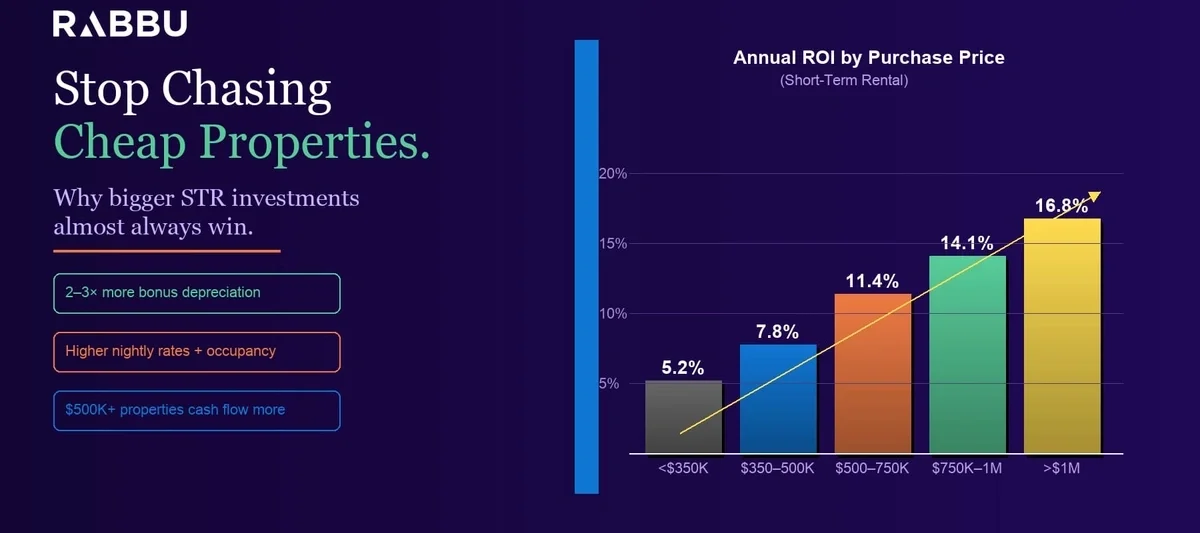
The revenue doesn't scale linearly with price; it often scales faster. A property that costs twice as much can generate three to four times the revenue, because you're serving a completely different guest segment.
That's why we consistently see higher ROI from higher-priced properties: you're not just buying more asset. You're buying into a better revenue category.
5. Long-term Appreciation Follows Quality
Real estate investors often think about STRs purely as cash-flow plays. But appreciation matters too, and it follows quality.
Well-located, well-maintained, larger homes in desirable STR markets tend to appreciate faster than entry-level properties. They attract a different pool of buyers when you eventually exit: both investors looking for yield and homebuyers looking for a primary or secondary residence.
A $1.2M lakefront home with a proven STR track record? That's a compelling asset to a wide range of buyers. A $300K condo in a beach town with an HOA that just restricted rentals? That's a much harder exit.
The Real Math: $500K+ is Usually the Better Bet
Let's make this concrete.
Investor A buys a $280K condo in a Florida beach town.
- HOA: $450/month ($5,400/year)
- Gross revenue: ~$35,000/year
- Net after management (25%), HOA, insurance, maintenance: ~$14,000
- First-year tax savings via bonus depreciation: ~$18,000
- Effective Year 1 benefit: ~$32,000 on $280K invested = ~11.4% effective return
Investor B buys a $620K 4BR single-family home in the same market.
- No HOA
- Gross revenue: ~$95,000/year
- Net after management (25%), insurance, maintenance: ~$46,000
- First-year tax savings via bonus depreciation: ~$55,000
- Effective Year 1 benefit: ~$101,000 on $620K invested = ~16.3% effective return
Same market. Same effort. Meaningfully different outcome.
And that gap compounds over time. The $620K property is likely to appreciate faster, generate more cash flow, carry less HOA risk, and be easier to sell when you're ready to exit.
What This Means for Your Next Purchase
None of this means you need to buy a million-dollar vacation home on your first deal. But it does mean that the calculus of "cheaper = safer" doesn't hold in the STR world.
Before your next acquisition, ask yourself:
- Is this property in the hotel/hostel competition zone, or is it in a category of its own?
- Does it have HOA exposure that could limit or kill my STR license?
- What does the bonus depreciation look like at this price point vs. 30–40% higher?
- What's the revenue ceiling and is there room to grow?
- Who am I going to sell this to in 7 years?
If you want to optimize for short-term cash flow, short-term tax savings, and long-term appreciation, the data points the same direction every time: buy the better property.
At Rabbu, we help investors find and underwrite short-term rental properties that actually perform — not just look good on paper. If you want to run the numbers on a specific deal or market, we're here for it.