Short-term rental cost segregation that offsets your W-2 income

Unlock the STR loophole with engineering-based cost segregation. Accelerate depreciation on your Airbnb or VRBO property to offset W-2 income, generate massive Year 1 deductions, and keep more of what you earn.

In partnership with

Close by December 31 to claim depreciation on your 2026 taxes

Your short-term rental purchase must close before year end for the deduction to count on this year's return. Sign your study by November 15 and get $250 off. See offer details

Why short-term rentals are ideal for cost segregation

Short-term rentals get tax advantages that long-term rentals don't. A longer recovery period, the STR loophole, and furnished interiors all make cost segregation work harder for you.

39-year recovery = bigger front-load

STRs use a 39-year recovery period (vs. 27.5 for long-term rentals), meaning less depreciation is claimed annually under straight-line. Cost segregation reclassifies 25-35% into 5/7/15-year categories, creating an even larger acceleration effect.

The STR loophole for W-2 earners

When average guest stays are 7 days or less and the owner materially participates, STR losses become non-passive. This means accelerated depreciation from cost segregation can directly offset W-2 wages, which can save high earners $30,000-$100,000+ in taxes.

Furnished interiors boost reclassification

STR properties are typically fully furnished, adding substantial 5-year personal property (furniture, appliances, decor, electronics). This increases the reclassifiable percentage compared to unfurnished long-term rentals.

How the STR loophole works

The STR loophole combines three IRS provisions to create a powerful tax strategy for short-term rental owners.

  1. The 7-day rule

    Under Treasury Reg. Section 1.469-1T(e)(3)(ii)(A), if your average guest stay is 7 days or less, your property is not a "rental activity" for passive loss purposes. It becomes a trade or business under Section 162.

  2. Material participation

    You must materially participate in the STR business. The most common test: log 100+ hours and more hours than any other individual (including cleaners, co-hosts, or property managers).

  3. Cost segregation + bonus depreciation

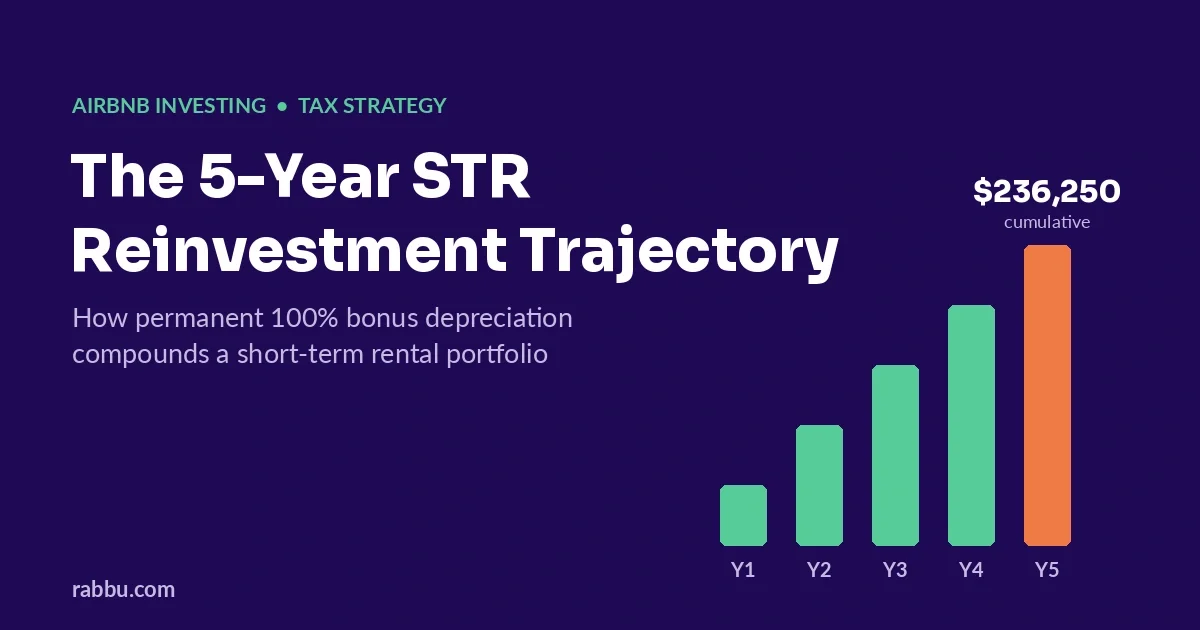
    A cost segregation study identifies 25-35% of your building basis as shorter-lived assets. With 100% bonus depreciation back under the One Big Beautiful Bill Act (OBBBA), they're fully expensed in Year 1, creating a paper loss that offsets your W-2 or business income.

Estimated first-year savings for STR properties

Assumes 37% marginal tax bracket, 20% land allocation, 30% reclassification rate, and 100% bonus depreciation.

  • $300,000

    Improvement basis
    $240,000
    Accelerated depr.
    $72,000
    Year 1 tax savings
    $26,640
  • $400,000

    Improvement basis
    $320,000
    Accelerated depr.
    $96,000
    Year 1 tax savings
    $35,520
  • $500,000

    Improvement basis
    $400,000
    Accelerated depr.
    $120,000
    Year 1 tax savings
    $44,400
  • $750,000

    Improvement basis
    $600,000
    Accelerated depr.
    $180,000
    Year 1 tax savings
    $66,600
  • $1,000,000

    Improvement basis
    $800,000
    Accelerated depr.
    $240,000
    Year 1 tax savings
    $88,800

Top STR markets for cost segregation

State tax rules change how much of the deduction you keep. See how six top STR states compare, and browse Airbnbs for sale in each.

Arizona

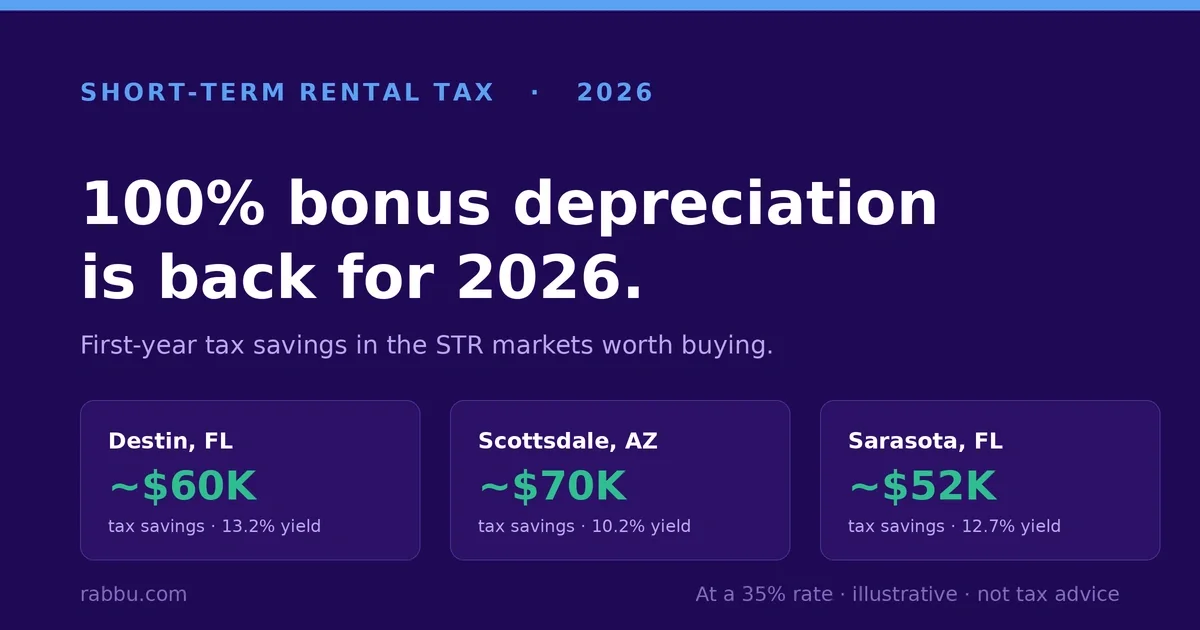
Full federal bonus; Arizona adds it back at a 2.5% flat rate, so the state impact is timing only. Scottsdale and Sedona STRs benefit from desert construction features (pools, HVAC, landscaping).

View Arizona Airbnbs for sale 

Why choose SMF Cost Segregation Advisors?

SMF specializes in cost segregation studies for single-family rentals, short-term rentals, condos, townhomes, and small multifamily properties up to 10 units.

Experience

SMF Cost Segregation Advisors has performed studies nationwide on residential and commercial investment properties, from $1M single-family rentals to $10M+ small multifamily apartments.

The SMF difference

Not all studies are created equal. The experience to find the shorter-life assets that others miss can make a substantial difference in your tax savings.

Live support & fast results

You always reach a live person. Preliminary estimates arrive within 24 hours, and CPA-ready reports 1–3 business days after your virtual site visit and documents, versus the 2–4 week industry standard.

Defensible results

Best-in-class, engineering-based studies built to withstand scrutiny. The methodology is thorough, well documented, and CPA-ready, for seamless filing with your tax professional.

Frequently asked questions

Answers to common questions about cost segregation, the STR loophole, and what a study costs.

What is short-term rental cost segregation?
Short-term rental cost segregation is an engineering-based tax strategy that reclassifies components of your STR property (cabinets, flooring, HVAC, landscaping, etc.) from the default 39-year depreciation schedule into 5-, 7-, or 15-year categories. This front-loads depreciation deductions, generating significant Year 1 tax savings. STRs use a 39-year recovery period because they are classified as nonresidential rental activity when the average guest stay is 7 days or less.
How does the STR loophole work with cost segregation?
The STR loophole allows short-term rental owners who materially participate in their rental activity to reclassify their losses as non-passive. When combined with cost segregation, this creates large paper losses from accelerated depreciation that can directly offset W-2 wages, business income, and other ordinary income. The key requirements are: average guest stay of 7 days or less, and material participation (typically 100+ hours and more than any other individual).
Can I do a cost segregation study on an Airbnb I already own?
Yes. A look-back cost segregation study allows you to capture all missed accelerated depreciation from prior years in a single catch-up deduction using IRS Form 3115 (Change in Accounting Method). This is filed with your current-year return and requires no amended returns. Many STR owners discover cost segregation years after purchasing their property and successfully claim substantial catch-up deductions.
What is the 7-day rule for short-term rentals?
The 7-day rule, found in Treasury Regulation Section 1.469-1T(e)(3)(ii)(A), states that a rental activity is not treated as a 'rental activity' for passive loss purposes if the average period of customer use is 7 days or less. This reclassifies the STR as a trade or business under Section 162, allowing losses to be non-passive when the owner materially participates. The average is calculated by dividing total guest-nights by total number of bookings.
How much does a cost segregation study cost for a short-term rental?
A cost segregation study for a single-unit STR property starts at $1,750 with SMF Cost Segregation Advisors. The typical return on investment is 10-20x the study cost. For example, a $350,000 Airbnb property can generate $25,000-$35,000 in first-year tax savings from a $1,750 study. Portfolio discounts are available for owners with multiple STR properties.
Do I report my STR on Schedule C or Schedule E?
Most STR owners report on Schedule E, even when using the STR loophole. Schedule C is generally reserved for operators providing substantial services (daily maid service, concierge, meals). Reporting on Schedule E with non-passive treatment avoids self-employment tax while still allowing losses to offset ordinary income. Consult your CPA for your specific situation.


Find out what your property could save

Book a 30-minute intro call with SMF Cost Segregation Advisors. Talk through your property, and get a complimentary cost segregation analysis within 24 hours.

IRS Audit Ready + Audit Defense Included

The information provided on this page is for educational purposes only and does not constitute tax, legal, or financial advice. Consult with a qualified tax professional before making any tax-related decisions. No warranties or guarantees are made regarding the accuracy or completeness of the information presented. Studies are performed by SMF Cost Segregation Advisors, an independent firm. Rabbu, Inc. does not provide tax advice.