
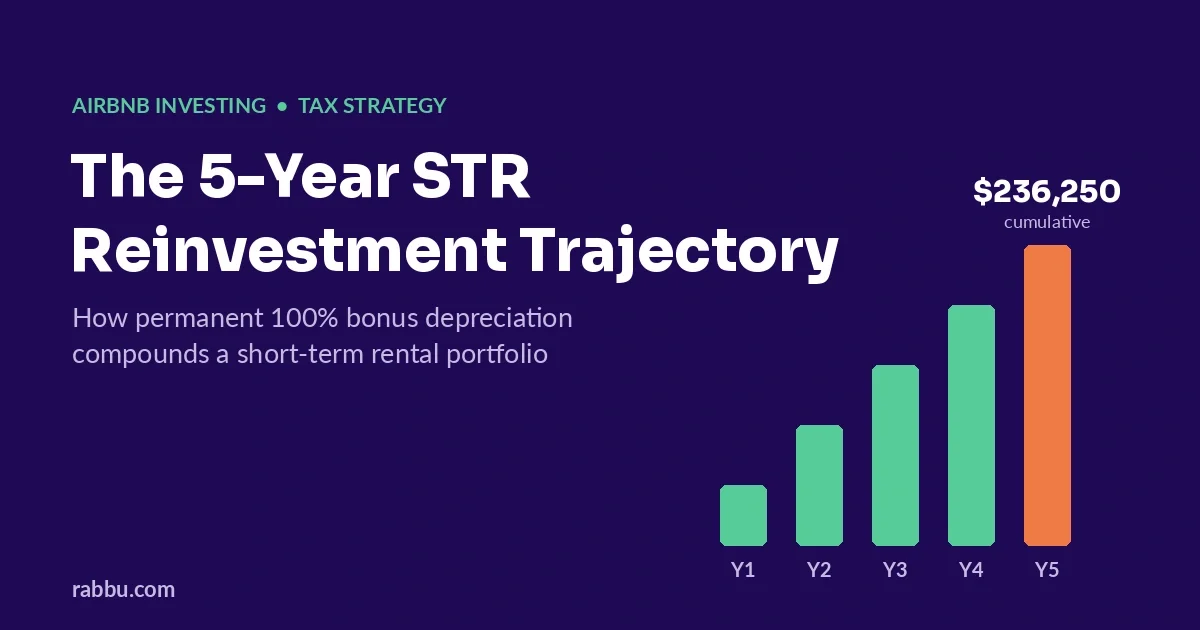
With 100% bonus depreciation now permanent, the Year-1 tax savings from one short-term rental can help fund the next one, and the next one after that. This post models a five-year reinvestment path, shows why permanence changes the math, and lays out exactly what has to be true for the strategy to work.
What is the STR reinvestment trajectory?
The reinvestment trajectory is a simple loop: buy a qualifying short-term rental, use cost segregation plus 100% bonus depreciation to capture a large first-year deduction, put the resulting tax savings toward the down payment on your next STR, and repeat. Because bonus depreciation is now permanent, every new property you acquire and place in service resets the 100% clock on its own basis. The savings compound into acquisition velocity.
This was not possible to model credibly a year ago. Under the old phase-down schedule, the deduction shrank every year and disappeared entirely in 2027, so the loop broke after the first property. This permanence is what turns a one-time write-off into a repeatable engine with long-term and scalable ROI.
How does the loop work, step by step?
-
Acquire a qualifying STR. Average guest stay of seven days or fewer, and you materially participate in running it. This is the short-term rental active-loss path, and it does not require a Real Estate Professional status.
-
Run a cost segregation study. An engineer reclassifies 20% to 35% of the building basis into 5-, 7-, and 15-year property.
-
Claim 100% bonus depreciation on that reclassified basis in Year 1.
-
Offset income. Because the property qualifies as non-passive, the resulting paper loss can offset W-2 or other active income, producing real tax savings.
-
Redeploy. Roll those savings, plus ongoing net cash flow, into the down payment on the next qualifying STR.
-
Repeat. The new property gets its own 100% bonus depreciation.
A five-year example
The assumptions below are illustrative. They hold the property constant to keep the mechanism visible, and they assume you acquire one qualifying STR per year and have enough active income to absorb each year's deduction. Most investors will move slower than one per year, and that is fine. The engine works at any cadence.
Per-property assumptions:
-
Purchase price: $500,000
-
Land (non-depreciable), 10%: $50,000
-
Building basis: $450,000
-
Cost-seg reclassification, 30%: $135,000
-
Year-1 bonus depreciation deduction: $135,000
-
Marginal federal rate: 35%
-
Year-1 federal tax savings: $135,000 × 35% = $47,250
|
Year |
New STR placed in service |
Year-1 bonus deduction |
Federal tax savings |
Cumulative tax savings |
|---|---|---|---|---|
|
1 |
Property 1 |
$135,000 |
$47,250 |
$47,250 |
|
2 |
Property 2 |
$135,000 |
$47,250 |
$94,500 |
|
3 |
Property 3 |
$135,000 |
$47,250 |
$141,750 |
|
4 |
Property 4 |
$135,000 |
$47,250 |
$189,000 |
|
5 |
Property 5 |
$135,000 |
$47,250 |
$236,250 |
Over five years: $675,000 in cumulative first-year deductions and $236,250 in cumulative federal tax savings, before any state tax benefit, ongoing cash flow, mortgage paydown, or appreciation.
One honest note on the math: $47,250 does not buy the next property on its own. On a $500,000 STR at 20% down, the down payment is $100,000, so the tax savings cover roughly half of it. The savings shorten the time to your next acquisition; they do not replace it.
Why does permanence change the math?
Under the Tax Cuts and Jobs Act, bonus depreciation was scheduled to fall to 20% in 2026 and hit zero in 2027. The One Big Beautiful Bill Act reversed that and made 100% bonus depreciation permanent for property acquired and placed in service after January 19, 2025.
For a single purchase, that difference is large. For a reinvestment strategy, it is the whole ballgame. A compounding loop only compounds if each new property still gets the full deduction. Permanence removes the "race the clock" pressure and lets you plan multi-year acquisitions with the certainty that property four gets the same treatment as property one.
What has to be true for this to work?
This strategy is powerful, but it is not automatic. Three things have to hold, and all three get harder as the portfolio grows.
You need enough active income to absorb the loss. The deduction is only as valuable as the income it offsets. A $135,000 paper loss saves $47,250 only if you have at least that much offsettable income at a 35% rate. If you do not, the excess loss carries forward. It is not lost, but the "savings I can reinvest now" narrative weakens.
You have to materially participate in each property. The active-loss treatment depends on meeting a material participation test, most commonly 100 or more hours where no one else spends more time than you, or 500 or more hours. That is manageable for one or two properties. Across four or five, you either keep hitting the test on each or make a grouping election, and both take real planning. This is the constraint that most often caps the realistic cadence.
Recapture comes due on exit. The accelerated depreciation is not free money; it is deferred. When you sell, the reclassified personal-property components are recaptured and taxed as ordinary income. The trajectory works best as a buy-and-hold strategy, or paired with a 1031 exchange to defer the recapture into the replacement property. Model the after-tax exit before you count the Year-1 savings as permanent.
Two smaller line items: each cost segregation study runs roughly $3,000 to $15,000, and state tax treatment of bonus depreciation varies, since some states do not conform to the federal rules.
How do I run my own numbers?
Start with a real property and real market data rather than the round numbers above.
-
Model revenue and returns for any address with the Rabbu Airbnb Calculator.
-
See where the yields actually are in the June 2026 Rabbu Demand Index and the best STR markets for bonus depreciation in 2026.
-
Understand the qualification rules in Who Qualifies for 100% Bonus Depreciation and the mechanics in How Cost Segregation Benefits STR Owners.
-
For the full strategy, read The STR Tax Playbook.
When you are ready to act, find your next STR on Rabbu, get matched with an STR-savvy lender, and connect with a local agent.
Final word
Permanent 100% bonus depreciation turns a single tax write-off into a repeatable engine for building an STR portfolio. The trajectory is real, but it rewards discipline: enough active income to use the deductions, genuine material participation on each property, and a hold-or-exchange plan that accounts for recapture. Run the numbers on a real property, confirm your situation with a CPA who understands short-term rentals, and let the engine compound.
This post is for informational purposes only and is not tax advice. Consult a qualified CPA before acting on any strategy described here.