Tax season just ended. Most people wrote a check, closed the tab, and moved on. The smartest real estate investors are doing something different right now - they're building a plan so next April looks completely different.
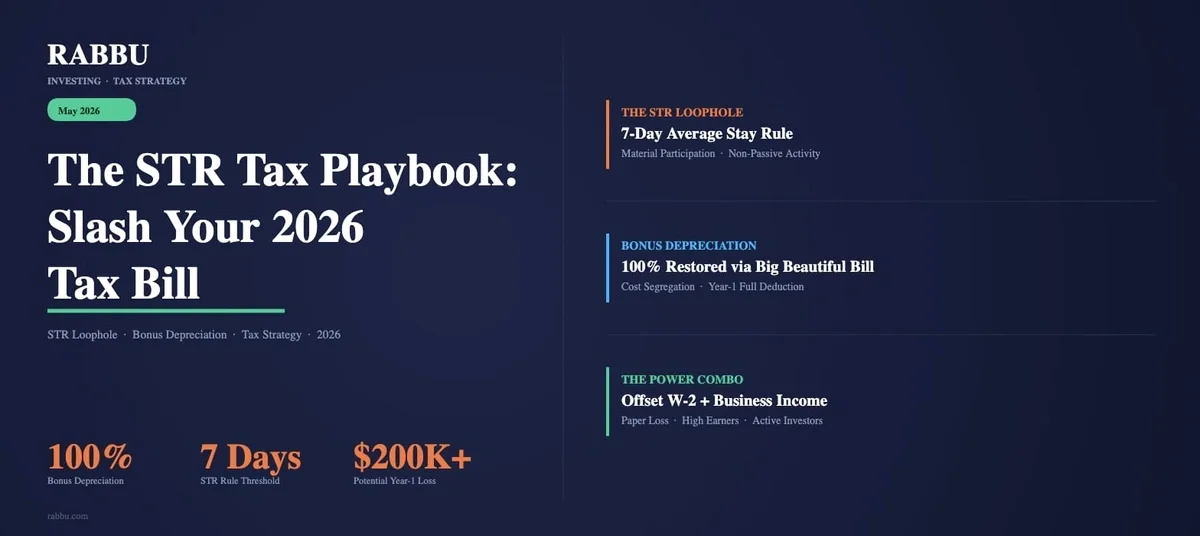
If you own or are considering a short-term rental, you have access to tax strategies that most W-2 earners, business owners, and real estate investors have never heard of. Two of them, the STR Loophole and Bonus Depreciation, can legally eliminate tens or even hundreds of thousands of dollars in taxable income.
I'm using both in 2026. Here's how they work.
Why Short-Term Rentals Are Different
Most rental income is classified as "passive" by the IRS. That matters because passive losses can only offset passive income, meaning if your rental generates a paper loss (even a big one), you typically can't use it to reduce your W-2 salary or business income.
Short-term rentals play by different rules.
When the average guest stay at your property is 7 days or fewer, the IRS does not classify that income as rental income in the traditional sense. It's treated more like a business. And that opens the door to one of the most powerful tax strategies available to individual investors.
The STR Loophole: What It Is and How It Works
The "STR Loophole" isn't a gray area or a hack. It's a provision in the tax code that allows short-term rental owners to treat their rental activity as non-passive, as long as they meet the material participation test.
The two-part test:
- The 7-day rule - The average length of guest stays at your property must be 7 days or fewer. If you're running a traditional short-term rental on Airbnb or Vrbo, you likely already meet this.
- Material participation - You must be materially involved in running the property. The IRS has several ways to qualify, but the most common is spending more than 500 hours per year on the activity, or more than 100 hours and more than anyone else involved (including a property manager).
What does "material participation" look like in practice? Guest communication, coordinating cleaners, managing pricing, handling maintenance - these all count. You don't have to be the one folding towels, but you do need to be actively running the business.
Why this is powerful: When your STR activity is non-passive, the losses it generates can offset any income, including W-2 wages and business income. That's the unlock.
Bonus Depreciation: The Paper Loss Machine
Every physical asset in a rental property depreciates over time - the IRS acknowledges this. Normally, a residential property is depreciated over 27.5 years. That's a slow drip.
Bonus Depreciation accelerates that dramatically.
Through a process called a cost segregation study, an engineer breaks down your property into its individual components (appliances, flooring, fixtures, landscaping, electrical systems) and reclassifies them into shorter depreciation schedules (5, 7, or 15 years instead of 27.5).
With 100% Bonus Depreciation, those reclassified components can be fully deducted in the year you place the property in service. Not spread over years, all at once.
Bonus Depreciation is back at 100%. After being phased down in recent years, it was restored to 100% as part of the Big Beautiful Bill. That means the full deduction is available again for qualifying property placed in service in 2026.
A simple example:
You buy a $600,000 short-term rental. A cost segregation study identifies $150,000 in short-life components eligible for Bonus Depreciation.
With 100% Bonus Depreciation, you can deduct that $150,000 in year one, even if the property generated cash flow.
The Power Combo: When Both Work Together
Here's where it gets interesting.
Individually, each strategy is useful. Together, they're a completely different animal.
- The STR Loophole removes the passive activity restriction, your rental losses are now non-passive and can offset any income.
- Bonus Depreciation generates a large paper loss in year one.
- Combined: that paper loss can directly offset your W-2 income, business income, capital gains - all of it.
A high-earning professional making $400,000 a year who buys a $700,000 short-term rental, qualifies for the STR Loophole, and takes Bonus Depreciation could potentially reduce their taxable income by $150,000–$200,000 in a single year, while owning an asset that generates real cash flow.
That's the play.
Who This Strategy Works Best For
This isn't for everyone. It works best for:
- High W-2 earners who want to reduce their tax liability without changing their income.
- Business owners and founders with significant taxable income.
- Anyone willing to be actively involved in managing their STR, not just passively collecting rent
- People who can do a cost segregation study - generally worth it on properties $400,000 and up
The key word is actively. If you want to be completely hands-off, the STR Loophole likely won't apply to you. The material participation requirement means you need to be genuinely running this as a business.
What to Watch Out For
A few things that trip people up:
- Not tracking your hours. The material participation test is based on documented hours. Keep a log. If you get audited, you need to prove it.
- Mixing short and long-term rentals. If part of your property is rented long-term, the math changes. Each activity is analyzed separately.
- Skipping the cost seg study. Bonus Depreciation only works on components that have been properly reclassified. Don't try to estimate this yourself — hire a qualified engineer.
- Using a CPA who doesn't specialize in real estate. This is still a niche area of tax law. Find someone who knows STR-specific strategies cold.
Start With the Right Property
The best tax strategy in the world doesn't matter if the underlying property doesn't perform. You need a property in a market with strong short-term rental demand, healthy occupancy rates, and the kind of ADR that makes the numbers work before you even think about depreciation.
That's exactly what Rabbu's marketplace is built to show you. Browse STR-ready properties with real revenue data attached so you can underwrite the deal and the tax strategy at the same time.
Final Word
The tax code rewards people who own real assets and run them like businesses. Short-term rentals, done right, check both boxes. The STR Loophole and Bonus Depreciation aren't secrets. They're just underused.
Now that tax season is in the rearview mirror, this is the time to plan. Talk to a CPA who knows real estate. Run the numbers on a property. And make sure next April looks different.
This post is for informational purposes only and does not constitute tax or legal advice. Consult a qualified CPA or tax attorney before implementing any tax strategy.