The One Big Beautiful Bill made 100% bonus depreciation permanent for qualifying property acquired and placed in service after January 19, 2025. That’s massive news for short-term rental (STR) investors looking to reduce their tax burden and improve cash flow. If you operate an Airbnb, Vrbo, or any short-term vacation rental, you may now be able to deduct most of your property improvements, furnishings, and startup costs in the year you start renting it out.
But to unlock this powerful tax benefit, STR owners need to meet specific IRS requirements. This post breaks down exactly how to qualify and what steps to take to ensure your bonus depreciation is allowed and maximized.
What Is Bonus Depreciation
Bonus depreciation allows you to immediately deduct 100 percent of the cost of qualifying property in the year you place it in service. Normally, these items would depreciate over five, seven, or fifteen years. With 100 percent bonus depreciation, you get the full deduction up front.
Qualifying assets for STRs typically include:
- Furniture
- Appliances
- Flooring and carpeting
- Landscaping and fencing
- Light fixtures
- Window coverings
All of these are considered “personal property” or “land improvements” and are fully deductible under Section 168(k) of the IRS code if acquired and placed in service after January 19, 2025..
STR-Specific Path to Bonus Depreciation
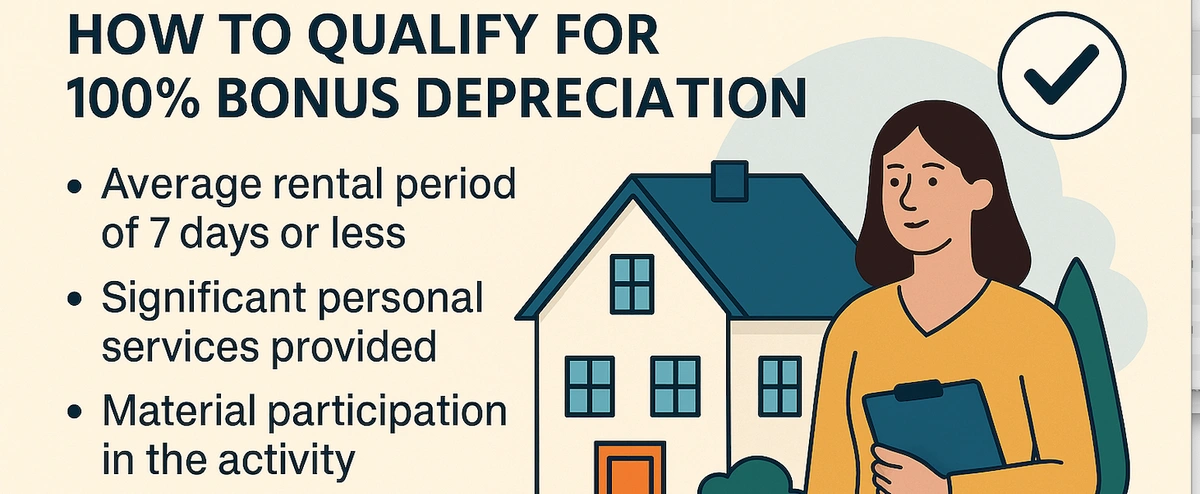
The key benefit for STR operators is that you do not need to qualify as a real estate professional to use bonus depreciation against active income. Instead, you can qualify through what’s called material participation, which is easier for STRs than long-term rentals.
To do so, the following conditions must be met:
1. Average Stay Must Be Seven Days or Less
If the average guest stay at your rental is seven days or fewer, the IRS classifies it as a short-term rental business, not a passive rental activity. This classification makes bonus depreciation much more usable because it means your STR losses can offset your W2 or business income.
If your average stay is between eight and thirty days, you may still qualify if you provide substantial personal services, like daily cleaning or meal delivery, but this is harder to prove.
2. You Must Materially Participate
The IRS provides several ways to meet material participation. The most common for STR operators are:
- You spend 500 or more hours working on the property during the year
- You spend 100 or more hours, and no one else (including cleaners, co-hosts, or property managers) spends more time than you
- You do substantially all of the work on the property yourself
Examples of qualifying tasks:
- Guest communication and bookings
- Cleaning (if done by you)
- Maintenance, repairs, or landscaping
- Restocking supplies
- Marketing the property
- Managing pricing, check-ins, and turnovers
Important: Time spent traveling to and from the property or doing investor-level tasks (like research or bookkeeping) does not count toward material participation.
What You Must Do to Qualify and Document Your Activity
To ensure you qualify and withstand any IRS scrutiny, STR owners should take these key steps:
Track All Time Spent on the STR
Keep a detailed log of your time, ideally broken down by day and by activity. Tools like Google Sheets, Notion, or hour-tracking apps can help. If you’re married and filing jointly, only one spouse needs to meet the participation tests.
Place the Property in Service by December 31
The property must be available for rent and actively marketed by December 31 of the year you want to claim the deduction.
Order a Cost Segregation Study
To take full advantage of bonus depreciation, work with a cost segregation firm. They’ll break down your purchase price and renovation costs into categories that qualify for faster depreciation. For many STRs, this can result in 25 to 35 percent of the property’s value being immediately deductible.
Example: Bonus Depreciation in Action for STR
Let’s say you buy a $500,000 property and allocate $50,000 to land value.
You spend $25,000 on furniture, appliances, and landscaping.
After a cost segregation study, $135,000 of the property qualifies for bonus depreciation.
At a 35% tax rate, this produces a $47,250 tax savings, which you can use to reduce your W2 income taxes or increase your refund.
Final Thoughts
The return of 100% bonus depreciation under the One Big Beautiful Bill creates a unique opportunity for STR owners to dramatically lower their tax liability while building long-term wealth
If you operate a short-term rental and materially participate in its management, you may qualify for massive upfront tax deductions
Make sure to consult with a CPA who understands real estate and cost segregation to ensure you qualify, document your hours, and file everything correct.
To get started, get prequalified for a loan with a lender who can provide STR financing and get connected to a local agent who can help find you the best property.
Recap and Key Takeaways
- Bonus depreciation lets STR owners deduct most costs up front in the year the property is placed in service
- The One Big Beautiful Bill made 100 percent bonus depreciation permanent for property acquired and placed in service after January 19, 2025
- STR operators qualify without real estate professional status if they materially participate and average stays are seven days or less
- You must track time, place the property in service by December 31, and order a cost segregation study
- This strategy can produce tax savings of $40,000 or more depending on your income
- To get started, get prequalified for a loan or find a local agent partner to work with.