Single-family homes generate 25-30% higher revenue than condos in vacation markets, while urban apartments outperform houses in city centers—but most investors choose property types based on gut feeling rather than data. The difference between a property that delivers 12% cash-on-cash returns and one that barely breaks even often comes down to matching the right property type to the right market with accurate revenue projections.
This guide breaks down revenue benchmarks by property type and bedroom count, shows you how regulations impact different properties, and reveals which markets favor houses versus condos versus unique stays. You'll learn to analyze any listing in minutes using Rabbu's integrated tools instead of spending weeks on fragmented research across multiple platforms.
Which Property Type Makes the Most Money on Airbnb
The best property type for Airbnb investors depends on your target market, available budget, and the type of guests you want to attract. Houses and villas consistently earn the highest revenue globally because they offer privacy, space, and appeal to families willing to pay premium rates. Urban apartments perform well in city centers where business travelers and solo guests prioritize location over square footage.
What works in one market won't necessarily work in another. A three-bedroom cabin near ski slopes might generate $80,000 annually, while the same investment in a city condo could produce $45,000 or $120,000 depending on the neighborhood. The property type that delivers the best returns aligns with local demand patterns, regulatory environment, and your financial goals.
Traditional real estate platforms show listing prices and photos but can't tell you whether a property will cash flow as an Airbnb. Rabbu's Airbnb marketplace connects you with exclusive STR listings, verified performance data, and profitability projections so you can identify winning property types in minutes instead of spending weeks on manual research.
Key differences between top-performing property types:
-
Single-family homes: Generate 15-25% higher nightly rates than condos in vacation destinations, ideal for family-focused markets with strong seasonal demand
-
Urban condos: Outperform houses in city centers where business travelers value location, achieving 65-80% year-round occupancy in top markets
-
Luxury properties: Command premium pricing but serve smaller guest pools, requiring careful market analysis
-
Small multifamily: Offer house-hacking opportunities with owner-occupied financing options
Find the Right Airbnb Investment Property
Search exclusive listings for both turnkey and potential Airbnb properties in one place.
Explore Airbnbs for SaleRevenue Benchmarks by Bedroom Count and Guest Capacity
Bedroom count directly impacts how many guests you can host and what you can charge per night. More bedrooms don't automatically mean better returns though. Larger properties generate higher gross revenue but require substantially more upfront investment for acquisition, furnishing, and ongoing maintenance.
One-bedroom properties perform best in urban markets serving business travelers, digital nomads, and couples. These units typically achieve 60-75% year-round occupancy with nightly rates ranging from $80-$150 in secondary cities to $150-$300 in major metros. Gross yields average 8-12% in top STR markets, with lower furnishing costs of $8,000-$15,000 making them attractive for investors building multi-unit portfolios.
Two-bedroom properties represent the sweet spot for many investors. They appeal to couples traveling together, small families, and business partners while maintaining reasonable acquisition costs. These units typically generate $120-$250 nightly in vacation markets and $150-$350 in premium urban locations. The broader guest pool creates more booking opportunities, while furnishing budgets of $15,000-$25,000 remain manageable.
Three to four-bedroom properties target family vacation markets, group retreats, and multi-generational travel. They command premium nightly rates of $250-$500+ in established destinations but often experience pronounced seasonal demand. Occupancy can range from 80-90% during peak months to 30-50% in shoulder seasons. Furnishing costs run $30,000-$60,000, and cleaning expenses increase proportionally.
Five-plus bedroom properties serve a niche market of large groups, family reunions, and special events. These properties can earn $500-$1,500+ per night in premium markets, yet the limited guest pool means longer booking windows and potentially lower annual occupancy. Success with larger properties demands exceptional marketing, professional management, and markets with proven demand for high-capacity rentals.
Use Rabbu's Calculator to model returns across different bedroom configurations in your target markets, factoring in market-specific occupancy rates, average daily rates, and total cost of ownership for each property size.
Startup and Ongoing Costs That Shrink Net Yield
Purchase price represents just the starting point for your total investment. Understanding the full cost structure separates profitable investments from cash flow disappointments. Many new investors focus exclusively on acquisition costs and projected revenue while underestimating substantial expenses required to launch and operate a successful short-term rental.
Furnishings and design budget covers furniture, appliances, linens, kitchenware, decor, and outdoor amenities. Budget $15,000-$25,000 for a basic two-bedroom condo, $30,000-$50,000 for a three-bedroom vacation home, and $60,000-$100,000+ for luxury properties competing in premium markets. Single-family homes require additional outdoor furniture, lawn equipment, and recreational amenities that condos don't need.
Cleaning and turnover expenses range from $75-$150 per cleaning for one-bedroom units to $200-$400+ for large homes. Factor 15-20% of gross revenue for cleaning costs in most markets, though high-turnover urban properties with frequent one-night stays can reach 25-30%. Deep cleaning becomes necessary quarterly for moderate-use properties and monthly for high-occupancy urban rentals.
Maintenance and capital expenditures run higher for short-term rentals than traditional rentals due to constant guest turnover. Budget 10-15% of gross revenue annually for routine maintenance, repairs, and capital expenditure reserves. Single-family homes carry additional exterior maintenance costs including landscaping, roof repairs, and HVAC servicing that condos typically don't face.
Common capital expenditures to plan for:
-
Furniture replacement every 3-5 years
-
Appliance upgrades every 7-10 years
-
Flooring refinishing every 5-7 years
-
HVAC system replacement every 12-15 years
Financing and holding costs include your mortgage payment, property taxes, insurance, and HOA fees for condos. Monthly debt service typically consumes 40-60% of gross revenue depending on purchase price, down payment, and interest rates. Property taxes vary from 0.5% to 2.5% of property value annually depending on location, while insurance often runs 2-3x higher for STRs than traditional rentals.
Model vacancy periods carefully. Even high-performing properties experience 10-20% vacancy in most markets, with seasonal destinations seeing 30-50% vacancy during off-peak months.
The Best STR Deals Never Hit Zillow
Browse exclusive listings for turnkey Airbnbs with actual income data.
Search Exclusive ListingsHow Regulations and HOAs Impact Each Property Type
Legal compliance varies dramatically by location and property type. Regulatory restrictions often determine which property types remain viable investments. Many investors discover zoning prohibitions, HOA bans, or licensing caps only after making offers, wasting time and earnest money.
Short-term rental zoning rules typically treat property types differently. Single-family homes in residential zones face fewer restrictions than condos, multifamily properties, or homes in historic districts. Some cities prohibit STRs entirely in certain zones, limit them to owner-occupied properties, or cap the total number of licenses available. Others impose minimum stay requirements of 30 days, effectively banning true short-term rentals.
Condo and HOA nightly-rental bans create additional hurdles. Many condominiums and planned communities prohibit short-term rentals entirely through HOA covenants, regardless of municipal regulations. These restrictions can change over time as communities that once allowed STRs sometimes vote to ban them. Even when STRs are permitted, HOAs often impose additional requirements including registration with the association, guest parking restrictions, and noise limitations.
Always request HOA documents during due diligence and verify current STR policies directly with the association. Rabbu's condo listings indicate HOA STR policies and include only verified STR-approved properties in filtered searches.
License and tax requirements vary by jurisdiction and sometimes by property type. Most STR-friendly cities require business licenses, collect transient occupancy taxes of 8-15% of gross bookings, and mandate safety inspections before issuing permits. Compliance costs include initial license fees of $100-$500, annual renewals of $50-$300, and ongoing tax collection responsibilities.
Connect with Rabbu's STR-specialized agents for local regulatory guidance and assistance navigating permit processes in your target markets.
Best Places to Own Airbnb for Top-Performing Property Types
Location drives demand, pricing power, and regulatory environment. Market selection matters as much as property type selection. The same three-bedroom house that generates 15% cash-on-cash returns in a proven vacation market might struggle to break even in an oversaturated city or restricted jurisdiction.
Mountain and ski destinations
Cabins and chalets dominate these markets, with three to five-bedroom properties performing exceptionally well during winter sports seasons and summer recreation periods. Average gross yields reach 12-18% in established markets like Breckenridge, Lake Tahoe, and Park City, with nightly rates ranging from $300-$800+ depending on proximity to slopes. Properties with mountain views, hot tubs, and ski-in/ski-out access command premium pricing and attract repeat guests.
Seasonal demand patterns require careful financial modeling. Typically 70-85% of annual revenue concentrates in 4-6 peak months. Off-season strategies including corporate retreats, fall foliage tourism, and mid-week discounts help maintain cash flow during shoulder periods.
Coastal vacation markets
Beachfront condos and vacation homes both perform well, though single-family homes typically outperform condos by 20-30% in revenue due to privacy, outdoor space, and parking. Premium beach markets like 30A Florida, Outer Banks, and Southern California coastal towns generate average nightly rates of $250-$600 for houses and $150-$350 for condos. Summer occupancy reaches 85-95% while shoulder seasons maintain 50-70%.
Properties within walking distance to beaches command significant pricing premiums over those requiring drives. Amenities like private pools, outdoor showers, and beach equipment storage differentiate top performers from average properties.
High-occupancy urban weekenders
City apartments and condos excel in metros with strong business travel, convention centers, and tourist attractions. Markets like Nashville, Austin, and Charleston favor one to two-bedroom units in walkable neighborhoods, with nightly rates of $120-$300 depending on location and amenities. Urban properties benefit from lower seasonality than vacation markets, creating more predictable cash flow and easier financial modeling.
Proximity to downtown districts, entertainment venues, and public transportation drives performance more than property size. This makes location selection critical within these markets.
Emerging Midwest cash-flow cities
Affordable entry points with growing tourism infrastructure offer strong cash-on-cash returns for investors seeking immediate cash flow over appreciation. Markets like Indianapolis, Columbus, and Kansas City provide acquisition opportunities under $200,000 for two to three-bedroom properties generating $2,000-$3,500 monthly revenue. Lower competition and STR-friendly regulations make these markets attractive for first-time investors.
However, these markets typically offer limited appreciation potential compared to coastal destinations, making them better suited for cash flow strategies than long-term equity growth.
Key market characteristics to evaluate using Rabbu's Market Data:
-
Tourism infrastructure with established attractions and seasonal events
-
Transportation access via major airports within 90 minutes
-
Local support through STR-friendly regulations and established service providers
-
Market maturity balancing opportunity with regulatory stability
Here’s how to identify the best short-term rental markets using Rabbu’s Market Finder tool:
-
Open Market Finder and sort the table by ROI (highest → lowest).
-
Look for markets with 20+ active Airbnbs — these show healthy demand.
-
Click on a market name (left column) to open the Market Data Tool.
-
View market maps, seasonality, and top Airbnbs.
-
Explore Airbnbs for Sale directly from this view.
-
-
Compare 5–10 markets, focusing on:
-
ROI score: higher = stronger returns.
-
Occupancy: consistent demand.
-
Gross Yield: revenue relative to property value.
-
-
Narrow to your top 2–3 markets for deeper analysis.
Pro Tip: The best STR markets combine high occupancy, strong ROI, and healthy gross yield relative to home prices.
Turnkey vs. Conversion: Choosing Your Investment Strategy
Property acquisition strategy impacts your timeline to cash flow, total capital requirements, and hands-on involvement. Turnkey properties already operating as Airbnbs offer immediate revenue with verified performance data. Conversion properties—traditional homes you transform into STRs—provide higher ROI potential through value-add improvements.
Buying a turnkey Airbnb (active STR properties)
Turnkey properties generate cash flow from day one, eliminating the 2-4 month setup period required for conversions. You acquire properties with established booking history, guest reviews, furnishings, and operational systems. This reduces investment risk through verified performance rather than projections. STR-specific lenders view established income favorably, often offering better terms and faster approval for properties with 12+ months of documented revenue.
The tradeoff comes in pricing. Turnkey properties command premiums of 10-20% above comparable non-STR homes because sellers capture the value of setup work and proven income. Limited upside potential exists since previous owners already optimized most value-add opportunities. Performance may not be replicable if the seller provided exceptional hospitality or had unique booking channels.
Browse Rabbu's marketplace of turnkey Airbnb properties with verified income history, existing permits, and established guest bases.
Converting a home into an Airbnb (STR potential properties)
Conversion properties offer higher ROI potential through strategic improvements, design choices, and operational optimization. They often generate 15-25% better returns than comparable turnkey purchases. Lower entry costs mean your capital goes further since you pay residential prices rather than STR premiums. Creative control over furnishings, amenities, and guest experience lets you differentiate from competitors.
The tradeoff comes in upfront costs, setup delays, and learning curves. Expect to invest $15,000-$60,000+ in furnishings and improvements, wait 2-4 months before first bookings, and navigate permit applications and contractor coordination. Regulatory uncertainty exists in some markets where permit approval isn't guaranteed, potentially leaving you with a property you can't legally operate as planned.
Tax advantages favor conversions through deductible setup expenses, improvement depreciation, and startup cost write-offs that turnkey purchases don't offer.
Find the Right Airbnb Investment Property
Search exclusive listings for both turnkey and potential Airbnb properties in one place.
Explore Airbnbs for SaleQuick Method to Analyze Any Listing Using Rabbu
Traditional STR analysis requires manual research across multiple platforms. You pull comps from Airbnb, check regulations on city websites, and model financials in spreadsheets. This fragmented process takes hours per property and still leaves critical questions unanswered. Rabbu solves this problem by hosting everything you need in one platform that’s free to use. Here’s how it works:
Step 1: Navigate to Rabbu Marketplace.
Browse exclusive STR listings with verified performance history in our Airbnb marketplace, including turnkey properties showing actual revenue and conversion opportunities with projected income. Filter by Active Airbnb for properties already generating cash flow, or Airbnb Potential for homes in strong markets awaiting conversion. Properties tagged with Actual Financials indicate actual historical financials for the last 12-months as inputted by the seller or listing agent.
Step 2: Use advanced filters for property type analysis.
Set price filters based on your budget, then sort by Gross Yield to identify highest-performing property types. Filter by bedroom count, property type, and amenities to match your investment strategy.
Step 3: Analyze performance with integrated calculator.
Enter any property address into Rabbu's Calculator to access revenue projections based on comparable STR performance in the immediate area. Adjust amenities and filters to match your target property exactly. The calculator generates seasonal revenue projections, operating expense estimates, and net operating income calculations using verified market data.
Step 4: Model returns with investor calculator.
Input purchase price and financing terms to calculate cap rate, cash-on-cash return, and monthly cash flow after all expenses. Compare multiple property types side-by-side to evaluate which bedroom counts and property configurations deliver optimal returns in your target market.
Step 5: Connect with STR lenders.
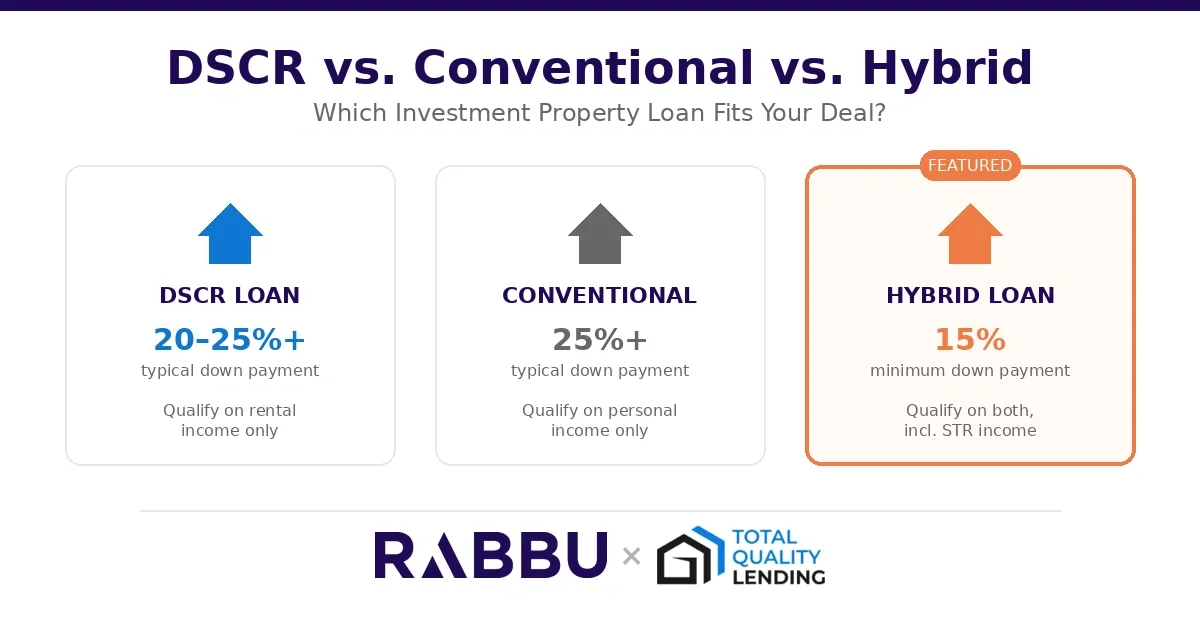
Contact vetted DSCR lenders directly from property listings. Specialized lenders offer DSCR loans that qualify properties based on rental income rather than your personal W-2s, closing deals in 15-30 days instead of 45-60 day timelines typical with conventional financing.
Find a Lender that Specializes in Short-Term Rentals
Connect with lenders who actually understand short-term rental cash flow and offer DSCR loans, portfolio financing, and investor-friendly terms.
Get Matched with STR LendersBuild a Data-Driven Buy Box That Matches Your Goals
Define clear investment criteria before shopping to avoid analysis paralysis and emotional decisions. Your buy box specifies target markets, property types, bedroom counts, price ranges, and minimum return thresholds. This creates a filter that helps you quickly evaluate opportunities and pass on properties that don't fit your strategy.
Cash-flow first vs. appreciation first strategies require different approaches. Monthly income strategies prioritize markets and property types generating immediate positive cash flow—typically favoring affordable emerging markets, smaller properties with lower acquisition costs, and locations with strong year-round demand. Appreciation strategies target high-growth coastal markets, larger luxury properties, and destinations with limited supply, accepting lower initial cash-on-cash returns in exchange for long-term equity growth.
Urban condos often provide stronger cash flow due to lower purchase prices and consistent occupancy. Single-family homes in premium vacation markets offer better appreciation potential but higher capital requirements.
Risk tolerance and regulation score impact long-term viability of your investment. Newer STR markets offer opportunity but carry policy risk. Conservative investors prioritize established STR-friendly markets with clear regulations, while those comfortable with higher risk might target emerging markets before competition saturates.
Capital budget and loan options determine what you can acquire. Total investment includes purchase price, closing costs, furnishings, reserves, and improvement budgets. Different property types require vastly different capital outlays. DSCR loans through Rabbu's lending partners enable property-based underwriting that ignores your personal income. Calculate your maximum comfortable investment including 6-12 months operating reserves, then identify property types and markets where that capital generates optimal returns.
The following table breaks down the various property types and which market they are best suited for:
|
Strategy |
Best Property Types |
Ideal Markets |
Key Metrics |
|
Cash Flow |
Condos, Small Multifamily |
Emerging Cities |
Monthly Net Income, CoC Return |
|
Appreciation |
Single-Family, Luxury |
Established Destinations |
Cap Rate, Market Growth |
|
Hybrid |
2-4 BR Single-Family |
Balanced Markets |
Gross Yield, Occupancy |
Rabbu’s marketplace features listings across every property type shown above, in markets nationwide.
Start Your STR Investment Property Search Today
Finding a profitable Airbnb investment doesn't have to take months of spreadsheet analysis and market research. Rabbu's marketplace gives you everything you need in one place: turnkey properties with verified income data, detailed market analytics, and transparent comparable listings.
Once you've found your ideal investment, our network of STR-specialized lenders can help you secure financing quickly with loans designed for short-term rental investors. From search to close, we've streamlined the entire process so you can start building your portfolio today.
The Best STR Deals Never Hit Zillow
Browse exclusive listings for turnkey Airbnbs with actual income data.
Search Exclusive ListingsFAQs About Airbnb Property Types
What is the 80/20 rule for Airbnb?
The 80/20 rule suggests that 80% of your revenue comes from 20% of your bookings, typically longer stays and premium guests who book during peak seasons. Focus your marketing and pricing strategy on attracting these high-value reservations rather than optimizing for maximum booking volume. Use Rabbu's market data to identify property types that attract longer-stay guests and command premium nightly rates in your target market.
What occupancy rate should I assume for break-even?
Most markets require 50-65% annual occupancy to break even after all expenses including mortgage, utilities, cleaning, maintenance, and management fees. Factor in seasonal variations and local competition when projecting occupancy rates. Vacation markets often need 70-80% occupancy during peak seasons to offset 20-40% occupancy in shoulder periods. Rabbu's Airbnb Calculator uses market-specific occupancy data for accurate projections rather than generic assumptions.
How often should I budget to refurbish furnishings?
Plan to refresh furnishings every 3-5 years depending on guest volume and property type. High-turnover urban properties require more frequent updates than seasonal vacation homes. Factor 3-5% of gross revenue annually for furniture replacement reserves, covering gradual upgrades to mattresses every 3-4 years, sofas every 4-6 years, and decor every 2-3 years. Luxury properties competing in premium markets may need more frequent updates to maintain competitive positioning.
Which property types have the lowest regulatory risk?
Single-family homes in residential neighborhoods typically face fewer STR restrictions than condos, multifamily properties, or homes in historic districts or commercial zones. However, the regulatory landscape varies dramatically by city and can change over time. Communities that once welcomed STRs sometimes impose new restrictions or outright bans.
Do DSCR lenders prefer single-family or multifamily Airbnb deals?
DSCR lenders typically prefer single-family homes due to easier valuation, broader resale market, and more predictable income patterns. Multifamily properties may require more documentation, higher down payments of 25-30% versus 20-25%, and stricter DSCR minimums of 1.35+ versus 1.20 because of perceived complexity. Connect with Rabbu's lending partners for property-type-specific guidance and program availability in your target markets.
Don't Let Financing Kill Your Deal
Most banks don't understand short-term rentals. These lenders do.
Find a Lender