
Mountain market Airbnb properties consistently outperform most other vacation rental categories in occupancy rates, year-round booking stability, and investor returns. While beach destinations face severe seasonality with 60-70% of annual revenue concentrated in 3-4 summer months, top mountain markets like Gatlinburg, Blue Ridge, and the Smoky Mountains generate strong bookings across all four seasons—fall foliage, winter skiing and holidays, spring hiking, and summer escapes. This multi-season demand creates more predictable cash flow, reduces vacancy risk, and often delivers 15-25% higher annual occupancy rates than single-season beach properties.
The challenge isn't recognizing mountain markets' appeal—it's identifying which specific mountain destinations offer the best investment opportunities, finding properties positioned to capture premium rates, and accessing inventory before it's picked over by experienced investors who've dominated these markets for years. This guide reveals the systematic approach successful investors use to find and acquire high-performing Airbnb properties in mountain markets that generate strong returns regardless of season.
Key Takeaways: Your Guide to Finding Airbnb Properties in Mountain Markets
-
Mountain markets deliver superior year-round performance with top destinations achieving 70-85% annual occupancy versus 55-65% for beach markets, creating more stable cash flow and reducing seasonal vacancy risk
-
Properties within 15 miles of mountain attractions (national parks, ski resorts, hiking trails, scenic drives) command 30-50% rate premiums and maintain 15-20% higher occupancy than remote mountain properties requiring long drives to activities
-
Rabbu's Market Finder compares mountain market performance across key metrics including occupancy by season, average daily rates, gross yields, and regulatory environments—helping you identify which mountain destinations offer the best risk-adjusted returns
-
Mountain properties sleeping 6+ guests generate 40-60% more revenue than smaller cabins because families and groups seek mountain getaways, making 3-4 bedroom properties the sweet spot for maximizing returns
-
Use Rabbu's Marketplace to find Airbnbs for sale in mountain markets
Why Traditional Methods Fail When Finding Airbnb Properties in Mountain Markets
The Fragmented Search Process That Wastes Months
Before platforms like Rabbu streamlined mountain market investment research, finding profitable Airbnb properties in mountain destinations required piecing together information from dozens of disconnected sources—a frustrating, time-consuming process that caused most investors to either give up or make expensive mistakes.
The traditional approach started with attempting to identify which mountain markets even existed as viable STR destinations. You'd Google "best mountain vacation rental markets" and find travel blog articles listing popular destinations, real estate broker opinions without data, and outdated forum discussions from 2018. No centralized source compared all mountain markets with actual performance metrics, forcing you to create your own research from scratch.
Once you identified potential markets like Gatlinburg or Blue Ridge, the research fragmentation intensified. To understand market performance, you'd need subscriptions to AirDNA ($500-2,000/year), AllTheRooms (similar pricing), and possibly Transparent, Mashvisor, or Rabbu (though many investors didn't know Rabbu existed). Each platform showed slightly different data, leaving you uncertain which numbers to trust.
Then you'd search for available properties across multiple disconnected channels. Traditional MLS sites (Zillow, Realtor.com) showed residential properties without STR performance data. Vacation rental-specific platforms existed but rarely included "for sale" functionality. You'd check Craigslist for FSBO listings, monitor STR investor Facebook groups for occasional sale posts, contact local real estate agents hoping they had pocket listings, and maybe stumble onto BizBuySell for operating STR businesses (mostly overpriced).
For each property that looked interesting, you'd manually research whether it was even in an STR-friendly zone. Mountain markets have complex zoning—some counties welcome STRs, others restrict them, and regulations often vary by township, neighborhood, and HOA. Finding this information required calling county planning departments, reading municipal codes, and hoping your interpretation was correct.
Next came the performance projection nightmare. You'd attempt to estimate revenue by finding comparable mountain properties on Airbnb and VRBO, manually recording their nightly rates across different seasons, making educated guesses about their occupancy based on review frequency, building spreadsheets to calculate annual revenue, and hoping your assumptions remotely resembled reality.
Then you needed to estimate expenses specific to mountain properties: higher utility costs for heating large cabins in winter, increased maintenance from weather exposure, elevated cleaning costs for bigger properties, property management fees (often 25-30% in mountain markets versus 20-25% elsewhere), snow removal services, and well/septic maintenance for rural properties.
After weeks of research on one property, you'd discover problems that should have been obvious from the start: the property was 35 minutes from attractions (too remote), in a neighborhood that recently banned STRs, or priced 40% above market value because the seller knew buyers lacked data.
This fragmented, manual, expertise-intensive process prevented most investors from ever acquiring mountain properties despite strong market fundamentals. The learning curve was too steep, the data too scattered, and the risk of expensive mistakes too high.
Why Zillow and Traditional Sites Don't Work for Airbnb Properties in Mountain Markets
Zillow and traditional real estate platforms fail mountain market short-term rental investors because they're designed for primary residence buyers, not vacation rental investors seeking data-driven acquisition decisions.
When you search "cabins for sale in Blue Ridge, Georgia" on Zillow, you'll see beautiful listings with stunning mountain views, impressive photos of great rooms with vaulted ceilings, and descriptions emphasizing features like "wrap-around decks" and "hot tubs." What you won't see: occupancy rates for mountain properties in that neighborhood, average daily rates by season (critical for mountain markets with extreme rate variations), distance to key attractions like Blue Ridge Scenic Railway or hiking trails, whether the property is permitted for STR use, how many competing Airbnbs operate within 5 miles, or projected annual revenue based on comparable mountain STR performance.
This information vacuum creates dangerous blind spots specific to mountain investing:
Location misjudgment: A property 30 miles from Gatlinburg might look equivalent to one 8 miles away on Zillow—both are "in the Smoky Mountains." But the 8-mile property commands $250/night and books 75% occupancy while the 30-mile property gets $180/night at 52% occupancy. Without proximity data integrated into listings, you can't distinguish high-performers from underperformers.
Seasonal blindness: Mountain markets exhibit extreme seasonal rate variations that Zillow doesn't capture. Properties might charge $600/night during fall foliage and Christmas week but only $150/night in February and March. Traditional platforms show listing prices without revealing this critical seasonality that determines annual revenue.
Zoning ignorance: Mountain regions have hyper-local zoning variations. One neighborhood in a mountain county allows unrestricted STRs, while another 2 miles away requires permits capped at 100 total. Zillow listings don't indicate zoning status, leaving you to discover regulatory problems after you're emotionally invested.
Amenity value confusion: Mountain markets place premium values on specific amenities (hot tubs, mountain views, fire pits, game rooms) that general platforms don't quantify. You can't determine whether a $400K cabin with a hot tub outperforms a $380K cabin without one because Zillow doesn't show how amenities impact rates and occupancy in mountain markets specifically.
Comparable selection errors: Traditional platforms show sales comparables based on residential metrics (square footage, bedrooms, finishes) rather than revenue generation. A 2,400 sq ft mountain cabin that generates $85K annually due to exceptional location and amenities might be fairly priced at $500K, while an equivalent-sized cabin generating $58K is overpriced at $450K—but Zillow treats them as comparable because they're similar sizes.
When you limit your search to traditional platforms, you're making $300,000-600,000 investment decisions with less information than you'd use to choose a $30,000 car.
The Missing Data Problem: Critical Mountain Market Intelligence
Mountain market investing requires specialized data that traditional sources don't provide:
-
Seasonal performance breakdowns showing monthly occupancy rates and ADR across all four seasons—essential for understanding cash flow timing and reserve requirements in markets where winter holidays generate 3-4X summer rates
-
Proximity analysis to multiple attraction types—distance to national parks, ski resorts, downtown areas, hiking trailheads, scenic drives, and waterfalls, each impacting booking appeal differently
-
Mountain-specific amenity valuations quantifying how features like hot tubs (+$45/night average), mountain views (+$35/night), game rooms (+$30/night), and fire pits (+$20/night) impact rates in specific mountain markets
-
Weather impact data showing how snow levels, foliage timing, and seasonal attractions affect booking patterns year over year
-
Competitive density by elevation and proximity bands—understanding whether you're entering oversaturated markets or under-served niches
-
Regulatory compliance by micro-region—county-level data isn't sufficient when townships, HOAs, and even specific developments have varying rules
-
Infrastructure considerations like well/septic systems, dirt road access, power reliability, and internet availability that dramatically impact guest satisfaction and operational costs in remote mountain properties
Without this mountain-specific data integrated into your search process, you're essentially gambling that the property you choose happens to be well-positioned—a costly approach when better information exists.
How to Find Airbnb Properties in Mountain Markets Using Rabbu's Platform
The most effective way to find high-performing Airbnb properties in mountain markets is using Rabbu's platform, which consolidates market intelligence, property listings, and analytical tools specifically designed for data-driven STR investing.
Step 1: Identify Top Mountain Markets for Airbnb Properties
Not all mountain markets deliver equal returns. Some mountain destinations generate consistent 75%+ occupancy with strong cash flow, while others struggle with 45-55% occupancy and marginal returns. Starting your search by identifying the best-performing mountain markets prevents wasted time analyzing properties in mediocre locations.
Use Rabbu's Market Finder to Compare Top Mountain Destinations
Rabbu's Market Finder allows you to compare mountain market performance across the United States, filtering by occupancy rates, average daily rates, gross yields, and property price ranges.
Compare established mountain destinations including:
Smoky Mountains Region (Tennessee): Gatlinburg, Pigeon Forge, and Sevierville form the largest mountain STR market in the U.S., with 15,000+ active properties generating some of the highest occupancy rates nationally (72-85% in top neighborhoods).
North Georgia Mountains: Blue Ridge, Helen, and Ellijay offer strong year-round performance with slightly lower competition and acquisition costs than the Smokies, attracting Atlanta-area weekend travelers plus seasonal vacationers.
Blue Ridge Mountains (North Carolina): Asheville, Boone, and surrounding areas provide access to the Blue Ridge Parkway with strong foliage season performance and growing winter sports appeal.
Colorado Mountain Resorts: Breckenridge, Vail, and Steamboat Springs command premium rates with strong ski season performance but face higher acquisition costs ($600K-1.2M+ entry points).
Poconos (Pennsylvania): Emerging mountain market with lower acquisition costs ($200K-350K) serving New York and Philadelphia markets, though occupancy rates (58-68%) trail top-tier destinations.
Ozark Mountains (Arkansas/Missouri): Budget-friendly entry points ($150K-280K) with moderate performance suitable for first-time investors accepting lower absolute cash flow for reduced capital requirements.
The Market Finder displays side-by-side comparisons showing average occupancy rates by season, ROI score, typical gross yields (annual revenue ÷ purchase price), and average property acquisition costs.
This comparison immediately reveals which mountain markets align with your investment criteria. If you're targeting 14%+ cash-on-cash returns with moderate capital ($300K-400K), Blue Ridge and the Smokies likely offer better opportunities than Colorado resorts requiring $800K+ with lower yields.
Key Metrics to Evaluate When Selecting Mountain Markets
Focus on these critical performance indicators when comparing mountain destinations:
-
Four-season occupancy balance measuring how evenly bookings distribute across spring, summer, fall, and winter—markets with three or four strong seasons (60%+ occupancy) provide more stable cash flow than markets with one dominant season
-
Peak season rate premiums quantifying how much more properties command during best weeks versus shoulder periods—mountain markets with 250-400% holiday premiums require careful cash flow planning and reserves
-
Drive-time accessibility from major metros within 3-4 hours driving distance from cities with 1M+ population—markets like Blue Ridge (Atlanta), Gatlinburg (Atlanta, Nashville, Charlotte), and Poconos (NYC, Philly) benefit from weekend visitor demand
-
Attraction density and diversity measuring quantity and variety of activities within 20 miles—markets offering hiking, waterfalls, scenic drives, downtown areas, wineries, AND ski resorts outperform single-attraction destinations
-
Permit accessibility and cost ranging from no permits required (rare) to capped permit systems ($1,000-3,000+ annual fees)—understanding regulatory burden before investing prevents expensive surprises
-
Average property size and guest capacity typical in the market—markets where 3-4BR cabins dominate align with family/group demand, while markets with mostly 1-2BR properties face greater competition and lower rates
-
Infrastructure reliability including paved road access, municipal utilities, high-speed internet—properties lacking these fundamentals underperform regardless of other attributes
Why Mountain Market Selection Matters More Than Individual Properties
Choosing the right mountain market determines 60-70% of your investment outcome—far more important than finding the "perfect" cabin within any given market.
A mediocre property (decent location, average furnishings, no exceptional features) in an outstanding mountain market (Gatlinburg, Blue Ridge) will almost always outperform an exceptional property (luxury finishes, premium amenities, professional management) in a weak mountain market with poor fundamentals.
Consider this: Even a basic 2-bedroom cabin in prime Gatlinburg neighborhoods generates 70-78% occupancy and $62K-75K annual revenue because tourist demand is overwhelming. Meanwhile, a luxury 4-bedroom mountain home in a poorly-positioned market 45 minutes from attractions might struggle to achieve 48% occupancy and $55K revenue despite being objectively nicer.
Market selection sets your ceiling. Property selection determines where within that ceiling you land. Start by identifying mountain markets with high ceilings (strong fundamentals, consistent demand, favorable regulations), then find properties that position you toward the top of those ranges.
Step 2: Access Exclusive Listings of Airbnb Properties in Mountain Markets
Once you've identified 2-3 target mountain markets using the Market Finder, it's time to browse actual available properties with STR-specific performance data.
Browse Rabbu's Marketplace for Mountain Market Properties
Rabbu's marketplace features curated inventory of mountain market properties with STR performance data integrated directly into listings. Filter specifically for mountain destinations (Gatlinburg, Blue Ridge, Boone, Breckenridge, Poconos, etc.) to see properties with:
Mountain market-specific metrics: Seasonal occupancy breakdowns showing performance in spring (April-May), summer (June-August), fall foliage (September-November), and winter holidays (December-February), elevation and proximity to key mountain attractions, amenity inventories highlighting mountain-specific features like hot tubs, fireplaces, mountain views, and distance to hiking trails and downtown areas.
Verified mountain property performance: Properties tagged with “Actual Financials” show actual historical income from currently operating mountain cabins and homes over the last 12 months.
Complete property context: Each listing indicates guest capacity (critical in mountain markets where larger properties generate disproportionate returns), road access type (paved vs gravel—impacts guest satisfaction and winter bookings), utility infrastructure (municipal, well/septic, high-speed internet availability), and HOA or development restrictions (many mountain communities have STR-specific rules).
When browsing mountain properties on Rabbu, pay special attention to proximity data. Properties within 10-15 miles of major mountain attractions consistently outperform those requiring 25-35 minute drives, even when the remote properties offer better views or larger lots. Guest convenience trumps remote beauty in booking decisions.
Turnkey vs Prospective Mountain Property Listings
Rabbu's marketplace includes different mountain property types with varying STR readiness:
|
Listing Type |
Mountain Market Advantages |
Typical Premium |
Setup Timeline |
Best For |
|
Active Airbnb + Actual Financials |
Verified seasonal performance, established mountain market positioning, existing bookings through peak seasons |
15-25% over unfurnished |
Immediate revenue—peak season bookings transfer |
Investors wanting proven mountain market success |
|
Airbnb Potential |
Location advantages without current STR operation |
At or slightly below market |
90-180 days complete setup |
Experienced investors willing to optimize |
Active Airbnb + Actual Financials provide the lowest-risk entry because you can verify actual four-season performance before purchasing. You see exactly how the property performs during fall foliage peak (October), winter holiday season (December-January), spring shoulder (March-April), and summer vacation period (June-August)—removing all projection uncertainty.
Airbnb Potential works best for investors with mountain market experience who can identify location advantages traditional buyers miss—like properties slightly outside high-competition zones but within acceptable drive times, or homes with minor updates needed to command premium mountain rental rates.
Here’s the step-by-step process to conducting a property search on Rabbu with the appropriate filters depending on the type of property you’re looking for:
-
Navigate to the Rabbu Marketplace
-
Select your chosen markets,
-
If you’re looking for a turnkey Airbnb, then click All Filters → Tags → Active Airbnb.
-
Active Airbnb = verified Airbnb listings with actual performance history.
-
Actual Financials = actual historical financials inputted by the seller or listing agent
-
-
Set price filters (typically >$300K) based on market norms.
-
Sort by Gross Yield, and filter results to 5–30% yield range.
-
If you’re looking for a property with STR potential, add tags for Airbnb Potential, Former Airbnb and Agent Pick.
-
If too few results:
-
Still low? Include Public Listings (less vetted, but higher volume).
-
-
To stay updated, click Save Search → set up email alerts for new matching properties.
-
Note that you must have a Rabbu account to save a search (it’s free)
-
-
When you find a property you like, click Contact Agent to inquire
Understanding Mountain Property Performance Data
Mountain market properties display unique performance patterns that require specialized interpretation:
Extreme Seasonal Variation: Don't be alarmed seeing $800/night rates in October (fall foliage peak) and $165/night in February (winter slow season). Mountain markets exhibit 300-500% rate swings between peak and off-peak periods. Focus on annual revenue and average occupancy, not individual month rates.
Weekend vs Weekday Performance: Mountain properties near major metros generate strong weekend bookings year-round (Friday-Sunday at 85-95% occupancy) with weaker weekday performance (Monday-Thursday at 45-65% occupancy). This pattern creates 65-75% annual occupancy despite weekday gaps.
Holiday Concentration: Properties may generate 35-45% of annual revenue during just 8-12 holiday weeks (Thanksgiving, Christmas/New Year, President's Day, Spring Break, Memorial Day, July 4th, Labor Day). Understanding this concentration helps you plan cash flow and reserves.
Weather Dependency: Mountain markets show year-over-year performance variations based on snowfall (affecting ski resort proximity properties), foliage timing (early or late fall affects October bookings), and summer heat waves (driving urban escapes to mountain properties with air conditioning).
Use this performance data to set realistic expectations and compare properties appropriately. A mountain cabin generating $72K annually with 68% occupancy isn't underperforming—those numbers align with strong mountain market results.
Find the Right Airbnb Investment Property
Search exclusive listings for both turnkey and potential Airbnb properties in one place.
Explore Airbnbs for SaleStep 3: Analyze Airbnb Properties in Mountain Markets With Data-Driven Tools
Mountain markets require specialized analysis accounting for seasonal variations, weather dependencies, and attraction proximity impacts that don't affect other property types.
Using the Airbnb Calculator for Mountain Market Properties
Rabbu's Airbnb Calculator lets you model mountain-specific variables that dramatically impact returns:
Seasonal rate modeling: Input different rates for peak seasons (fall foliage, winter holidays), mid-seasons (summer, spring), and shoulder periods (late winter, early spring) to generate accurate annual revenue projections. Mountain properties with $350 peak rates, $220 summer rates, and $160 shoulder rates generate very different returns than properties attempting flat $240 year-round pricing.
Mountain-specific expense modeling: The Calculator accounts for elevated costs typical in mountain markets including higher utilities (heating 2,500+ sq ft cabins in winter mountain climates), increased cleaning costs (larger mountain homes with more bathrooms and living spaces), snow removal services in winter mountain areas, well/septic maintenance for rural properties, and elevated property management fees (25-30% in remote mountain markets versus 20-25% in urban areas).
Proximity-based adjustments: Model how distance to attractions affects occupancy and rates. Properties within 10 miles of Gatlinburg command 20-35% rate premiums and achieve 10-15% higher occupancy than properties 25+ miles away. The Calculator helps you quantify these location advantages.
Guest capacity optimization: Test how different bedroom configurations impact revenue. In mountain markets, 3-bedroom cabins sleeping 8-10 guests often generate 45-65% more revenue than 2-bedroom cabins sleeping 4-6 guests—but only cost 15-25% more to acquire and operate, dramatically improving ROI.
Weather scenario modeling: Run conservative scenarios assuming peak season occupancy 15-20% below average to account for years with poor snow, early foliage, or other weather variations that impact mountain market demand.
For example, input a 3-bedroom Blue Ridge cabin purchased at $365,000:
-
Peak season (Oct, Nov, Dec, July): $285/night at 82% occupancy
-
Mid-season (May, June, Aug, Sept): $215/night at 68% occupancy
-
Shoulder (Jan-April): $165/night at 52% occupancy
-
Mountain-market operating expenses: 58% of revenue
-
Result: $73,200 annual revenue, $30,700 NOI, 13.2% cash-on-cash return
This detailed modeling reveals whether mountain properties justify their acquisition costs based on realistic seasonal performance patterns.
Validating Mountain Market Numbers With Market Data
Cross-reference your Calculator projections with Rabbu's Market Data to ensure assumptions reflect current mountain market reality:
Verify seasonal occupancy patterns: If your projections assume 78% occupancy during fall foliage but Market Data shows Blue Ridge properties averaging 71% in October-November, adjust expectations downward to avoid overestimating revenue.
Check ADR by property size and features: Market Data reveals what 3-bedroom cabins with hot tubs actually charge versus 3-bedroom cabins without hot tubs in specific mountain markets—helping you understand whether the $35,000 hot tub installation generates sufficient rate premiums ($40-50/night) to justify the investment.
Analyze competitive supply trends: Markets adding 40-50 new mountain cabins monthly face increasing competition that historical data doesn't fully reflect. Future performance may soften even for well-positioned properties if supply growth outpaces demand growth.
Monitor regional booking trends: Market Data showing declining occupancy rates across an entire mountain region (all Smoky Mountains properties down 8% year-over-year) suggests market-wide challenges, while declining performance in one neighborhood with stable results elsewhere might indicate localized issues.
Validate holiday rate premiums: Confirm your assumptions about Christmas week commanding 3.5X regular rates align with what comparable mountain properties actually achieve. Some mountain markets support 400% premiums; others max out at 250%.
This validation prevents the dangerous assumption that "mountain markets are strong, so any mountain property works." Even in excellent markets like Gatlinburg, properties in the bottom quartile underperform due to distance from attractions, poor amenities, or inadequate presentation.
Calculate Your ROI Potential for Mountain Properties
Mountain market properties exhibit different return profiles than beach or urban STRs due to multi-season demand creating more stable cash flow:
|
Return Metric |
Strong Mountain Property |
Average Mountain Property |
Weak Mountain Property |
|
Annual Occupancy |
72-85% (four-season demand) |
62-70% (three strong seasons) |
48-58% (one-two seasons only) |
|
Gross Yield |
18-24% (annual revenue ÷ price) |
14-18% |
10-14% |
|
Net Yield |
10-14% (NOI ÷ price) |
7-10% |
4-7% |
|
Cash-on-Cash Return |
12-18% |
8-12% |
4-8% |
|
Break-Even Occupancy |
45-52% (strong cash flow cushion) |
55-62% (moderate cushion) |
65-72% (minimal cushion) |
Mountain properties' multi-season performance typically generates more predictable returns than highly seasonal beach properties. While peak mountain weeks command extraordinary rates ($500-900/night during Christmas and fall foliage), the shoulder and mid-seasons still produce positive cash flow ($150-220/night) rather than sitting vacant.
Target mountain properties delivering:
-
70%+ annual occupancy across all four seasons
-
16%+ gross yield (revenue-to-price ratio)
-
10-15% cash-on-cash returns in year one
-
Break-even occupancy below 58% (providing cushion for market fluctuations)
Properties meeting these benchmarks in proven mountain markets provide attractive risk-adjusted returns with multi-year cash flow stability.
Rabbu’s Investor Return Calculator makes these calculations automatically (you can adjust the assumptions) and can be found on the property detail page for every active listing in Rabbu’s marketplace as well as on the Airbnb Calculator (which works for any address in the US whether actively listed or not).
Simply input the property purchase price and hit the Calculate button, then you’ll see the following metrics:
-
Cap rate
-
Gross yield
-
Cash-on-cash return
-
Net operating income
-
Leveraged net cash flow
You can fine tune any of the expense inputs that factor into these calculations. The calculator takes into account all the following expenses:
-
Total investment: Totals the purchase price, closing costs, immediate repairs, furnishing costs, and initial expenses.
-
Expenses: Totals the channel fee, property management fee, supply fees, property taxes, insurance, HOA fees, utilities, maintenance, and other expenses.
-
Financing: Takes into account down payment, loan closing costs, interest rate, interest type, and amortization term.
All of this information will help you determine if your Airbnb will be profitable before even making an offer.
Step 4: Connect With STR-Specialized Professionals Who Understand Mountain Markets
Mountain market investing involves unique considerations that generic real estate agents and lenders don't understand. Working with mountain-market-specialized professionals accelerates your success and prevents costly mistakes.
Finding Agents Who Know Airbnb Properties in Mountain Markets
Connect with STR-specialized agents through Rabbu who focus specifically on mountain vacation rental markets. These agents provide value traditional mountain real estate agents can't:
Micro-location expertise: Mountain-focused STR agents know which specific neighborhoods, roads, and developments within each mountain market generate the strongest STR performance. They'll steer you away from areas 25 minutes from attractions (even though they're technically "in" the mountain market) toward properties within the critical 10-15 minute proximity zone.
Attraction-proximity intelligence: Agents specializing in mountain STRs understand the hierarchy of attractions—properties near national park entrances command premiums over properties near secondary attractions. They know which hiking trailheads are most popular, which scenic drives generate the most traffic, and which downtown areas drive booking decisions.
Seasonal performance knowledge: Mountain STR agents have seen how properties perform across multiple fall foliage seasons, winter holiday periods, and summer vacation cycles. They can identify properties that consistently book strong versus those with inconsistent performance across seasons.
Regulatory navigation: Mountain regions have complex, often changing STR regulations varying by county, township, and HOA. Specialized agents know which areas welcome STRs, which are restrictive, which require permits, and which face pending regulation changes that could impact future operations.
Mountain-specific property features: Experienced mountain STR agents know which amenities actually drive bookings and rate premiums in mountain markets—hot tubs (huge), fire pits (significant), mountain views (moderate), proximity to hiking (critical)—versus features that don't impact performance as much as sellers claim.
Weather and infrastructure realities: Mountain agents warn you about properties with steep driveways that become problematic in winter, wells that run low in summer, septic systems undersized for nightly rental turnovers, or dirt roads that guests complain about despite the seller's assurance they're "totally fine."
When interviewing mountain STR agents, ask specific questions: How many mountain vacation rentals have you helped clients acquire? What percentage of your business is STR-focused versus traditional residential? Which specific mountain neighborhoods or developments do you recommend for investors targeting $300K-400K budgets? Can you share examples of clients' actual performance results in properties you helped them acquire?
Getting Matched With DSCR Lenders for Mountain Properties
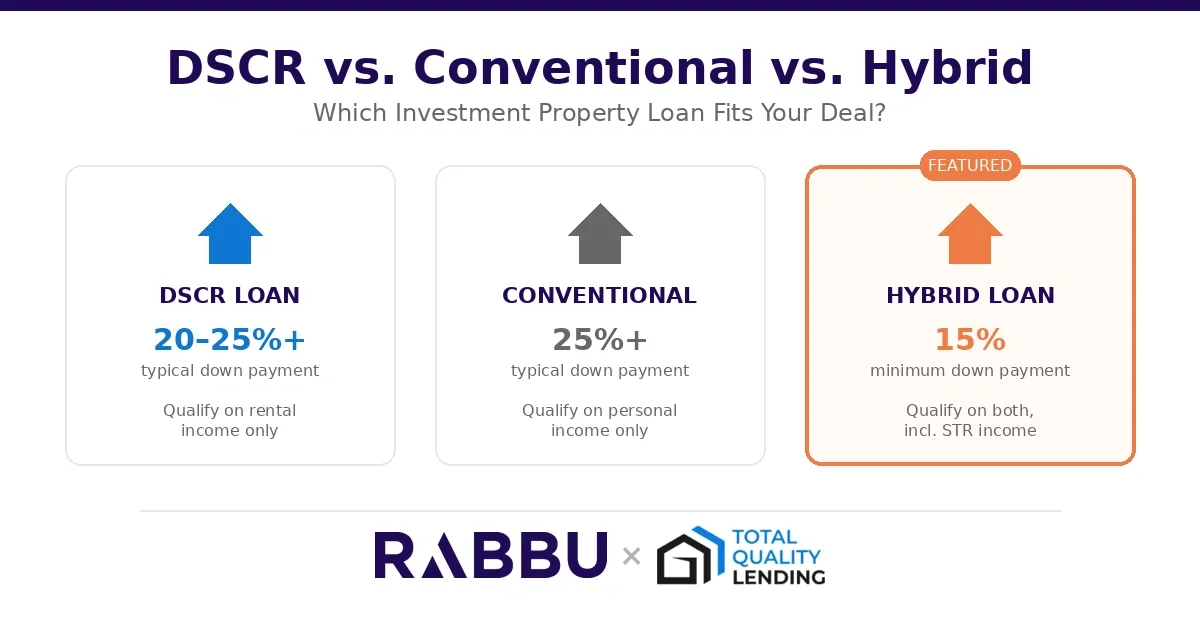
Get matched with DSCR lenders through Rabbu who finance mountain STR properties and understand seasonal revenue patterns that might confuse traditional lenders.
Mountain properties benefit from DSCR financing because:
Seasonal cash flow acceptance: DSCR lenders understand mountain properties generating 40-50% of annual revenue in 3-4 peak months with slower shoulder periods. Traditional lenders reviewing your monthly income might worry about February showing $3,500 revenue when your mortgage is $2,800—but DSCR lenders analyzing annual performance see $74,000 revenue easily covering $42,000 annual debt service (1.76 DSCR).
Remote property financing: Many mountain properties are in rural areas where traditional lenders worry about resale liquidity. DSCR lenders focusing on income-producing capability care less about location remoteness when properties generate strong cash flows.
Well/septic acceptance: Traditional lenders often apply stricter standards for properties on wells and septic systems (common in mountain markets). DSCR lenders primarily concerned with income generation worry less about utility infrastructure as long as properties perform financially.
Larger property financing: Mountain markets favor 3-4 bedroom properties sleeping 8-12 guests—often 2,000-3,500 sq ft cabins and homes. DSCR programs readily finance these larger properties based on their higher revenue generation, while some conventional programs become more restrictive above certain square footages or property values.
Portfolio building: Investors acquiring multiple mountain properties across Gatlinburg, Blue Ridge, and other markets benefit from DSCR loans' unlimited property capacity versus conventional loans capping most investors at 10 financed properties.
Work with Rabbu's lender network to secure pre-qualification specifically for mountain market financing, highlighting that you're targeting proven destinations with verified multi-season demand. This positions you favorably with lenders who may have concerns about highly seasonal or speculative locations.
Find a Lender that Specializes in Short-Term Rentals
Connect with lenders who actually understand short-term rental cash flow and offer DSCR loans, portfolio financing, and investor-friendly terms.
Get Matched with STR LendersAirbnb Properties in Mountain Markets vs Beach Market Properties: Understanding the Difference
Both mountain and beach vacation rental markets generate strong returns, but they suit different investor profiles and strategies.
|
Factor |
Mountain Market Properties |
Beach Market Properties |
|
Seasonality |
3-4 strong seasons with multi-season demand |
1-2 peak seasons (summer, sometimes spring break) |
|
Annual Occupancy |
68-82% (year-round bookings) |
58-72% (concentrated in 4-5 months) |
|
Rate Stability |
Moderate swings (250-350% peak vs shoulder) |
Extreme swings (400-600% summer vs winter) |
|
Weather Dependency |
Moderate—snow, foliage timing affects bookings |
High—hurricanes, red tide, cold snaps kill seasons |
|
Drive-Time Appeal |
Strong weekend + vacation demand |
Primarily vacation demand (6-8 night stays) |
|
Guest Demographics |
Families, groups, couples, all age ranges |
Primarily families with children in summer |
|
Competitive Landscape |
Established markets with steady supply |
Varies—some oversaturated, others undersupplied |
|
Property Maintenance |
Higher—mountain weather hard on properties |
Moderate—salt air creates corrosion issues |
|
Regulatory Environment |
Generally favorable with exceptions |
Increasingly restrictive in many beach towns |
|
Appreciation Potential |
Moderate to strong in prime markets |
Strong but facing regulatory risks |
When to Choose Airbnb Properties in Mountain Markets
Focus your investment strategy on mountain markets when:
-
Year-round cash flow stability is priority and you can't afford 5-7 months of minimal or negative cash flow common in beach markets
-
You're targeting markets within 3-4 hours of major metros where weekend demand supplements vacation bookings, reducing reliance on seasonal tourists
-
You prefer diversified guest demographics rather than depending almost entirely on summer families with children who dominate beach rentals
-
Regulatory risk concerns you and you want markets with more favorable STR environments than increasingly restrictive beach towns
-
You want four-season booking opportunities allowing you to capitalize on fall foliage, winter holidays, spring hiking, and summer escapes versus betting everything on 100-120 summer days
-
You appreciate weather-resilience where properties generate bookings in snow, rain, and cold temperatures that would devastate beach occupancy
-
You're comfortable with larger properties (3-4BR cabins) that mountain markets favor versus smaller 2-3BR condos more common in beach markets
When to Consider Beach Market Properties
Beach market properties make more sense when:
-
You can handle extreme seasonality with strong summer cash flow funding slow winter periods requiring reserves
-
You're targeting high absolute revenue where top beach properties generate $120K-180K annually (though often with marginal winter performance) versus $70K-100K for comparable mountain investments
-
You prefer smaller properties like 2-3BR condos requiring less capital than mountain cabins
-
You have extensive beach market experience and understand which beach destinations remain favorable versus those facing regulatory challenges
-
You can capture shoulder season demand in year-round warm beaches (Gulf Coast, Southern California) with more distributed bookings
-
You're focused on specific beach markets with strong fundamentals and favorable regulations rather than beach markets generally
-
You want luxury price points where beachfront properties command $1M-3M+ creating high-end STR opportunities
Most investors building diversified portfolios include both mountain and beach properties, but if you're starting with 1-3 properties, mountain markets often provide better learning opportunities with more forgiving seasonality and steadier cash flow.
Common Mistakes When Searching for Airbnb Properties in Mountain Markets
Even experienced investors make errors when entering mountain markets:
-
Prioritizing stunning views over proximity to attractions—properties 30 minutes from activities command $50-80/night less and book 15-20% fewer nights than properties 10 minutes from attractions despite better views
-
Underestimating the importance of paved road access—guests complain extensively about steep, gravel, or dirt road access, impacting reviews and repeat bookings
-
Assuming all mountain markets perform equally—Gatlinburg (exceptional), Boone (strong), and random West Virginia mountain towns (weak) have dramatically different fundamentals despite all being "mountain markets"
-
Focusing only on winter performance in ski-adjacent mountain markets while ignoring whether properties generate summer and fall bookings that determine annual profitability
-
Overlooking HOA and development restrictions that prohibit or severely limit STR operations in many mountain communities and subdivisions
-
Buying properties requiring 4WD or chains in winter—most guests won't have these and won't risk visiting properties advertising "4WD recommended," killing winter bookings
-
Ignoring cell service and internet reliability—remote mountain properties with poor connectivity generate guest complaints and negative reviews regardless of other positive attributes
-
Underestimating utility costs for heating large mountain cabins in winter—$400-700/month utility bills during December-February cut into cash flow
-
Expecting beach-market ADRs in mountain markets—quality mountain properties earn $180-320/night, not $350-600/night like comparable beachfront properties
-
Purchasing sight-unseen without visiting during different seasons—properties beautiful in summer might have serious winter access issues or vice versa
Expert Tips for Finding Airbnb Properties in Mountain Markets
Professional mountain market STR investors and agents share these insights:
-
Properties within 15 miles of national park entrances consistently outperform remote mountain properties by 25-40% in occupancy and 20-30% in ADR despite often costing only 10-15% more
-
Hot tubs are non-negotiable in competitive mountain markets—properties with hot tubs command $40-60/night premiums and book 12-18% higher occupancy than comparable properties without them
-
Focus on 3-4 bedroom mountain properties sleeping 8-12 guests as the sweet spot—larger than this and you're competing for limited group bookings; smaller and you're leaving significant revenue on the table
-
Prioritize paved road access even if it costs $20K-30K more in purchase price—the guest satisfaction and review advantages pay back quickly
-
Target properties in established neighborhoods with existing STR density rather than being the pioneer STR in an untested area where neighbors may organize to restrict operations
-
Analyze performance across minimum three fall foliage seasons—properties consistently booking 80%+ during October demonstrate genuine market positioning, while those with erratic foliage performance face location or presentation challenges
-
Calculate break-even occupancy including elevated winter utilities—properties needing 62% occupancy to break even in mountain markets provide less cushion than properties with 52% break-even points
-
Visit properties during shoulder seasons (March-April, late January-February) to experience worst-case scenarios—if you're comfortable with the property in challenging conditions, peak seasons will exceed expectations
-
Verify high-speed internet before closing—StarLink has solved this for many remote properties, but confirm actual speeds, not seller claims
-
Budget 15-20% higher for furniture and amenities in mountain properties versus beach or urban—larger spaces, mountain-themed décor expectations, and outdoor entertainment areas increase setup costs
The Best STR Deals Never Hit Zillow
Browse exclusive listings for turnkey Airbnbs with actual income data.
Search Exclusive ListingsUse Rabbu to Find, Analyze, and Finance Airbnb Properties in Mountain Markets
Finding high-performing Airbnb properties in mountain markets no longer requires months of fragmented research across disconnected platforms. Rabbu consolidates market intelligence, property listings, analytical tools, and professional connections specifically designed for mountain market STR investing.
Execute this mountain market investment strategy starting this week:
First, use Rabbu's Market Finder to compare mountain market performance across your target regions. Filter for markets with 68%+ annual occupancy, balanced four-season performance, and property prices aligned with your capital availability. Shortlist the top 2-3 mountain markets that meet your investment criteria.
Second, browse Rabbu's marketplace filtering specifically for properties in your shortlisted mountain markets. Focus on properties within 15 miles of major attractions, sleeping 6+ guests, and featuring critical mountain amenities like hot tubs and mountain views. Set up alerts for new mountain market listings matching your criteria.
Third, analyze promising mountain properties using Rabbu's Airbnb Calculator modeling seasonal rate variations typical in mountain markets. Input different rates for fall foliage peak, winter holidays, summer vacation, and shoulder periods to generate accurate annual revenue projections. Account for elevated mountain market expenses including utilities, snow removal, and larger property cleaning costs.
Fourth, validate your projections with Rabbu's Market Data confirming occupancy and rate assumptions align with actual mountain market performance in specific neighborhoods. Cross-reference claimed performance for operating properties against comparable historical results.
Fifth, connect with STR-specialized agents through Rabbu who focus on your target mountain markets. Request agents with specific experience in Gatlinburg, Blue Ridge, or whichever mountain destinations you're targeting. Communicate your investment criteria emphasizing proximity to attractions, guest capacity requirements, and target returns.
Sixth, get pre-qualified with DSCR lenders through Rabbu who understand mountain market seasonality and finance vacation rentals in your target regions. Highlight that you're pursuing proven mountain destinations with multi-season demand and verified comparable performance.
Seventh, visit properties in person before making offers, preferably during shoulder seasons when you can evaluate road access, internet reliability, and property condition without the distraction of peak-season beauty. Test cell service, drive from property to major attractions, and imagine the guest experience during less-than-ideal weather.
The difference between acquiring high-performing mountain properties that generate consistent year-round cash flow and marginal properties that barely break even comes down to systematic market selection, data-driven property analysis, and working with professionals who understand mountain market dynamics. Rabbu provides all three components in one integrated platform.
Start Finding Mountain Market Properties on Rabbu →
Mountain markets offer some of the most attractive risk-adjusted returns in short-term rental investing through multi-season demand, year-round cash flow stability, and favorable regulatory environments. With Rabbu's market intelligence, analytical tools, and professional network, you can confidently identify which mountain markets offer the best opportunities and acquire properties positioned to capture premium rates and occupancy across all four seasons.
Rabbu Platform FAQs: How Our Tools Help You Find Airbnb Properties in Mountain Markets
How does Rabbu's Market Finder help me compare different mountain markets like Gatlinburg vs Blue Ridge?
Rabbu's Market Finder displays side-by-side comparisons of mountain markets showing annual occupancy rates broken down by season, average daily rates for different property sizes, gross yield percentages (annual revenue ÷ purchase price), regulatory environment scores, average acquisition costs, and proximity to major metropolitan areas. This allows you to compare Gatlinburg (typically 75-85% occupancy, higher competition, $320K-450K entry points) against Blue Ridge (68-76% occupancy, moderate competition, $280K-380K entry points) and other mountain destinations to determine which markets align with your capital availability, return targets, and risk tolerance.
What makes mountain market properties perform better year-round compared to beach properties?
Mountain markets generate strong bookings across four distinct seasons—fall foliage (September-November), winter holidays and skiing (December-February), spring hiking and renewal (March-May), and summer escape from heat (June-August)—while most beach markets concentrate 60-70% of annual revenue into 3-4 summer months with minimal winter demand. This multi-season appeal creates 68-82% annual occupancy for mountain properties versus 58-72% for beach properties, generating more stable monthly cash flow with less reliance on reserves to cover slow periods. Use Rabbu's Market Data to verify seasonal occupancy patterns in specific mountain markets before investing.
How important is proximity to attractions when buying mountain Airbnb properties?
Proximity to attractions is the single most important factor determining mountain property performance after market selection. Properties within 10-15 miles of major mountain attractions (national parks, ski resorts, downtown areas, popular hiking trails) command 25-40% rate premiums and achieve 15-20% higher occupancy than properties 25+ miles away requiring longer drives. A $340K cabin 12 miles from Gatlinburg generating $75K annually at 76% occupancy will consistently outperform a $310K cabin 32 miles away generating $52K at 58% occupancy. Use Rabbu's Calculator to model how proximity impacts your specific investment returns.
Should I buy a mountain property with a hot tub or add one after closing?
Properties with existing hot tubs command immediate rate premiums ($40-60/night) and occupancy advantages (12-18% higher) that make them worthwhile investments despite 15-20% higher purchase prices. Adding hot tubs post-closing costs $8,000-15,000 for quality units plus installation, requires 3-6 months to complete including permits and electrical work, and takes 12-18 months of elevated bookings to recoup investment. For first-time mountain investors, purchasing properties with hot tubs already installed and proven to drive bookings provides better risk-adjusted returns than post-acquisition installations. Use Rabbu's Airbnb marketplace to filter for mountain properties with hot tubs already installed.
How do I verify a mountain property's performance claims before buying?
For operating mountain properties, request 24 months of booking platform statements (Airbnb/VRBO payout reports), reservation calendars showing actual bookings by date, property management reports if professionally managed, and bank statements showing rental deposits. Cross-reference claimed performance with Rabbu's Market Data showing comparable property performance in the same mountain market and neighborhood. Verify the property's claimed occupancy and ADR align with or exceed neighborhood averages, confirming exceptional performance claims with evidence like high review counts (100+) and strong ratings (4.85+). Never accept summary spreadsheets without underlying documentation when evaluating mountain properties with premium pricing based on performance claims.
Can Rabbu help me find STR-specialized agents who focus on specific mountain markets?
Yes, Rabbu's agent network includes STR-specialized agents focusing on specific mountain markets including Gatlinburg/Smoky Mountains, Blue Ridge/North Georgia Mountains, Asheville/Blue Ridge Parkway, Colorado mountain resorts, Poconos, and other mountain destinations. When requesting agent matches, specify your target mountain market and investment criteria (budget, return targets, timeline). Rabbu connects you with 2-3 agents specializing in your target region who understand micro-location dynamics, attraction proximity impact, seasonal performance patterns, and regulatory environments specific to those mountain markets—providing expertise generic mountain real estate agents lack.
Do DSCR lenders understand mountain properties' seasonal revenue patterns?
Yes, DSCR lenders financing vacation rentals through Rabbu's lender network understand mountain markets generate 40-50% of annual revenue during 3-4 peak months (October foliage, December holidays, July summer) with slower shoulder periods. They evaluate annual debt service coverage ratios rather than month-by-month performance, recognizing that $74,000 annual revenue easily covers $42,000 annual debt service (1.76 DSCR) even though February might show only $3,800 revenue versus $2,900 mortgage payment. This makes DSCR financing ideal for seasonal mountain properties where traditional lenders might worry about monthly cash flow variations.
Don't Let Financing Kill Your Deal
Most banks don't understand short-term rentals. These lenders do.
Find a Lender