Quick answer: A hybrid investor loan is a business-purpose mortgage that qualifies you using both your personal income (like a conventional loan) and the property's projected rental income (like a DSCR loan). It allows down payments as low as 15%, accepts short-term rental income, and can be held in an LLC with no personal credit reporting.
If you're financing an investment property, you've probably been offered two choices: a conventional loan, which qualifies you on your personal income, or a DSCR loan, which qualifies the property on its rental income. Both are excellent tools — we offer both, and we're fans of each. But no single loan fits every deal: conventional loans require bigger down payments on multi-family and keep everything in your personal name, and a DSCR loan's approval and pricing depend on the appraiser's rent estimate, which sometimes comes in lower than the property's real earning power.
That's why we built a third option. Our Hybrid Investor Business Purpose Loan combines the strengths of DSCR and conventional underwriting — with none of the usual roadblocks — designed specifically for real estate investors.
What Is a Hybrid Investor Loan?
A hybrid investor loan is a non-agency, non-conventional business-purpose loan for real estate investors. Instead of qualifying you on one income source, it combines your personal income with the property's projected rental income — so you qualify on the full financial picture, not half of it.
Find a Lender that Specializes in Short-Term Rentals
Connect with lenders who actually understand short-term rental cash flow and offer DSCR loans, portfolio financing, and investor-friendly terms.
How Does the Hybrid Loan Work?
-
Combines two income sources: your personal income (like a conventional loan) plus the property's projected rental income (like a DSCR loan) — for stronger qualification than either alone.
-
Short-term rental income counts: projected Airbnb, VRBO, and other STR income is accepted.
-
Hold it in your LLC: both the loan and title can be held in your LLC for privacy and liability protection.
-
No personal credit reporting when held in an LLC: the loan stays off your personal credit, preserving your DTI for future personal financing.
-
Prepayment options available: flexible prepay structures often result in lower rates — and they're optional, not required.
-
As little as 15% down: including 2–4 unit and short-term rental properties.
Hybrid Loan vs. DSCR Loan: What's the Difference?
DSCR loans are one of our favorite tools: they qualify the property on its rental income alone, with no personal income documentation, and as business-purpose loans they don't report to your personal credit. For a lot of deals, DSCR is the right answer. The difference is what happens when the appraised rents come in low — a DSCR loan's approval and pricing ride on that one number, while the hybrid gives you a second path:
-
Lower down payment — as low as 15%, especially on short-term rentals and multi-family.
-
Not solely dependent on the DSCR ratio — no loan denials or pricing hits due to low appraised rents. Appraisers sometimes work from limited rent data that's outdated; with the hybrid, your personal income backstops the qualification.
-
No DSCR-based pricing penalties — your rate isn't tied to the ratio.
-
More flexibility on unique or non-traditional investment property types.
Hybrid Loan vs. Conventional Loan: What's the Difference?
A conventional loan qualifies you based on personal income and offers familiar terms, but it wasn't designed for investors who are scaling. The hybrid removes the biggest friction points:
-
Only 15% down on 2–4 unit properties — versus the 25%+ conventional typically requires.
-
Short-term rental income is allowed — conventional often restricts it.
-
Loan and title in your LLC — conventional requires your personal name.
-
No personal credit reporting when held in an LLC — keeps your DTI low for the next purchase.
-
Prepayment structure can improve rates significantly — available, but never required.
-
More flexibility on unique or non-traditional property types.
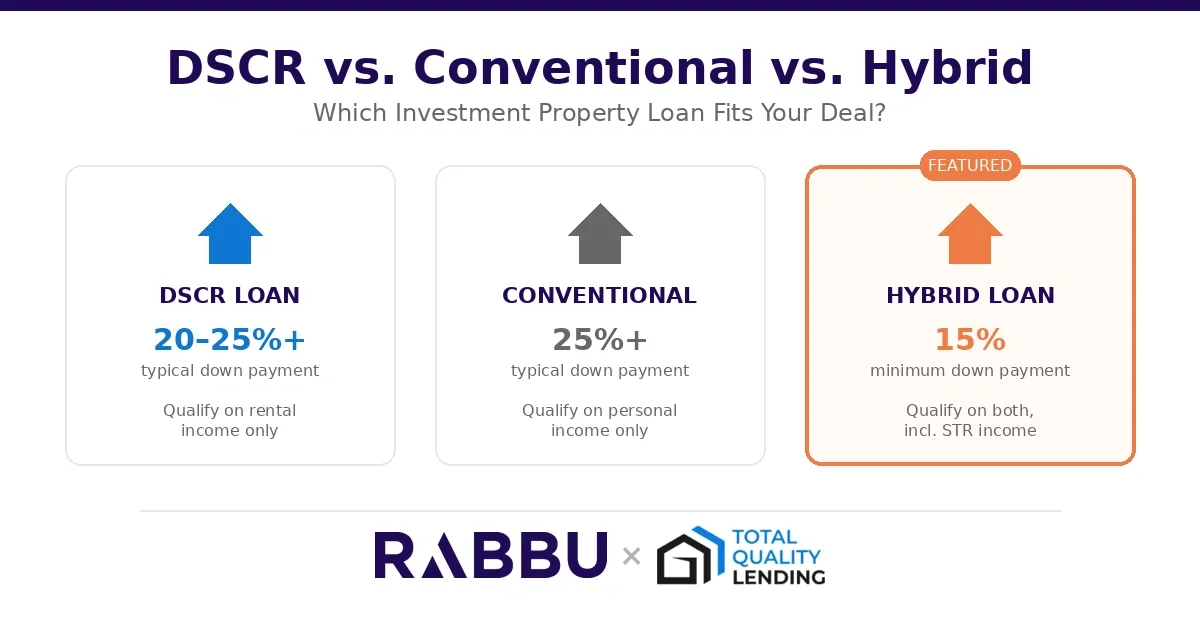
DSCR vs. Conventional vs. Hybrid: Side-by-Side Comparison
|
Hybrid Investor Loan |
DSCR Loan |
Conventional Loan |
|
|
Income used to qualify |
Personal income + projected rental income (including short-term rental income) |
Property's rental income only (DSCR ratio) |
Personal income only (DTI) |
|
Minimum FICO |
620 |
620 on most programs |
620 agency minimum, though investment property pricing typically improves at 680+ |
|
Down payment |
As little as 15%, including 2–4 unit and short-term rental properties |
Typically 20% to 25%, often higher on short-term rentals and multi-family |
25%+ typically required on 2–4 unit investment properties |
|
Short-term rental income (Airbnb/VRBO) |
Accepted |
Allowed, but pricing and approval hinge on appraised rents |
Often restricted |
|
Loan & title in an LLC |
Yes, privacy and liability protection |
Yes |
No, personal name required |
|
Personal credit reporting |
None when held in an LLC, preserves your DTI |
None, business-purpose loans don't report personally |
Reports personally affect DTI for future financing |
|
Pricing tied to DSCR ratio |
No, no DSCR-based pricing penalties |
Yes, low appraised rents can mean denials or rate hits |
N/A |
|
Flexibility on unique property types |
More flexible |
Moderate |
Limited |
Terms and requirements vary by scenario. Talk with us about your specific deal.
Which Loan Is Best for Your Investment Property?
It depends on the deal. We offer DSCR, conventional, and hybrid loans — and we're fans of all three. A DSCR loan is hard to beat when the property cash-flows well and you'd rather not document personal income. Conventional makes sense for many buyers who plan to hold in their personal name. And the hybrid shines when you want the lowest down payment, STR income counted, or a deal that a rent appraisal alone wouldn't support. Our real value isn't just the products: it's being your loan strategist and advisor. We help you choose the right loan for your investing goals, your property type, and your long-term plan.
For investors who want flexibility, scale, and protection in one loan — lower down payments, LLC ownership, Airbnb income that counts, and borrowing power preserved for the next deal — the hybrid is hard to beat.
Frequently Asked Questions
What credit score do I need for an investment property loan?
Our hybrid investor loan starts at a 620 minimum FICO, and most DSCR programs start at 620 as well. Conventional investment property financing carries a 620 agency minimum, but pricing and terms typically improve at 680 and above. Higher scores unlock better pricing and leverage across all three.
Can I buy an investment property with 15% down?
Yes. Our hybrid investor loan allows as little as 15% down, including on 2–4 unit and short-term rental properties, where conventional loans typically require 25% or more.
Can I use Airbnb or VRBO income to qualify for a mortgage?
With a hybrid investor loan, yes. Projected short-term rental income from platforms like Airbnb and VRBO is accepted alongside your personal income. DSCR loans can also work for STRs, though qualification there depends on the appraised rents. Conventional loans often restrict short-term rental income.
Can an LLC hold the loan and title on my rental property?
Yes. With the hybrid loan, both the loan and the title can be held in your LLC for privacy and liability protection. Conventional loans require the property to be in your personal name.
Does a hybrid investor loan show up on my personal credit?
When the loan is held in an LLC, there is no personal credit reporting, so it doesn't raise your DTI, and your personal borrowing power stays intact for future financing. The same is true of DSCR loans: as business-purpose loans, they don't report to personal credit either. Conventional loans do.
What is the difference between a DSCR loan and a hybrid loan?
A DSCR loan qualifies the property using its rental income alone, the debt-service coverage ratio, with no personal income documentation required. A hybrid loan combines your personal income with the property's projected rental income, so qualification doesn't rest on the appraised rent figure alone. Both are business-purpose loans that can be held in an LLC.
Is a prepayment penalty required on a hybrid loan?
No. Prepayment structures are optional, but choosing one often results in a meaningfully lower rate.
Ready to see which loan fits your next deal? Reach out to the team at Total Quality Lending and let's map out the right financing strategy for your portfolio.