Buying an Airbnb property with no money down sounds impossible—until you realize most successful STR investors started with creative financing strategies that bypassed traditional 25% down payment requirements. Rental arbitrage, DSCR loans, seller financing, and strategic partnerships allow you to enter the short-term rental market with minimal upfront capital while building toward property ownership.
This guide walks you through seven legitimate financing options requiring little to no cash, step-by-step property acquisition strategies, and how to use data-driven tools to identify deals that actually cashflow. You'll learn which creative approaches work for first-time investors versus experienced operators, how to avoid common pitfalls that derail deals, and exactly where to find STR-specialized lenders who understand vacation rental income potential.
Can You Really Buy An Airbnb With No Money Down
Yes, you can start an Airbnb business with minimal capital through rental arbitrage (leasing properties and subletting them with landlord permission), co-hosting arrangements, or creative financing methods like seller financing and VA loans. The distinction matters: rental arbitrage and co-hosting generate income without owning property, while financing strategies like DSCR loans and partnerships allow you to acquire real estate with 10-20% down instead of the typical 25%.
Traditional platforms like Zillow show properties for sale but tell you nothing about STR profitability or local regulations. Rabbu's marketplace shows turnkey Airbnbs with verified income history and conversion properties with data-backed projections—plus connects you with lenders who understand creative deal structures. This eliminates weeks of hunting across multiple platforms trying to piece together whether a property will actually work as a short-term rental.
Financing Options That Require Little Or No Cash
Several legitimate financing methods reduce your upfront capital requirements compared to conventional 25% down payments. Each option carries specific qualification requirements and tradeoffs.
VA And USDA Loans
Veterans and active military members can access VA loans requiring zero down payment on properties up to $766,550 in most markets. USDA loans offer the same benefit for properties in designated rural areas, which include many popular vacation destinations. Both programs require owner occupancy for at least one year, though you can legally operate extra bedrooms as STRs during this period.
VA loans typically offer interest rates 0.5-1% lower than conventional mortgages without requiring private mortgage insurance. USDA loans carry similar benefits but restrict eligible properties to areas outside major metropolitan centers—often mountain towns, lake communities, and rural destinations where STR demand runs high.
Seller Financing
Seller financing occurs when the property owner acts as the lender, allowing you to make payments directly to them rather than obtaining a traditional mortgage. This works best when sellers own properties free and clear, need steady income rather than a lump sum, or face properties that won't qualify for conventional financing due to condition issues.
Typical terms include 10-20% down payment, interest rates 1-2% above market, and balloon payments due in 3-7 years requiring refinancing or sale. Rabbu's agent network identifies motivated sellers likely to consider financing and helps structure deals that protect both parties.
Lease Option Agreements
Lease options combine a rental agreement with an option to purchase the property at a predetermined price within 1-3 years. You pay an upfront option fee (usually 2-5% of purchase price) that's often credited toward the purchase, then make monthly payments where a portion accumulates as additional purchase credit.
This works well for STR investors because you can operate the property as a short-term rental during the lease period (with landlord permission), using the income to build capital for eventual purchase. The key is ensuring rental income significantly exceeds the lease payment plus operating costs.
Home Equity Loans And HELOCs
If you already own a primary residence with substantial equity, home equity loans and HELOCs (Home Equity Lines of Credit) allow you to borrow against that equity for investment property down payments. Home equity loans provide a lump sum with fixed rates, while HELOCs function like credit cards with variable rates where you only pay interest on amounts actually borrowed.
Most lenders allow you to access up to 80-85% of your home's value minus existing mortgage balance. A $400,000 home with a $200,000 mortgage gives you access to roughly $120,000-$140,000. These loans close in 2-3 weeks versus 45-60 days for investment property mortgages.
The risk is clear: you're leveraging your primary residence to fund an investment property. If the STR underperforms, you're still obligated to make payments on both properties.
Cash Out Refinance
Cash-out refinancing replaces your existing mortgage with a larger loan, extracting the difference as cash for investment property acquisition. Unlike HELOCs that create a second lien, cash-out refinances consolidate everything into one loan, often at lower rates than home equity products.
This works best when current mortgage rates are comparable to your existing rate, or when your property has appreciated significantly since purchase. Lenders typically allow cash-out up to 80% loan-to-value on primary residences and 75% on investment properties. The process takes 30-45 days and includes full underwriting, appraisal, and closing costs typically 2-5% of the new loan amount.
Partnerships And Private Money
Joint ventures with capital partners allow you to acquire properties where they provide funding while you contribute expertise and management. Common structures include 50/50 profit splits where the capital partner receives preferred returns (typically 6-8% annually) before profits are distributed, or equity partnerships where ownership percentages reflect each party's contribution.
Family loans and private lending from friends or colleagues often provide more flexible terms than institutional lenders—lower rates, longer payback periods, and creative structures. Document everything formally with promissory notes, clear repayment terms, and attorney review to prevent misunderstandings.
When structuring partnerships, define roles explicitly: who handles guest communication, maintenance, booking management, and financial reporting? What happens if one party wants to exit? Clear agreements prevent conflicts.
DSCR Loans And STR-Specialized Financing
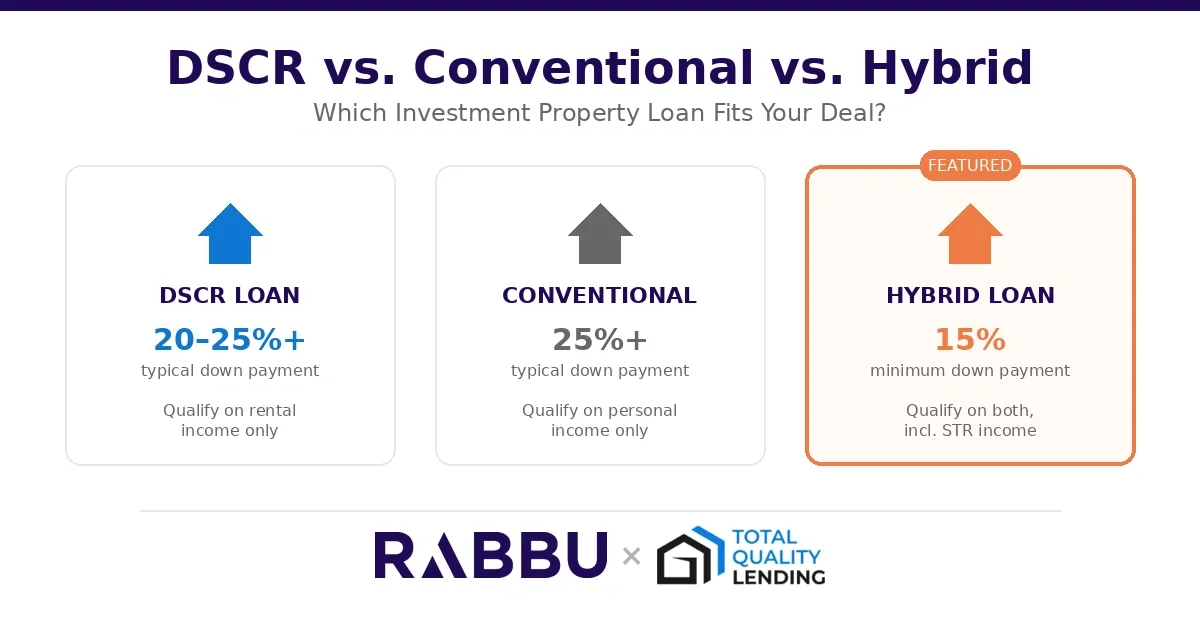
DSCR (Debt Service Coverage Ratio) loans qualify you based on the property's projected income rather than your personal W-2 earnings. Specialized STR lenders calculate DSCR by dividing projected monthly rental income by total monthly debt obligations—if the ratio exceeds 1.0-1.25, you qualify regardless of personal income.
Key advantages include:
-
15-25% down payment: Lower than conventional investment property loans requiring 25-30%
-
15-30 day closings: Faster than traditional 45-60 day timelines
-
No property limits: Unlike conventional lending that caps investors at 10 financed properties
-
Income-based qualification: Your personal tax returns don't matter
Traditional lenders don't recognize STR income potential, instead using conservative long-term rental comparables that undervalue earning power by 40-60%. Rabbu's lending partner network specializes in STR underwriting, using actual Airbnb market data to calculate realistic income projections.
Don't Let Financing Kill Your Deal
Most banks don't understand short-term rentals. These lenders do.
Find a LenderCreative Ways To Start An Airbnb Business With No Money
The following strategies don't require property ownership but generate income that builds capital for eventual real estate acquisition. Think of them as stepping stones—ways to learn the STR business while building reserves.
Rent To Airbnb Arbitrage
Rental arbitrage involves leasing a property on a long-term basis (typically 12 months) then subletting it short-term on Airbnb, capturing the difference between monthly rent and STR revenue. Although we don't formally endorse this strategy, its one people use. This works best in markets where monthly STR income exceeds long-term rent by 2-3x, providing enough margin to cover furnishing costs, utilities, cleaning, platform fees, and still generate profit.
Legal requirements include:
-
Written landlord consent: Explicit written approval for short-term subletting in your lease agreement
-
Local STR permits: Many cities require permits regardless of whether you own the property
-
Proper insurance: Standard renters insurance doesn't cover STR activity—you'll need specific short-term rental liability coverage
-
HOA approval: If the property is in an HOA, verify rules allow short-term rentals before signing
Calculate your margin carefully: if you're paying $2,000 monthly rent and projecting $5,500 in STR revenue, you'll face roughly $1,200 in operating costs (cleaning, utilities, supplies, platform fees), $400-500 in furnishing costs (amortized), and ideally maintain $800-1,000 vacancy buffer, leaving $1,000-1,400 monthly profit.
Co-Hosting For A Percentage
Co-hosting involves managing other people's Airbnb properties in exchange for 15-25% of booking revenue, with no upfront investment required. You handle guest communication, pricing optimization, listing management, review responses, and coordination with cleaning and maintenance providers.
Typical revenue splits are 20% for basic management (guest communication, booking management) and 25-30% for full-service management including pricing strategy, professional photography, and proactive maintenance coordination. On a property generating $6,000 monthly, a 20% split provides $1,200 in income per property—manage 5-6 properties and you're earning $6,000-7,200 monthly while learning the business.
Joint Ventures With Property Owners
Joint ventures create true partnership structures where you share both profits and risks rather than simply earning management fees. Common arrangements include owners providing the property while you provide management expertise, with profits split 50/50 or 60/40 after all expenses including mortgage, maintenance, and management costs.
This works particularly well with owners who inherited properties, live out of state, or don't have time to manage STR operations but recognize the income potential exceeds long-term rentals. Define performance metrics clearly: what occupancy rate and average daily rate are you targeting? How are major expenses approved?
Buy Rehab Refi Rent Short Term (BRRRR for STRs)
The BRRRR strategy—Buy, Rehab, Refinance, Rent, Repeat—adapts to short-term rentals by forcing appreciation through renovations, then refinancing based on improved value and STR income potential to extract most or all of your initial capital. You start by purchasing a distressed property below market value, invest 15-25% of purchase price in strategic renovations, then refinance into a DSCR loan based on the property's new appraised value and projected STR income.
For example: purchase a $200,000 distressed property with 20% down ($40,000), invest $30,000 in renovations, refinance at new appraised value of $280,000 at 75% LTV ($210,000 loan), and extract $10,000 while owning a property generating $4,500 monthly in STR income. Tax advantages amplify returns through cost segregation studies that accelerate depreciation on improvements—turning 27.5-year straight-line depreciation into 5-7 year accelerated schedules.
Step-By-Step Guide To Acquire Your First Airbnb Property
Successful STR investing follows a systematic process that eliminates guesswork. Each step builds on the previous one, creating a data-driven framework.
Step 1: Identify Top Markets Using Data-Driven Analysis
Start with Rabbu's Market Finder and sort by ROI from highest to lowest, looking for markets with 20+ active Airbnbs showing healthy year-round demand. Compare 5-10 markets focusing on ROI score, average occupancy rates (target 65%+), and gross yield (target 8%+), then click into individual markets to access detailed seasonality patterns.
This contrasts with choosing markets based on personal preference or generic population growth data that ignores actual STR performance metrics. Markets that look attractive for long-term rentals often underperform for STRs due to oversaturation, restrictive regulations, or seasonal demand patterns that create extended vacancy periods.
Pay attention to regulatory environment indicators—markets with clear, stable STR regulations reduce your risk of permit denials or sudden rule changes.
Step 2: Browse High-Performing Properties in Rabbu's Marketplace
Navigate to Rabbu's marketplace and filter by your chosen markets, then decide between turnkey properties and conversion opportunities based on your risk tolerance and available capital.
For Turnkey Airbnbs (properties already operating as STRs), filter by "Active Airbnb" tag:
-
Immediate cash flow from day one
-
Proven performance data that strengthens financing applications
-
Existing permits and regulatory approvals
-
Established guest reviews and booking momentum
-
Higher purchase prices reflecting the income stream
For STR Conversion Properties (homes not currently operating as STRs), add filters for "Airbnb Potential," "Former Airbnb," and "Agent Pick":
-
Lower entry cost (10-20% below turnkey equivalents)
-
Higher ROI potential through strategic positioning
-
Creative control over design and guest experience
-
Significant tax advantages through cost segregation on improvements
-
2-4 month setup period before generating income
Set up email alerts for new matching properties—good deals in competitive markets receive multiple offers within 48 hours.
Find the Right Airbnb Investment Property
Search exclusive listings for both turnkey and potential Airbnb properties in one place.
Explore Airbnbs for SaleStep 3: Verify Revenue With Actual Airbnb Data
Use Rabbu's free Airbnb Calculator with the specific property address and bedroom count to generate income projections based on actual comparable performance. Filter comparables by guest reviews (minimum 5 reviews) and average rating (4.9+) to benchmark against top performers rather than poorly managed properties.
Add or remove amenities to match your target property's features—pools, hot tubs, lake access, and mountain views create 20-40% pricing premiums. Aim for 5-10 comparable listings within 2-3 miles to ensure your data reflects true local market conditions.
Toggle between 75th percentile (realistic top-performer target) and 90th percentile (exceptional performance requiring professional management) to understand your property's income range. Conservative investors can underwrite deals using 75th percentile projections, while experienced operators comfortable with active management can target 90th percentile returns.
Step 4: Secure Low Down Capital Financing Through STR-Specialized Lenders
Apply the financing strategies from the earlier section, prioritizing DSCR loans that qualify based on property income rather than personal earnings. Use Rabbu's Find a Lender tool to connect with 1-3 STR-specialized lenders simultaneously.
Prepare documentation including:
-
Credit report (most DSCR lenders require 680+ credit scores for best rates)
-
Cash reserves (proof of 6-12 months operating expenses beyond down payment)
-
Income projections (export your Rabbu Calculator analysis)
-
Property details (address, purchase price, planned use, renovation plans)
Rabbu's lending partners understand STR underwriting and move faster than traditional banks—expect preliminary approval within 3-5 days and full underwriting completion in 15-21 days versus 45-60 days for conventional mortgages.
Step 5: Make A Competitive Offer With Expert Agent Support
Contact Rabbu's vetted STR-specialized agents who understand local STR regulations and permit requirements, know how to negotiate based on cash flow projections rather than just comparable sales, and include STR-specific contingencies like permit approval and minimum revenue verification.
Structure offers creatively using seller credits toward furnishing costs, rate buydowns that reduce your mortgage payment in early years, or delayed closings that allow you to secure permits before taking ownership. Include contingencies for permit approval if operating in regulated markets.
Step 6: Furnish And Stage For Guests
Budget $15,000-25,000 for complete furnishing of a 3-bedroom property, prioritizing guest-impact items that drive bookings and positive reviews. Focus initial spending on quality mattresses and bedding, adequate seating for listed occupancy, reliable Wi-Fi and streaming services, smart locks for seamless check-in, and basic kitchen equipment.
Phase your furnishing over 2-3 months if capital is tight, starting with essentials required to accept your first guests then adding amenities that justify rate increases as revenue flows in. Professional photography isn't optional—it typically costs $300-500 but increases booking rates 30-40% compared to amateur iPhone photos.
Step 7: Launch And Optimize The Listing
Create compelling listings that answer three questions every guest asks: Where exactly is this property and what's nearby? What makes this property special compared to alternatives? What's included and what can I expect?
Use your first 2-3 sentences to hook browsers with your unique value proposition, then provide detailed information about amenities, sleeping arrangements, and house rules. Implement dynamic pricing using tools like PriceLabs or Wheelhouse that adjust rates based on local demand—static pricing leaves 15-25% of potential revenue on the table.
Focus initial efforts on acquiring your first 10-15 reviews by offering slightly below-market rates and providing exceptional guest experiences. Use market data from Rabbu's platform to optimize seasonal pricing—if comparable properties charge $50/night premiums for hot tubs, add one and capture that rate increase.
How To Invest In Airbnb Without Owning Property
Service-based businesses in the STR ecosystem generate income that funds future property purchases while building expertise. The following approaches require sweat equity rather than capital.
Franchise Or Management Agreements
Property management companies managing 10+ STR properties typically earn 20-30% of gross revenue through formal management agreements with standardized service offerings. This differs from ad-hoc co-hosting by creating systematized operations, branded service delivery, and scalable systems.
Successful management companies implement standardized pricing strategies across their portfolio, maintain preferred vendor relationships for cleaning and maintenance, use centralized guest communication systems, and create quality control processes. Revenue scales quickly—managing 20 properties averaging $5,000 monthly at 25% management fees generates $25,000 monthly income.
Airbnb Experiences And Ancillary Services
Airbnb Experiences allow you to monetize expertise or local knowledge by creating tours, classes, or activities for travelers—no property required. Successful experiences typically charge $50-150 per person and can be delivered to small groups, creating $300-800 per session income with minimal overhead.
Popular categories include food and drink tours showcasing local cuisine, outdoor adventures like hiking or kayaking, creative workshops teaching photography or cooking, and insider access to local culture or history. The key is identifying something unique you can offer that travelers can't easily replicate on their own.
Short Term Rental Cleaning Businesses
STR cleaning services represent one of the fastest-growing service sectors as the vacation rental industry expands, with professional cleaners earning $80-150 per turnover depending on property size and market rates. Building a cleaning business serving 15-20 properties generates $12,000-30,000 monthly revenue with relatively low startup costs.
The capital you build through cleaning services can fund your first property acquisition within 12-18 months while giving you knowledge of what makes properties successful. Many successful STR investors started as cleaners, learning the business from the inside before acquiring their own properties.
Evaluate Deals Using Airbnb Income Data And DSCR Metrics
Analyzing properties for profitability before purchase requires understanding key metrics that predict cash flow performance. Unlike long-term rentals where simple rent-to-price ratios suffice, STR investments demand more sophisticated analysis accounting for seasonality and variable occupancy patterns.
Critical STR metrics include:
-
Occupancy Rate: Percentage of available nights booked, targeting 65-75% in most markets
-
Average Daily Rate (ADR): Mean nightly rate across all bookings, varying significantly by season
-
Revenue Per Available Night (RevPAR): ADR × Occupancy Rate, the truest measure of pricing power
-
Seasonality Index: Revenue variance between peak and off-peak seasons, indicating income stability
-
Operating Expense Ratio: Total expenses as percentage of revenue, typically 35-50% for STRs
-
Debt Service Coverage Ratio (DSCR): Net operating income ÷ debt obligations, minimum 1.2 for quality deals
Use Rabbu's Investor Return Calculator to input purchase price, down payment, financing terms, and projected income/expenses, generating Cap Rate, ROI, and cash-on-cash return for property comparisons. The Investor Return Calculator can be found on the property card for any active listing in the Rabbu marketplace and is also available for any property (even if not listed on the marketplace) through Rabbu’s free Calculator.
After inputting the property purchase price, hit the Calculate button, then you’ll see the following metrics:
-
Cap rate
-
Gross yield
-
Cash-on-cash return
-
Net operating income
-
Leveraged net cash flow
You can fine tune any of the expense inputs that factor into these calculations. The calculator takes into account all the following expenses:
-
Total investment: Totals the purchase price, closing costs, immediate repairs, furnishing costs, and initial expenses.
-
Expenses: Totals the channel fee, property management fee, supply fees, property taxes, insurance, HOA fees, utilities, maintenance, and other expenses.
-
Financing: Takes into account down payment, loan closing costs, interest rate, interest type, and amortization term.
The table below contrasts traditional rental metrics with STR-specific measurements:
|
Traditional Metrics |
STR-Specific Metrics |
|
Monthly Rent |
Average Daily Rate (ADR) |
|
Annual Rent |
Revenue Per Available Night (RevPAR) |
|
Rent-to-Price Ratio |
Gross Yield + Seasonality |
|
Cap Rate (simplified) |
DSCR (Debt Service Coverage Ratio) |
|
Vacancy Rate (static) |
Occupancy Rate + Seasonal Variance |
Rabbu's integrated approach eliminates hunting for data across AirDNA, Mashvisor, and manual spreadsheets. Every property in Rabbu's marketplace includes pre-calculated metrics based on verified market data.
Find a Lender that Specializes in Short-Term Rentals
Connect with lenders who actually understand short-term rental cash flow and offer DSCR loans, portfolio financing, and investor-friendly terms.
Get Matched with STR LendersCommon Roadblocks And How To Overcome Them
Even with creative financing strategies and data-driven property selection, investors face obstacles that derail deals. Understanding barriers and solutions accelerates your path to acquisition.
Credit issues affect qualification for most financing programs. Work with credit repair specialists to dispute inaccuracies and remove negative items (typically 3-6 month process), become an authorized user on family members' established credit cards to boost your score quickly, or pursue alternative lenders through Rabbu's network who specialize in lower-credit borrowers with compensating factors like larger down payments.
Income verification challenges particularly affect self-employed investors whose tax returns show low income due to legitimate business deductions. DSCR loans solve this entirely by ignoring personal income and qualifying based solely on property cash flow—your business can generate $200,000 but report $75,000 taxable income, and lenders won't care as long as the property's projected income covers its debt obligations.
Market saturation concerns arise in popular STR destinations where new investors fear too much competition. Use Rabbu's Market Finder to identify underserved niches within saturated markets (pet-friendly properties where few exist, family-focused homes with multiple bedrooms) or nearby markets with favorable regulations.
Data quality concerns plague investors using generic platforms that provide unreliable projections. Rabbu's verified performance data comes from actual Airbnb listings with documented booking history and transparent comparable selection criteria.
Legal And Compliance Checklist For Short-Term Rentals
Regulatory compliance isn't optional—operating without proper permits risks fines, forced closures, and criminal charges in some jurisdictions. Requirements vary dramatically by location, making local expertise essential.
Zoning And Permitting
Verify municipal STR rules before making offers, checking whether your property's zoning allows short-term rentals, whether permit caps exist (and if any remain available), what the application process and timeline looks like, and whether any pending regulatory changes could affect your ability to operate. Some cities like San Francisco and New York heavily restrict STRs, while others like Tennessee and Florida actively encourage vacation rental investment. STR-specialized agents in Rabbu's network can help with this verification process as part of their service.
Occupancy Tax Registration
Register for transient occupancy tax (TOT) and sales tax collection before accepting your first guest, then set up monthly or quarterly remittance processes depending on local requirements. Many jurisdictions now require Airbnb to collect and remit taxes automatically, but you remain legally responsible for compliance even when platforms handle collection.
Penalties for non-compliance often include back taxes plus interest, fines of $500-2,000 per violation, and potential permit revocation. Setting up proper tax collection takes 1-2 hours but prevents problems that can cost thousands to resolve.
Insurance Requirements
Standard homeowner policies explicitly exclude coverage for short-term rental activity, creating massive liability gaps. Obtain STR-specific coverage through Rabbu's insurance specialist partners that addresses commercial liability for guest injuries, loss of income if the property becomes uninhabitable, and guest-caused damage beyond security deposits.
Expect to pay 2-3x standard homeowner premiums for proper STR coverage. One serious guest injury without proper coverage can result in personal liability exceeding $500,000.
Scale Your Short-Term Rental Portfolio After Your First Deal
Success with your first property creates momentum and capital that funds additional acquisitions. Portfolio growth accelerates when you leverage existing assets and systematize operations.
Recycle Equity With BRRRR
Use appreciation and cash flow from your first property to fund additional acquisitions through cash-out refinancing or HELOCs that extract equity without selling. If your property purchased for $250,000 now appraises at $310,000 after 18 months of appreciation, you can extract $48,000 through cash-out refinance (75% LTV = $232,500 new loan minus $200,000 existing loan) while maintaining the cash flow.
This recycled capital funds down payments on 2-3 additional properties, dramatically accelerating portfolio growth compared to saving new capital from W-2 income. Leverage Rabbu's marketplace for subsequent property identification.
Cross Collateralize Cash Flowing STRs
Portfolio loans allow you to use multiple properties as collateral for a single loan, often securing better terms and faster closings than individual property financing. Once you own 3-4 cash-flowing STRs, specialized portfolio lenders can refinance all of them together, extracting equity while consolidating debt service.
Connect with Rabbu's DSCR lending partners for portfolio financing solutions that recognize your track record as an operator. Portfolio loans often close in 15-21 days since lenders are evaluating your proven performance rather than speculating on potential.
Automate Operations To Free Capital
Implement systems and tools that reduce time investment per property from 10-15 hours monthly to 2-3 hours, allowing you to manage 10+ properties without proportionally increasing your workload. Key automation includes dynamic pricing tools that adjust rates automatically, automated guest messaging for check-in instructions, centralized booking calendars that prevent double-bookings, and digital guidebooks that answer guest questions before they're asked.
The time you free through automation allows you to focus on acquisition and optimization rather than operational firefighting.
Build Your Portfolio With Data Backed Confidence
The difference between investors who build successful STR portfolios and those who struggle with underperforming properties comes down to using integrated, data-driven platforms. Traditional approaches require using AirDNA for market research, Zillow for property listings, generic mortgage brokers unfamiliar with STR financing, and local agents who don't understand vacation rental dynamics—creating weeks of inefficient research.
Rabbu's streamlined solution combines market intelligence showing top-performing markets with verified occupancy data, property marketplace featuring pre-analyzed listings with income projections, calculator tools generating professional-grade financial projections, and STR-specialized lender network offering DSCR and portfolio loan programs with 15-30 day closings.
Browse our marketplace and find exclusive Airbnb properties for sale you won't find anywhere else.
FAQs About Buying An Airbnb With No Money Down
What credit score do lenders require for low down Airbnb loans?
Most specialized STR lenders require a minimum credit score between 620-680, though some portfolio lenders may accept lower scores with compensating factors like higher cash reserves or STR experience. Rabbu's lending partners offer various programs for credit scores of 620+.
How much cash in reserves do investors typically maintain?
Industry experts recommend maintaining three to six months of mortgage payments and operating expenses in reserves, even with zero-down financing, to handle vacancy periods and unexpected repairs.
Does a higher interest rate eliminate the benefits of no money down financing?
While zero-down loans typically carry higher rates, the ability to acquire cash-flowing properties without depleting savings often outweighs the additional interest cost, especially in appreciating markets.
How long does it typically take to close on a low down STR deal?
Creative financing deals often take 45-90 days to close due to additional documentation and approval processes, compared to 30-45 days for conventional purchases. DSCR loans through Rabbu's partners can often close faster than traditional financing.
How does Rabbu help me find better deals than other platforms?
Rabbu offers exclusive access to active STR properties with verified performance data that aren't found on Zillow or other generic platforms. The marketplace includes off-market properties only listed on Rabbu, plus integrated tools for market analysis, income projection, and financing—eliminating the need to use multiple platforms.
The Best STR Deals Never Hit Zillow
Browse exclusive listings for turnkey Airbnbs with actual income data.
Search Exclusive Listings