Buying your first Airbnb investment property means navigating a completely different process than purchasing a primary residence—you're evaluating cash flow potential, analyzing occupancy data, verifying STR regulations, and securing financing that recognizes rental income rather than just your W-2 earnings. Most first-time investors waste months researching markets on platforms that weren't built for short-term rentals, only to discover their "perfect property" sits in an oversaturated market or violates local zoning laws.
One of the most common questions we hear at Rabbu is, “How do I buy my first Airbnb investment property?” The short answer: we built the Rabbu platform to make that process simpler, smarter, and more accessible for first-time investors.
This guide walks you through the exact steps to identify profitable markets, find properties with strong return potential, secure STR-specific financing, and avoid the costly mistakes that derail new hosts before they ever welcome their first guest.
Use Rabbu's Market Finder to Choose a Profitable Short-Term Rental Market
Buying your first Airbnb investment property starts with selecting a market where properties actually generate strong occupancy rates and nightly rates high enough to cover expenses. Location determines roughly 70-80% of your property's success—a perfectly furnished home in a weak market will underperform a basic property in a high-demand area.
Traditional real estate platforms show you where homes are for sale, but they don't tell you which markets actually generate strong Airbnb income. Rabbu's Market Finder tool ranks over 400 U.S. markets using real occupancy data, revenue benchmarks, and supply trends so you can identify profitable areas before you start property hunting.
Step 1. Rank Markets Using Rabbu's ROI Score
Rabbu's ROI Score ranges from 0 to 100 and indicates how suitable a specific market is for short-term rental investment. A higher score means lower competition, higher occupancy rates, and better revenue potential relative to average home prices.
The score combines average home values, average annual revenue, average occupancy rate, total number of active Airbnbs, and year-over-year growth in listings. Start by sorting the Market Finder table from high to low based on ROI score, then filter to show only markets with at least 20 active Airbnbs—this minimum ensures enough data exists to make reliable projections.
Step 2. Look at Occupancy and ADR Data
Occupancy rate tells you how often properties stay booked, while Average Daily Rate (ADR) shows what guests actually pay per night. Strong markets typically show occupancy rates above 60% and ADRs high enough to cover your mortgage, taxes, insurance, and operating expenses while still generating profit.
Rabbu updates this information monthly and displays it for free in the Market Finder tool. Click on any market to see detailed ADR data, or navigate directly to the Market Data tool and select your target market.
Step 3. Evaluate Seasonality Trends
Some markets thrive year-round while others experience dramatic seasonal swings. Beach towns might hit 90% occupancy in summer but drop to 30% in winter, while business travel destinations maintain steadier bookings across all months.
Click on your target market in the Market Finder tool to see monthly occupancy patterns displayed as a chart. The seasonal performance graph shows peak months, shoulder seasons, and slow periods so you can plan your cash flow expectations realistically.
Step 4. Check Supply Growth
Markets with explosive year-over-year growth in new STR listings often signal increasing competition that erodes occupancy rates and forces price reductions. Moderate growth around 5-15% annually typically indicates healthy demand, while 30%+ growth suggests potential oversaturation.
To view year-over-year supply growth, click on your target market in the Market Finder tool and select "View Score Details" under the ROI score. The supply trend analysis shows whether new listings are flooding the market or growth remains sustainable.
Find the Right Airbnb Investment Property
Search exclusive listings for both turnkey and potential Airbnb properties in one place.
Explore Airbnbs for SaleDecide Whether You Want to Buy a Turnkey Airbnb or Convert a Single Family Home Into a Short-Term Rental
Buying a turnkey Airbnb is like purchasing an existing business with established customers and revenue history. Converting a traditional home into an STR is like starting a business from scratch. Both approaches work for first-time investors, though they require different skill sets, capital structures, and risk tolerances.
Pros of a Turnkey Airbnb
A turnkey Airbnb already operates as a short-term rental, so you start earning income immediately after ownership transfers. You skip the 3-6 months of setup, furnishing, and listing optimization that conversions require.
You can analyze actual historical revenue and occupancy instead of relying on projections. This documented performance reduces risk and makes underwriting easier, especially when platforms like Rabbu verify the data with actual booking records.
The property comes fully furnished, decorated, and often managed by an existing team including cleaners and maintenance contractors. This setup works well for investors who want passive income or who live far from their investment property.
Cons of a Turnkey Airbnb
Turnkey properties often sell 15-30% above market value because sellers monetize both the real estate and the established business. You pay a premium for convenience and existing cash flow.
Most value-add work like furnishing, design optimization, and operational improvements is already complete. You have less room to improve revenue or appreciation through hands-on effort compared to conversions.
Past performance doesn't guarantee future results. Changes in ownership, management quality, guest reviews, or platform algorithms can affect occupancy rates and revenue after you take over.
Pros of Converting a Home Into an Airbnb
By handling the conversion yourself, you control costs and can create equity through value-add improvements. Well-executed conversions often outperform turnkey deals on cash-on-cash return metrics.
Buying a traditional residential property and converting it to an STR typically costs 20-30% less than purchasing a fully furnished, cash-flowing Airbnb. You avoid paying the turnkey premium.
You choose the design aesthetic, amenities, and guest experience from scratch. This creative freedom lets you differentiate your property and potentially command higher nightly rates if you execute well.
Cons of Converting a Home Into an Airbnb
Without operating history, you rely entirely on market data and comparable properties for income projections. This approach requires solid underwriting skills and access to accurate local performance data.
Renovations, furnishing, professional photography, and permitting take time and money. You might face 3-6 months of prep work before seeing your first booking, during which you're still paying the mortgage and carrying costs.
Some cities restrict or prohibit new short-term rentals through zoning laws, permit caps, or outright bans. Regulations can change after you purchase, potentially limiting your ability to operate legally.
How to Find a Property That's Already Operating as an Airbnb
After identifying strong Airbnb markets, search for turnkey properties already operating as short-term rentals in those areas. This approach simplifies your first investment since you're buying a proven business rather than building one from scratch.
Use Rabbu's Marketplace to Find Turnkey Airbnbs That Are Already Profitable
Rabbu's Marketplace shows Airbnb-ready homes backed by real performance data including verified revenue, historical occupancy rates, and yield potential. Each listing displays information you won't find on traditional real estate platforms.
Here’s how to search for turnkey properties:
-
Navigate to the Rabbu Marketplace
-
Select your chosen markets
-
If you’re looking for a turnkey Airbnb, then click All Filters → Tags → Active Airbnb.
-
Active Airbnb = verified Airbnb listings with actual performance history.
-
Actual Financials = actual historical financials inputted by the seller or listing agent
-
-
Set price filters (typically >$300K) based on market norms.
-
Sort by Gross Yield, and filter results to 5–30% yield range.
-
To stay updated, click Save Search → set up email alerts for new matching properties.
-
Note that you must have a Rabbu account to save a search (it’s free)
-
-
When you find a property you like, click Contact Agent to connect with a vetted local short term rental agent.
Important Note: Active Airbnb properties move fast — many transact within 48 hours. Contact agents immediately if something fits your criteria. Many of these are equivalent to “off market” properties—only listed on Rabbu’s marketplace and not found anywhere else.
From the property listing you can also calculate anticipated return on investment by scrolling down to the Investor Returns Calculator. Simply input the property purchase price and hit the Calculate button, then you’ll see the following metrics:
-
Cap rate
-
Gross yield
-
Cash-on-cash return
-
Net operating income
-
Leveraged net cash flow
You can fine tune any of the expense inputs that factor into these calculations. The calculator takes into account all the following expenses:
-
Total investment: Totals the purchase price, closing costs, immediate repairs, furnishing costs, and initial expenses.
-
Expenses: Totals the channel fee, property management fee, supply fees, property taxes, insurance, HOA fees, utilities, maintenance, and other expenses.
-
Financing: Takes into account down payment, loan closing costs, interest rate, interest type, and amortization term.
Even Turnkey Airbnbs Require Due Diligence
Even the most polished “turnkey” Airbnb listings can come with surprises beneath the surface. Sellers may market a property as fully operational, but hidden issues like deferred maintenance, outdated permits, or local compliance problems can quietly erode profitability. Before closing, review inspection reports carefully, verify that all short-term rental licenses and tax registrations are valid, and confirm that the property complies with city and county ordinances. A few hours of due diligence can prevent months of headaches, and protect the investment returns that make turnkey deals appealing in the first place.
The Best STR Deals Never Hit Zillow
Browse exclusive listings for turnkey Airbnbs with actual income data.
Search Exclusive ListingsHow to Find a Property With Strong Airbnb Potential
After identifying strong markets, use Rabbu’s marketplace to find properties with strong return potential that aren't yet operating as short-term rentals. Prospective STR properties often offer better value since you avoid paying the turnkey premium.
Use Rabbu's Marketplace to Look for Properties With Short-Term Rental Potential
Rabbu's marketplace identifies property features and amenities that make good Airbnb investments by showing projected revenue based on comparable properties in the area. Each prospective listing displays estimated annual income, gross yield calculations, and amenity breakdowns that impact nightly rates.
Properties with three or more bedrooms typically generate higher total revenue than studios or one-bedrooms. Outdoor spaces like patios, decks, pools, or hot tubs command premium pricing in most markets. Walking distance to beaches, ski resorts, downtown areas, or tourist destinations increases booking appeal.
Here’s how to search for properties with strong STR potential:
-
Navigate to the Rabbu Marketplace
-
Select your chosen markets
-
If you’re looking for a property with STR potential, add tags for Airbnb Potential, Former Airbnb and Agent Pick.
-
Set price filters (typically >$300K) based on market norms.
-
Sort by Gross Yield, and filter results to 5–30% yield range.
-
If too few results:
-
Still low? Include Public Listings (less vetted, but higher volume).
-
-
To stay updated, click Save Search → set up email alerts for new matching properties.
-
Note that you must have a Rabbu account to save a search (it’s free)
-
-
When you find a property you like, click Contact Agent to connect with a vetted local short term rental agent.
From the property listing you can also calculate anticipated return on investment by scrolling down to the Investor Returns Calculator. Simply input the property purchase price and hit the Calculate button, then you’ll see the following metrics:
-
Cap rate
-
Gross yield
-
Cash-on-cash return
-
Net operating income
-
Leveraged net cash flow
You can fine tune any of the expense inputs that factor into these calculations. The calculator takes into account all the following expenses:
-
Total investment: Totals the purchase price, closing costs, immediate repairs, furnishing costs, and initial expenses.
-
Expenses: Totals the channel fee, property management fee, supply fees, property taxes, insurance, HOA fees, utilities, maintenance, and other expenses.
-
Financing: Takes into account down payment, loan closing costs, interest rate, interest type, and amortization term.
Verify Zoning, Licensing, and Airbnb Regulations Before You Buy
Municipal STR regulations vary dramatically by city and even by neighborhood within the same city. Many first-time investors skip this verification step and face fines, forced closures, or having to sell properties they can't legally operate.
Short-Term Rental Ordinances
Check whether your target city allows short-term rentals and what restrictions apply. Some cities limit STR operations to owner-occupied properties only, while others restrict the total number of rental days per year to 90 or 180 days maximum. Minimum night stay requirements are also common—many resort towns prohibit one-night bookings to reduce party risks.
Licensing and Taxes
Most STR-friendly cities require business licenses, occupancy tax registration, and sometimes special permits or inspections before you can legally host guests. Platforms like Airbnb increasingly collect and remit taxes automatically, but you remain responsible for proper licensing and compliance with local regulations.
HOA and Condo Rules
Homeowner association bylaws and condominium rules often prohibit or severely restrict short-term rentals even in cities where STRs are otherwise legal. Review the CC&Rs (Covenants, Conditions, and Restrictions) and confirm with the HOA board before purchasing—verbal assurances don't provide sufficient protection.
Calculate Startup and Ongoing Costs
Whether you buy an existing Airbnb or convert a single-family home, calculate both startup and ongoing costs accurately. Underestimating total investment required is one of the most common mistakes first-time buyers make.
Down Payment and Closing Fees
Investment properties typically require 20-25% down payments for conventional loans or DSCR loans. A $400,000 property means bringing $80,000-$100,000 to closing.
Closing costs add another 2-5% of the purchase price:
-
Appraisal fees: $500-$800 for standard properties
-
Inspection costs: $400-$600 for general inspection, plus specialty inspections
-
Title insurance and escrow: 0.5-1% of purchase price depending on state
-
Lender fees: Origination, underwriting, and processing fees totaling 1-2% of loan amount
-
Reserve funds: Many lenders require proof of 6-12 months operating reserves beyond your down payment
Important: Make sure you work with a lender who specializes in STR properties and DSCR loans for a smoother (and quicker) closing process.
Find a Lender that Specializes in Short-Term Rentals
Connect with lenders who actually understand short-term rental cash flow and offer DSCR loans, portfolio financing, and investor-friendly terms.
Get Matched with STR LendersRenovation and Furnishings
Turnkey properties might need $5,000-$15,000 for minor updates, fresh paint, or replacing worn items. Conversions typically require $20,000-$50,000 or more depending on the property's condition and your target market positioning.
Furnishing costs vary by property size and quality level. Budget setups using IKEA-level quality cost $8,000-$15,000. Mid-range setups with quality furniture that photographs well run $15,000-$30,000. Premium setups with designer furniture and luxury finishes cost $30,000-$60,000 or more.
Startup supplies like dishes, cookware, cleaning products, toiletries, and welcome amenities add another $2,000-$4,000 for a well-stocked property.
Cleaning, Utilities, and Software
Professional cleaning after each guest typically costs $80-$150 per turnover. You'll pay this 10-30 times per month depending on booking frequency.
Monthly recurring costs include utilities like electric, gas, water, trash, internet, and streaming services running $200-$500 per month. Property management software for channel managers, dynamic pricing tools, and automation platforms costs $50-$200 monthly. STR-specific insurance runs 20-40% higher than standard homeowner's insurance.
Estimate Airbnb Revenue and ROI
Whether you buy an existing Airbnb or start one from scratch, verify the potential revenue and associated return on your investment. This step is critical even when historical operating revenue exists—past performance doesn't guarantee future results.
Pull Comps and Historical Earnings
Use Rabbu's Market Data to find similar properties in the area and analyze their booking history and pricing patterns. Look for comps with matching characteristics—same number of bedrooms, similar amenities, comparable locations.
Pay attention to seasonal occupancy patterns showing how bookings fluctuate month by month. Check average daily rates during peak and off-peak seasons. Review total annual revenue ranges for comparable properties. High-performing comps typically have 4.8+ ratings and frequent bookings.
Run Cash-on-Cash and Cap Rate
Use Rabbu's free Airbnb Calculator to model investment metrics. Input your property address, purchase price, estimated renovation costs, and projected revenue to generate comprehensive financial projections.
Cash-on-Cash Return measures annual cash flow divided by total cash invested (down payment plus closing costs plus startup expenses). A $120,000 total investment generating $18,000 annual cash flow after all expenses yields a 15% cash-on-cash return.
Cap Rate calculates net operating income divided by purchase price. A $400,000 property generating $48,000 gross revenue minus $24,000 operating expenses yields a 6% cap rate.
Break-even analysis shows the minimum occupancy needed to cover all expenses including mortgage, taxes, insurance, utilities, and management. Most successful STR investments break even around 40-50% occupancy, leaving room for profit above that threshold.
Stress-Test Occupancy Scenarios
Run projections at 60%, 50%, and even 40% occupancy to see how your cash flow holds up. Markets can soften, regulations can change, and new competition can enter your area.
Ask yourself: Can I cover the mortgage and expenses if occupancy drops 20% below projections? Do I have reserves to survive three consecutive slow months? What happens to my returns if I drop prices 15% to stay competitive?
Compare Financing Options for First-Time Short-Term Rental Buyers
Traditional mortgage lenders often discount or ignore your Airbnb income potential entirely. Specialized STR lenders qualify you based on property cash flow rather than personal W-2 earnings, making them far more effective for investment property purchases.
Rabbu connects you with lenders who specialize in financing short-term rentals so you can find competitive loan terms and close deals faster than conventional financing allows.
Conventional Loan
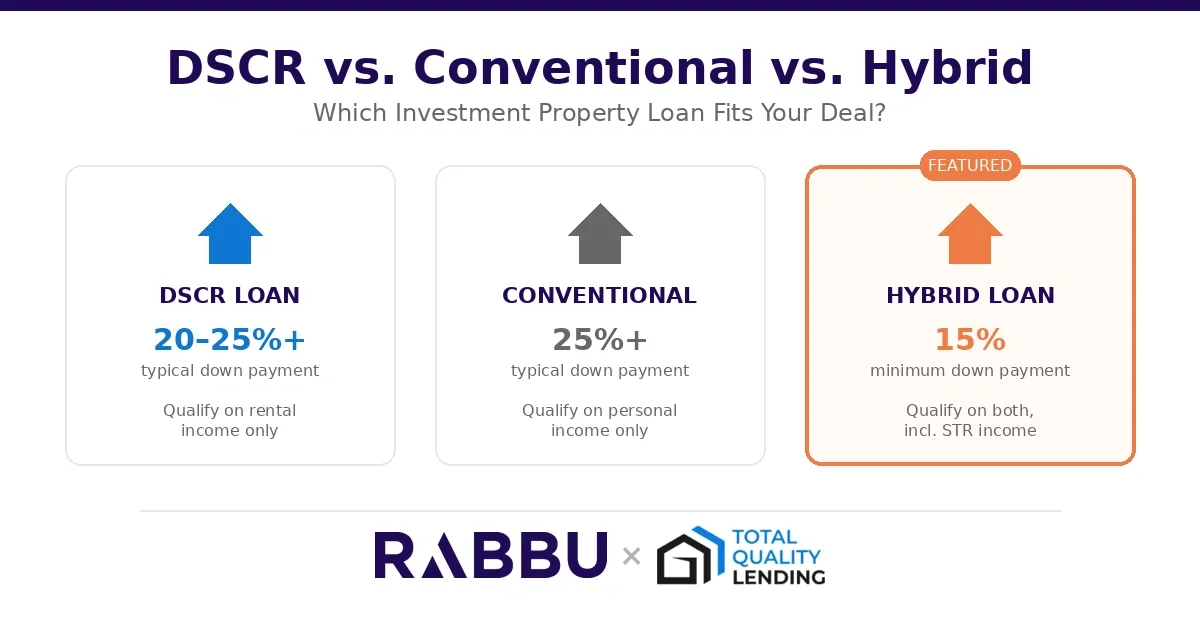
Traditional investment property mortgages through banks or credit unions typically require 20-25% down, two years of tax returns, proof of stable employment, and debt-to-income ratios under 43%. Interest rates run 0.5-1% higher than primary residence loans, currently ranging from 7-8% depending on credit score and market conditions.
These loans work well if you're a W-2 employee with strong documented income buying your first investment property. They become increasingly difficult as you scale beyond 4-5 properties.
DSCR Loan
Debt Service Coverage Ratio loans qualify based on the property's income potential rather than your personal finances. The lender calculates whether projected rental income covers the mortgage payment plus taxes, insurance, and HOA fees.
A DSCR of 1.0 means the property's income exactly covers its debt obligations, while 1.25 means income exceeds debt by 25%. Most lenders require 1.0-1.25 minimum DSCR, with better rates available at 1.35 or higher.
DSCR loans typically require 15-25% down payment with interest rates from 6.75-8.5% depending on DSCR ratio and property type. No income documentation is needed—no tax returns, W-2s, or employment verification. Closing timelines run 15-30 days with no arbitrary caps on portfolio size.
HELOC or Cash-Out Refi
Using existing home equity to fund Airbnb purchases gives you access to capital at lower interest rates than investment property loans. A Home Equity Line of Credit (HELOC) on your primary residence might offer 7-8% rates with interest-only payment options during the draw period.
Cash-out refinancing lets you tap equity from existing investment properties to fund new purchases. This strategy works well for portfolio growth but increases leverage and risk across your holdings.
Partnerships and Creative Financing
Investor partnerships split both capital requirements and returns—you might contribute expertise and management while a partner provides funding. Seller financing arrangements where the property owner carries the note can offer flexible terms, though they're rare in competitive markets.
House hacking strategies like buying a duplex, living in one unit, and renting the other as an STR can help you qualify for owner-occupied financing rates while building your investment portfolio.
Don't Let Financing Kill Your Deal
Most banks don't understand short-term rentals. These lenders do.
Find a LenderLine Up an STR-Savvy Team of Agents and Lenders
Working with professionals who understand short-term rental investing makes the difference between smooth transactions and costly mistakes. Traditional real estate agents focus on comparable sales prices without considering rental income potential, while STR-specialized agents evaluate properties based on cash flow, occupancy potential, and regulatory compliance.
Rabbu's network of STR-specific agents and lenders connects you with professionals who understand vacation rental underwriting.
Get Pre-Approved Before Putting In an Offer
If you need financing, secure pre-approval before making offers. Pre-approval demonstrates you're a serious buyer with verified financing capacity, making sellers more likely to accept your offer even when competing against cash buyers.
The pre-approval process takes 3-7 days and requires submitting financial documentation to your chosen lender. You'll receive a letter stating the maximum loan amount you qualify for, which strengthens your negotiating position and helps you move quickly when you find the right property.
Schedule Walkthroughs and Inspection
Visit properties in person whenever possible, viewing them through both an investor lens and a guest experience perspective. Look for deferred maintenance issues like roof condition, HVAC age, plumbing problems, and foundation concerns that affect your renovation budget.
Consider the guest experience: Is parking convenient? Does the layout flow well? Are bedrooms private enough for multiple couples? Properties that photograph beautifully but feel awkward in person often struggle with repeat bookings and positive reviews.
Make an Offer and Negotiate Like an Investor
Negotiation strategies for investment properties differ from traditional home buying because you're purchasing based on cash flow potential rather than emotional attachment. Your offer reflects the property's income-generating value, not just comparable sales prices.
Include Furnishings and Future Bookings
For turnkey Airbnb properties, negotiate for existing furniture, décor, and supplies to be included in the purchase price or offered at a reasonable separate price. Taking over existing bookings provides immediate cash flow and maintains the property's review momentum and calendar visibility.
Ask the seller to transfer confirmed reservations along with guest contact information. This allows you to honor existing bookings and avoid cancellation penalties that damage your new listing's ranking.
Use Contingencies for STR Approval
Include contingencies that allow you to back out if you can't obtain necessary permits and licenses before closing. This protection is critical in markets with uncertain or restrictive STR regulations where approval isn't guaranteed.
Your purchase agreement might state: "This offer is contingent upon buyer obtaining all required short-term rental permits and approvals within 30 days of acceptance." This clause protects your earnest money if the city denies your application.
Leverage Closing Credits
Negotiate seller credits for repairs, improvements, or initial operating expenses rather than just focusing on purchase price reductions. A $10,000 credit for furnishings or renovations can be more valuable than a $10,000 price reduction since it helps cover startup costs without increasing your loan amount.
Avoid These First-Time Host Mistakes
Common pitfalls that new Airbnb investors encounter can significantly impact profitability and long-term success. Learning from others' mistakes costs less than making them yourself.
Overestimating Occupancy
Most markets average 50-70% annual occupancy, not the 90%+ that optimistic projections sometimes assume. Your first year will likely perform below market averages while you build reviews and optimize your listing.
Budget conservatively using 50-60% occupancy for your first 12 months, then adjust projections based on actual performance. Properties that break even at 45-50% occupancy give you comfortable margin for error during slow periods or market downturns.
Ignoring Reviews and Regulations
Guest satisfaction directly impacts your visibility in search results and your ability to command premium pricing. Airbnb's algorithm heavily weights recent reviews, response rates, and booking acceptance rates when determining search ranking.
Staying compliant with changing local laws protects your investment from fines, forced closures, or legal action. Join local STR host groups, monitor city council meetings, and maintain relationships with neighbors to stay informed about regulatory changes.
Skimping on Cleaning Quality
Cleaning standards directly impact reviews, bookings, and long-term success more than almost any other operational factor. Guests forgive minor décor choices but never forgive dirty bathrooms, stained linens, or dusty surfaces.
Pay professional cleaners well at $80-$150 per turnover and maintain detailed cleaning checklists covering every surface, appliance, and amenity. Budget 15-20% of gross revenue for cleaning costs—trying to save money here almost always backfires through negative reviews and decreased bookings.
Start Earning Cash Flow With Confidence
You now have a complete roadmap for buying your first Airbnb investment property—from market selection and property evaluation through financing and ongoing management. The difference between investors who succeed and those who struggle often comes down to using data-driven tools and working with specialized professionals who understand the short-term rental business.
Browse our marketplace to find profitable Airbnb investments that cash flow, backed by real performance data and connected to STR-specialized agents and lenders who can help you close your first deal in 30-60 days.
Find the Right Airbnb Investment Property
Search exclusive listings for both turnkey and potential Airbnb properties in one place.
Explore Airbnbs for SaleFAQs About Buying Your First Airbnb
How much cash reserve should I keep for an Airbnb property?
Most successful hosts maintain three to six months of operating expenses in reserve to cover vacancies, repairs, and seasonal fluctuations. This typically ranges from $5,000-$20,000 depending on the property's monthly expenses and your risk tolerance.
Can I buy an Airbnb property in an LLC?
Yes, many investors purchase STR properties through LLCs for liability protection and tax benefits. However, financing options may be more limited and expensive compared to personal ownership since most lenders charge 0.5-1% higher rates for LLC-owned properties.
What insurance coverage does an Airbnb property need?
Standard homeowner's insurance typically doesn't cover short-term rentals, so you'll need specialized STR insurance or commercial coverage. Airbnb provides host protection up to $1 million, but it has significant limitations and exclusions that make dedicated STR insurance essential.
How do I reduce vacancy during slow seasons?
Successful hosts adjust pricing by lowering rates 20-40% during off-peak periods, target different guest segments like business travelers or remote workers, and consider monthly rentals during traditionally slow periods. Some hosts also use the property personally or for long-term tenants temporarily to maintain cash flow.
The Best STR Deals Never Hit Zillow
Browse exclusive listings for turnkey Airbnbs with actual income data.
Search Exclusive Listings