Traditional real estate platforms show you bedroom counts and square footage, but they can't tell you whether a $450,000 property will generate $65,000 annually as an Airbnb or barely break even. Finding furnished short-term rental properties that actually deliver strong returns requires specialized marketplaces, verified income data, and STR-focused professionals who understand vacation rental economics—not just residential real estate.
This guide walks you through the complete process of identifying high-performing STR markets, analyzing turnkey properties versus conversion opportunities, calculating accurate revenue projections, navigating legal requirements, and securing specialized financing that qualifies you based on property income rather than personal tax returns.
Define Furnished Short-Term Rental Properties
Furnished short-term rental properties are investment homes equipped with furniture, kitchenware, linens, and amenities ready for guest bookings on platforms like Airbnb and Vrbo. The best platforms to find these properties include specialized short-term rental marketplaces like Rabbu, general real estate sites with STR filters like Redfin and Zillow, and working with agents who specialize in short-term rental investments. You're essentially buying a turnkey business rather than just real estate.
The distinction matters more than you might think. While long-term rentals generate predictable monthly income from single tenants, furnished STRs accommodate rotating guests at premium nightly rates—often earning 2-3x more monthly revenue than comparable unfurnished properties.
Key Differences From Unfurnished or Long-Term Rentals
Furnished STR properties operate as hospitality businesses rather than passive real estate holdings. You'll manage bookings through platforms like Airbnb, coordinate cleanings after each guest departure, and respond to guest inquiries often within hours. The revenue upside compensates for this increased involvement—Rabbu's market data shows top-performing STRs in markets like Scottsdale and Nashville generate $75,000-$150,000 annually compared to $24,000-$36,000 for comparable long-term rentals.
The guest demographic differs dramatically too. STR guests expect hotel-like experiences with fully stocked kitchens, quality mattresses, streaming entertainment, and thoughtful design. Long-term tenants tolerate basic furnishings and minimal amenities since they're building a home.
Minimum Furniture and Amenity Standards for Airbnb
Successful short-term rental properties include essential elements that guests expect and that directly impact your booking rates and occupancy:
-
Quality mattresses and bedding: Comfortable sleep drives 5-star reviews. Budget $800-1,200 per bedroom for mattresses and $200-300 for hotel-quality sheets, comforters, and pillows.
-
Fully equipped kitchen: Guests booking STRs want cooking capability. Include cookware, bakeware, utensils, dinnerware for guest count plus two, coffee maker, toaster, and basic spices.
-
Reliable high-speed WiFi: Rabbu's data shows properties advertising 100+ Mbps speeds command 8-12% higher nightly rates.
-
Smart TV with streaming: Provide a smart TV with Netflix, Hulu, and streaming capability so guests use their own accounts.
-
In-unit laundry: Properties with washers and dryers increase booking conversion by 15-20% according to Airbnb's data, particularly for stays longer than 3 nights.
The total furniture and setup cost for a 3-bedroom STR typically ranges $12,000-$25,000 depending on quality tier. This upfront investment pays back through higher nightly rates and better reviews that drive long-term occupancy.
Find the Right Airbnb Investment Property
Search exclusive listings for both turnkey and potential Airbnb properties in one place.
Explore Airbnbs for SaleThe Old Way vs. The New Way of Finding Short-Term Rental Properties
Traditional real estate platforms weren't designed for investment property analysis, especially short-term rentals. Zillow, Redfin, and Realtor.com focus on helping families find homes to live in—not helping investors identify cash-flowing assets.
The old process looked like this: search Zillow for properties in vacation markets, manually research each address to estimate STR income potential, call local property managers for occupancy data, hire appraisers for rental income projections, consult zoning departments about STR legality, and repeat this 40-hour research process for every single property. By the time you finished analyzing one home, three other investors already made offers.
Why Traditional Real Estate Portals Fall Short for Airbnb Investors
Zillow and Redfin show you bedroom counts, square footage, and recent comparable sales—but nothing about income potential. A 3-bedroom home listed at $450,000 might generate $65,000 annually as an Airbnb in one neighborhood but only $28,000 in another neighborhood three miles away. Traditional platforms can't tell you this difference because they don't integrate STR market data.
Even when you find the "Short Term Rental" filter on Redfin or Zillow's "Fully Furnished" tag, you're seeing properties the current owner claims are suitable for STR use—not verified income data or regulatory compliance. Many listings tagged "short term rental" aren't legally permitted for STR operation, while high-potential homes sit untagged because the seller didn't think to add that label.
The agents connected to listings on traditional platforms typically specialize in residential sales, not investment properties. They can't answer questions about cap rates, DSCR qualifications, or which property management companies deliver the best occupancy rates.
The Rabbu Advantage: Integrated Short-Term Rental Investment Platform
Rabbu's marketplace consolidates every step of short-term rental investing into one platform designed specifically for vacation rental investors. Instead of bouncing between Zillow for listings, AirDNA for market data, spreadsheets for financial analysis, and Google for agent referrals, you access everything in one place.
Every property listing on Rabbu includes actual historical financials or income projections based on actual Airbnb data in that specific neighborhood. You'll see estimated annual revenue, occupancy rates, average daily rates, and gross yield calculations before you ever contact an agent. The platform pulls real data from active Airbnbs nearby, filters for top performers, and generates conservative projections you can trust when underwriting deals.
Rabbu also connects you exclusively with STR-specialized real estate agents who understand vacation rental markets, local regulations, and investment-focused negotiations. The entire ecosystem—data, listings, agents, and financing—works together instead of requiring you to coordinate disconnected services.
The Best STR Deals Never Hit Zillow
Browse exclusive listings for turnkey Airbnbs with actual income data.
Search Exclusive ListingsStep 1: Identify the Best Short-Term Rental Markets Using Data
Finding individual properties before identifying strong markets puts the cart before the horse. The same 3-bedroom home that generates $85,000 annually in Gatlinburg might earn only $32,000 in a different Tennessee market with weaker tourism demand. Market selection drives 60-70% of your investment returns, while individual property selection within that market accounts for the remaining 30-40%.
Smart investors start by analyzing market-level metrics: average occupancy rates, typical daily rates, regulatory environment, seasonality patterns, and supply-demand dynamics. This data-driven approach eliminates emotional decision-making like buying where you vacation or investing only in your home state.
Using Rabbu's Market Finder Tool
Rabbu's Market Finder tool ranks over 500 U.S. markets by STR investment performance, showing you exactly where top investors are deploying capital. Navigate to the Market Finder, sort by "ROI Score" to see the highest-performing markets at the top, and filter for markets with 20+ active Airbnbs to ensure adequate comparable data and guest demand.
Click into any market to see detailed performance metrics: median gross yield, average occupancy rates by month, typical nightly rates by bedroom count, and seasonality charts showing revenue distribution across the year.
Compare 3-5 markets that fit your budget and risk tolerance. A market showing 12% gross yields with 68% occupancy and minimal regulations typically outperforms a 7% gross yield market with 55% occupancy and complex permitting requirements—even if the second market feels more familiar.
Key Market Metrics That Predict STR Success
Gross yield measures annual STR revenue as a percentage of purchase price. Markets showing 10%+ gross yields for typical properties indicate strong cash flow potential. Calculate this as (Annual Revenue ÷ Purchase Price) × 100.
Occupancy rate reveals demand consistency. Markets maintaining 60%+ annual occupancy demonstrate reliable guest demand beyond peak seasons. Anything below 50% suggests oversupply or weak tourism infrastructure. Top hosts typically achieve 15-20 percentage points higher occupancy than market averages through superior listings and dynamic pricing.
Average daily rate (ADR) indicates what guests pay per night in a market. Higher ADRs mean you generate more revenue from fewer bookings, reducing cleaning costs and turnover wear. Markets with $200+ ADRs for 3-bedroom homes typically deliver better returns than $120 ADR markets, even with slightly lower occupancy.
Seasonality shows revenue concentration across months. Year-round markets like Orlando or Phoenix generate consistent income monthly, while seasonal markets like Cape Cod or Lake Tahoe see 60-80% of annual revenue in 3-4 peak months. Seasonal markets often show higher gross yields but require cash reserves for low-season expenses.
Step 2: Browse High-Performing Airbnb Listings in Rabbu's Marketplace
Once you've identified target markets, shift to property-level analysis. Rabbu's marketplace features two distinct property types: turnkey Airbnbs already operating as STRs with proven income history, and conversion opportunities—traditional homes with strong STR potential based on location and comparable performance.
The strategic decision between property types depends on your experience level, available capital, and timeline to cash flow. Turnkey properties command premium prices but eliminate ramp-up time and income uncertainty. Conversion properties offer lower entry costs and forced appreciation potential but require furnishing, setup, and 2-4 months before generating meaningful revenue.
Turnkey Airbnb Properties: Immediate Cash Flow Opportunities
Turnkey STR properties are existing Airbnb or Vrbo businesses being sold as operating entities. The seller transfers the furnished property, existing bookings, and sometimes the active listing itself.
The advantages are compelling for investors prioritizing immediate returns:
-
Day-one income generation: Forward bookings transfer with the property, so you're earning revenue immediately after closing.
-
Optimized furniture and décor: No need to spend weeks shopping for furnishings or guessing which amenities drive bookings.
-
Verified performance data: Historical booking history removes income uncertainty compared to projections.
-
Favorable lending terms: STR-specialized lenders view turnkey properties more favorably when you can show 12-24 months of actual booking history.
The tradeoff? Turnkey properties typically sell at 10-20% premiums compared to similar non-operating homes. Sellers price in the established income stream, existing reviews, and immediate cash flow.
Here’s how to find a turnkey Airbnb property for sale on Rabbu's marketplace:
-
Navigate to the Rabbu Marketplace
-
Select your chosen markets
-
If you’re looking for a turnkey Airbnb, then click All Filters → Tags → Active Airbnb.
-
Active Airbnb = verified Airbnb listings with actual performance history.
-
Actual Financials = actual historical financials inputted by the seller or listing agent
-
-
Set price filters (typically >$300K) based on market norms.
-
Sort by Gross Yield, and filter results to 5–30% yield range.
-
To stay updated, click Save Search → set up email alerts for new matching properties.
-
Note that you must have a Rabbu account to save a search (it’s free)
-
-
When you find a property you like, click Contact Agent to inquire
Important Note: Active Airbnb properties move fast — many transact within 48 hours. Contact agents immediately if something fits your criteria. Many of these are equivalent to “off market” properties—only listed on Rabbu’s marketplace and not found anywhere else.
STR Conversion Properties: Higher ROI Potential
Conversion properties are traditional homes that aren't currently operating as STRs but show strong income potential based on location and comparable performance. Properties sell at standard residential prices without STR premiums, creating opportunities for higher returns if you're willing to handle setup.
The advantages center on value creation and lower entry costs. You'll pay $400,000 for a home that might sell for $480,000 as a turnkey STR after you furnish it and establish booking history. This $80,000 gap represents forced appreciation you create through operational conversion.
The challenges are front-loaded. You'll spend $15,000-$30,000 furnishing the property, 3-6 weeks setting up utilities and internet, and 2-4 months building booking momentum and reviews before reaching stabilized occupancy.
Here’s how to find high-potential conversion properties for sale on Rabbu's marketplace:
-
Navigate to the Rabbu Marketplace
-
Select your chosen markets
-
If you’re looking for a property with STR potential, add tags for Airbnb Potential, Former Airbnb and Agent Pick.
-
Set price filters (typically >$300K) based on market norms.
-
Sort by Gross Yield, and filter results to 5–30% yield range.
-
If too few results:
-
Still low? Include Public Listings (less vetted, but higher volume).
-
-
To stay updated, click Save Search → set up email alerts for new matching properties.
-
Note that you must have a Rabbu account to save a search (it’s free)
-
-
When you find a property you like, click Contact Agent to inquire
How to Navigate Rabbu's Advanced Filters
Click "All Filters" on the marketplace search page to access granular filtering options. Set your price range based on available capital—remember to reserve 25% of your budget for down payment, closing costs, and furniture if buying a conversion property. You can set filters for bedroom count, bathroom count, and property type.
Sort results by "Gross Yield" to prioritize properties offering the highest revenue relative to purchase price. Properties showing 10%+ gross yields typically generate strong cash-on-cash returns after accounting for operating expenses and debt service.
Inquire Immediately if a Property Meets Your Revenue Threshold
High-performing turnkey properties are among the most sought-after investments in real estate. When you find a property showing verified income above your minimum threshold, contact the listing agent immediately through Rabbu's platform.
Multiple investors often compete for the same turnkey property, especially in top markets. Sellers favor buyers who demonstrate seriousness through pre-approval letters, quick response times, and willingness to accommodate seller timelines.
Find the Right Airbnb Investment Property
Search exclusive listings for both turnkey and potential Airbnb properties in one place.
Explore Airbnbs for SaleStep 3: Analyze Airbnb Revenue Potential with Rabbu's Calculator
Revenue projections separate profitable investments from money pits. A property might look attractive at $425,000 until you discover comparable STRs only generate $38,000 annually—producing a marginal 8.9% gross yield before expenses.
Manual revenue analysis requires identifying 8-12 comparable Airbnb listings, scraping their booking calendars, estimating occupancy rates, calculating average nightly rates, and projecting annual income. This process takes 3-5 hours per property and introduces significant estimation error. Rabbu's integrated calculator completes the same analysis in under 10 minutes with greater accuracy.
Using Rabbu's Airbnb Calculator for Income Projections
Navigate to Rabbu's Airbnb Calculator and enter the property address and bedroom count. The calculator automatically identifies comparable STR properties within a 1-3 mile radius and analyzes their performance.
Set comparison filters to find relevant comps:
-
Require 5+ reviews to ensure established listings
-
Filter for 4.9+ star ratings to model top-performer income
-
Match key amenities like pools or hot tubs that significantly impact rates
-
Aim for 5-10 comparable properties for accuracy
Review the comparable properties the calculator selected. Look at their photos to verify similar quality and appeal to your target property. If the comps include luxury estates when you're analyzing a modest cabin, adjust your filters to find more appropriate matches.
The calculator outputs estimated annual revenue, average daily rate, projected occupancy, and gross yield. It also breaks down monthly revenue patterns so you can see seasonal fluctuations and plan for low-season cash flow needs.
Understanding Top Performer vs. Average Returns
Rabbu's calculator includes a toggle between 75th percentile and 90th percentile projections. This distinction matters enormously—the difference between average and excellent hosting can mean $25,000-$40,000 additional annual revenue on the same property.
Top performers achieve superior results through professional photography, dynamic pricing software, instant guest communication, thoughtful amenities, and meticulous property maintenance. Operational excellence factors compound over time as 5-star reviews drive more bookings, which generate more reviews, creating a virtuous cycle of occupancy and rate premiums.
Model your projections using 75th-90th percentile performance if you're committed to professional hosting practices. Use average or median projections only if you plan passive management with minimal optimization.
Key Revenue Metrics Every STR Investor Must Know
Cap rate measures net operating income as a percentage of property value. Calculate it as (Annual Revenue - Operating Expenses) ÷ Purchase Price. A property generating $65,000 revenue with $28,000 in expenses produces $37,000 NOI. Divided by a $425,000 purchase price, that's an 8.7% cap rate.
Cash-on-cash return measures annual cash flow against your actual invested capital. If you invest $120,000 total and generate $18,000 annual cash flow after all expenses and mortgage payments, that's a 15% cash-on-cash return. This metric matters more than cap rate for leveraged investors since it reflects your actual dollar returns.
Gross yield is the simplest metric: Annual Revenue ÷ Purchase Price. A $450,000 property generating $54,000 annually shows 12% gross yield. While this ignores expenses, it's useful for rapid initial screening.
Average daily rate (ADR) shows what you earn per booked night. Calculate it as Total Revenue ÷ Nights Booked. Higher ADRs mean you generate target revenue with fewer bookings, reducing cleaning costs and property wear.
Step 4: Calculate STR Investment Returns with Integrated Tools
Revenue projections are only half the equation—you need to model expenses, mortgage payments, and cash flow to determine actual returns. Rabbu's Investor Return Calculator eliminates spreadsheet underwriting by integrating income projections with expense modeling and financing scenarios.
Rabbu's Investor Return Calculator Walkthrough
Rabbu’s Investor Return Calculator can be found on the property card for any active listing in the Airbnb marketplace and is also available for any property (even if not listed on the marketplace) through Rabbu’s free Calculator. After generating income projections in the Airbnb Calculator, scroll down to the Investor Return Calculator. Enter your expected purchase price and down payment percentage (typically 15-25% for STR financing).
Add expected expenses:
-
Mortgage payment based on current DSCR loan rates (typically 7-8.5%)
-
Property taxes from the listing details
-
Insurance (budget 2-3x standard homeowner's insurance for STR coverage)
-
HOA fees if applicable
-
Property management (typically 20-25% of revenue)
-
Reserves for maintenance and capital expenditures (budget 10-15% of revenue)
Click "Calculate" to see your projected cap rate, cash-on-cash return, and monthly cash flow. The calculator shows both stabilized year-one returns and projected five-year returns accounting for appreciation and debt paydown.
Comparing Properties Apples-to-Apples
The standardized calculation methodology lets you compare properties across different markets and price points objectively. A $350,000 property in Tennessee and a $625,000 property in Colorado might both show 14% cash-on-cash returns despite dramatically different prices and revenue levels.
Create a comparison spreadsheet with your top 3-5 properties, listing their cash-on-cash returns, cap rates, and total cash investment required. This side-by-side view reveals which opportunities offer the best risk-adjusted returns for your capital.
Step 5: Analyze Short-Term Rental Market Trends and Seasonality
Individual property analysis tells you what one home might earn. Market-level trend analysis tells you whether that performance is sustainable, improving, or deteriorating. A property showing $72,000 annual revenue looks attractive until you discover the market's average revenue declined 15% over the past two years due to oversupply or weakening tourism demand.
Rabbu's Market Data platform shows multi-year trends in occupancy, daily rates, and revenue for every major STR market. This historical context helps you distinguish between temporary market fluctuations and structural changes that impact long-term returns.
Understanding Seasonal Revenue Patterns
Click into your target market's data page to see monthly revenue distribution. Markets like Phoenix or Orlando show relatively flat revenue across months—perhaps 15-20% variation between peak and low seasons. Seasonal markets like Cape Cod or Park City might generate 70% of annual revenue in just 4-5 months.
Year-round markets provide more predictable cash flow and easier financing since lenders see consistent income. Seasonal markets often show higher gross yields but require larger cash reserves to cover 6-8 months of minimal revenue while still paying mortgages, insurance, and utilities.
Neither pattern is inherently superior—your choice depends on cash flow needs and risk tolerance. Seasonal markets work well for investors with other income sources or multiple properties that balance each other's seasonality.
Bedroom Mix and Amenity Impact Analysis
Rabbu's market data breaks down performance by bedroom count, showing you which unit sizes generate the best returns. Some markets favor 2-bedroom condos with high occupancy and modest nightly rates. Others reward 4-5 bedroom homes that command premium rates from family groups despite lower occupancy.
The data also quantifies amenity impact. In Phoenix, properties with pools earn 35-40% higher nightly rates than comparable homes without pools. In mountain markets, hot tubs drive similar premiums.
Legal and Zoning Checks Before You Write an Offer
The fastest way to destroy an STR investment is buying a property you can't legally operate as a short-term rental. Cities like New York, San Francisco, and Santa Monica have effectively banned most STR activity through restrictive regulations. Even STR-friendly markets often have zoning restrictions, occupancy caps, or licensing requirements you'll need to navigate.
Due diligence on regulatory compliance happens before you write an offer, not during your inspection period. Once you're under contract, discovering STR prohibitions leaves you choosing between backing out or proceeding with a property that can't generate projected returns.
City and County STR Regulations
Start with your target city's official website, searching for "short-term rental ordinance" or "vacation rental regulations." Look for common restrictions like licensing requirements and application processes, occupancy limits based on bedrooms or square footage, minimum stay requirements, owner-occupancy mandates, parking requirements, and safety and inspection requirements.
Contact the city's planning or code enforcement department directly to verify the specific property address can operate as an STR. Some cities have grandfathered properties or zone-specific allowances that aren't obvious from reading general ordinances.
Working with STR-specialized agents through Rabbu's network gives you professionals who already understand local regulations and can quickly verify compliance.
HOA and Condo Association Rules
Homeowners associations and condo boards can prohibit short-term rentals even in cities where STRs are legal. Request the CC&Rs (Covenants, Conditions, and Restrictions) and bylaws from the seller or listing agent before making an offer.
Search the documents for terms like "short-term," "vacation rental," "transient," and "minimum lease term." Some HOAs explicitly ban rentals under 30 or 90 days. Others prohibit "commercial use" or "hotel-like operations" in language that could apply to STRs even without explicitly mentioning them.
If the documents are ambiguous, request written confirmation from the HOA board that STR operation is permitted. Some boards tolerate existing STRs but might enforce restrictions if challenged by neighboring owners.
Licensing and Tax Registration Requirements
Most STR-friendly jurisdictions require business licenses, occupancy tax registration, and sometimes special STR permits. Budget 4-8 weeks for application processing in your timeline to revenue generation.
Required documentation typically includes business license application and fees ($50-$500 depending on jurisdiction), proof of property ownership or lease agreement, certificate of insurance showing STR liability coverage, safety inspection certificates, occupancy tax registration with state and local revenue departments, and parking plan documentation if required.
Your STR-specialized agent can provide a jurisdiction-specific checklist of required licenses and connect you with local professionals who handle permitting if you prefer delegating this process.
Step 6: Connect with STR-Specialized Professionals
The difference between working with STR-specialized professionals versus traditional residential agents and lenders often determines whether your investment succeeds or fails. Traditional real estate professionals are credentialed and competent—they're just optimized for helping families buy homes to live in, not investors building cash-flowing portfolios.
STR-specialized professionals speak your language, understand your metrics, and have networks of complementary service providers who accelerate your path from property identification to stabilized cash flow.
Why STR-Specialized Agents Are Essential
STR-focused agents bring expertise traditional residential agents can't match:
-
Regulatory knowledge: They understand local STR regulations and can quickly verify whether a property can legally operate as a vacation rental.
-
Income-based analysis: They analyze properties based on income potential and cap rates rather than just comparable sales and emotional appeal.
-
Off-market access: They have exclusive access to turnkey STRs being sold privately before hitting public listings.
-
Investment-focused negotiations: They'll push sellers to include furniture and décor in the sale price and negotiate based on income multiples rather than just comparable sales.
Perhaps most importantly, STR-specialized agents structure contingencies around licensing approval and income verification rather than standard residential contract terms.
Finding Vetted STR Agents Through Rabbu
Rabbu's Find an Agent tool connects you with pre-vetted STR specialists in your target market. Enter the city or county where you're investing, and the platform matches you with 2-3 agents who specialize in vacation rental properties in that area.
Every agent in Rabbu's network has been evaluated for STR market expertise, verified track record of closed STR transactions, understanding of DSCR and alternative financing options, and connections to local property managers and service providers.
The matched agents work under standard fiduciary duty, representing your interests in negotiations and property selection. Initial consultations are free, and you're not obligated to work with any agent until you sign a buyer representation agreement.
Work With an Agent Who Understands Airbnb Investing
Get connected with an agent who knows STR regulations, revenue comps, and how to negotiate competitive offers.
Find an STR AgentStep 7: Get STR-Friendly Financing
Traditional mortgage lenders create unnecessary obstacles for STR investors by ignoring or heavily discounting vacation rental income potential. A property generating $6,000 monthly from Airbnb bookings might only qualify you for financing based on $1,800 in assumed long-term rental income—or the lender might ignore the STR income entirely.
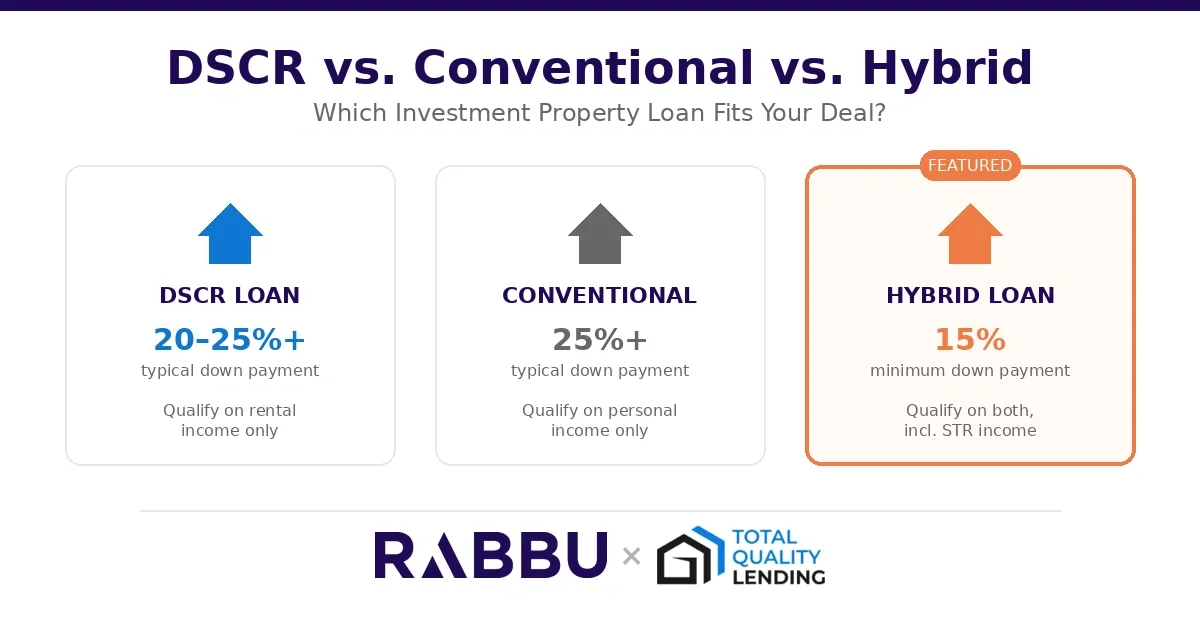
STR-specialized lenders solve this problem by qualifying you based on the property's actual income potential rather than your personal tax returns. This fundamental difference means you can acquire properties faster, qualify for higher loan amounts, and scale your portfolio without hitting arbitrary property count limits.
Using Rabbu's Find a Lender Tool
Navigate to Rabbu's Find a Lender platform and enter your target property location. Select your preferred loan type, expected purchase price range, and timeline to close.
Within 24-48 hours, you'll receive preliminary loan program details including estimated rates, down payment requirements, closing timelines, and qualification criteria. You can compare offers side-by-side to identify the best combination of rate, terms, and speed for your specific deal.
DSCR Loan Advantages for STR Investors
DSCR (Debt Service Coverage Ratio) loans qualify you based on your property's income potential rather than your personal W-2 earnings or tax returns. The lender calculates projected rental income, divides it by total monthly debt obligations (mortgage, taxes, insurance, HOA), and approves the loan if that ratio exceeds 1.0-1.25 depending on the program.
This qualification method offers enormous advantages:
-
Property-based qualification: You'll qualify based on the property's $5,500 monthly Airbnb income potential rather than needing to show equivalent personal income on tax returns.
-
Self-employed friendly: Self-employed investors who minimize taxable income through legitimate business deductions can qualify easily since the lender ignores personal finances entirely.
-
Unlimited scaling: You can finance your 15th, 20th, or 30th property as easily as your first, as long as each individual property's income covers its debt service.
-
Faster closing: Minimal documentation and streamlined underwriting means you close deals in 15-30 days.
The tradeoff? DSCR loans typically carry interest rates 0.5-1.5% higher than conventional mortgages and require 15-25% down payments. However, the faster closing timelines, easier qualification, and portfolio scalability more than compensate for slightly higher rates.
Alternative Financing Strategies
Beyond DSCR loans, consider alternative financing approaches for different situations. Seller financing works when motivated sellers prefer steady income over lump-sum proceeds. You'll negotiate interest rate, down payment, and term directly with the seller, often getting more flexible terms than institutional lenders offer.
Partnerships let you combine capital with complementary skills. You might provide 70% of the down payment while your partner contributes 30% plus property management expertise. Structure arrangements with clear operating agreements defining profit splits, decision authority, and exit strategies.
1031 exchanges allow you to sell existing investment properties and reinvest proceeds into new STRs without paying capital gains taxes. This strategy works well for investors holding appreciated long-term rentals who want to transition into higher-returning STR investments.
Find a Lender that Specializes in Short-Term Rentals
Connect with lenders who actually understand short-term rental cash flow and offer DSCR loans, portfolio financing, and investor-friendly terms.
Get Matched with STR LendersValuing Furniture, Reviews, and Future Bookings
Turnkey STR purchases include assets beyond just real estate—furniture packages, existing guest reviews, and forward reservations all carry value that affects your purchase price and negotiation strategy.
Pricing Furnishings and Décor Packages
Furniture and décor in turnkey properties typically represent $12,000-$30,000 in value depending on property size and quality tier. However, used furniture depreciates significantly—that $25,000 furniture package the seller bought two years ago might only be worth $15,000-$18,000 today.
Evaluate furniture value by comparing replacement cost with 30-50% depreciation depending on age and condition. Request itemized furniture lists from sellers showing original purchase prices and dates. This documentation helps you calculate fair value and provides tax basis information for depreciation schedules.
Monetizing In-Place Guest Reviews
Guest reviews represent significant value that's often overlooked in purchase negotiations. A property with 150+ reviews averaging 4.85 stars will generate 30-50% more bookings in its first year under new ownership compared to starting from zero reviews.
Reviews drive booking velocity through Airbnb and Vrbo's search algorithms, which prioritize listings with strong review histories. They also provide social proof that converts browsers into bookers—guests feel more confident booking properties with extensive positive feedback versus unproven listings.
Some platforms allow review transfer when properties sell, maintaining the listing's history under new ownership. Even when direct transfer isn't possible, you can reference the property's previous performance in your listing description.
Accounting for Forward Reservations
Turnkey properties often include forward bookings—confirmed reservations extending weeks or months into the future. Bookings transfer to you at closing, providing immediate cash flow. However, you'll want to review the booking calendar during due diligence to understand near-term revenue and guest commitments you're inheriting.
Due Diligence Checklist for Short-Term Rental Investors
Comprehensive inspection processes for STR purchases ensure nothing gets overlooked before closing. Follow this systematic approach to verify every aspect of your investment.
Verify Zoning and Licensing
Confirm legal operation status with local authorities. Request copies of current STR licenses, permits, and approvals from the seller. Contact the city planning department to verify the property address is zoned for short-term rental use and confirm no pending regulatory changes that might restrict operations.
Inspect Physical Condition and Furnishings
Schedule a professional inspection plus furniture and appliance assessment. Create a checklist for systematic review: test all appliances, check HVAC systems, inspect plumbing and electrical, evaluate furniture condition, verify outdoor equipment functionality, and document any deferred maintenance.
Review Financial Statements and Platform Metrics
Analyze booking platform data, expenses, and profit margins. Request access to the seller's Airbnb or Vrbo host dashboard to verify reported occupancy and revenue. Review 12-24 months of financial statements including all expenses. Calculate actual net operating income and compare to seller's representations.
Confirm Insurance and Safety Compliance
Verify proper STR insurance coverage and safety equipment. Request proof of current STR-specific insurance policy. Inspect fire extinguishers, smoke detectors, carbon monoxide detectors, first aid kits, and emergency lighting. Confirm compliance with local safety inspection requirements.
Red Flags and Scam Avoidance Tips
Protect yourself from common fraudulent schemes by recognizing warning signs during your property search and due diligence.
Inflated Revenue Screenshots
Verify income claims through independent sources rather than trusting seller-provided screenshots. Request direct access to booking platform dashboards instead of accepting PDF reports. Cross-reference reported revenue with market data from Rabbu's platform. Be wary of sellers who resist providing transparent access to financial data.
Unpermitted Renovations or Layouts
Identify illegal modifications that affect STR operations. Look for unpermitted additions, converted garages listed as bedrooms, or non-conforming unit configurations. Request building permits for any recent renovations. Non-permitted work can trigger code enforcement issues and jeopardize your STR license.
Sellers Refusing Access to Channel Manager Data
Transparent data access is essential for verifying performance claims. Legitimate sellers provide full access to booking calendars, review history, and financial dashboards. Sellers who offer only summary reports or screenshots may be hiding occupancy gaps, cancellations, or negative reviews.
Take Action: Your Next Steps to STR Investment Success
Start your search on Rabbu's marketplace today to browse exclusive listings with verified income data. Turnkey properties move quickly—often receiving multiple offers within 48 hours—so set up saved searches and email alerts for your target markets.
Work with an STR Investment Concierge through STR Search partnership if you prefer a done-for-you option. This premium service handles property identification, due diligence coordination, and transaction management for hands-off investors.
Build your STR investment team using Rabbu's partner ecosystem: agents, lenders, insurance specialists, and cost segregation experts. The right professional network accelerates your path from property identification to stabilized cash flow.
The Best STR Deals Never Hit Zillow
Browse exclusive listings for turnkey Airbnbs with actual income data.
Search Exclusive ListingsFrequently Asked Questions About Buying Furnished Short-Term Rentals
What insurance policy type do I need for a furnished short-term rental property?
Short-term rental insurance differs from standard homeowner's or landlord policies because it covers commercial use and guest liability. Contact STR-specialized insurance providers through Rabbu's partner network for proper coverage that includes furnishings and business interruption.
How do I transfer existing Airbnb or Vrbo listings to my new account after purchase?
Listing transfers require coordination with the platform and seller to maintain reviews and booking history. Most platforms allow ownership transfers through their host tools, but you'll need seller cooperation to complete the process. We’ve written an article that explains how to transfer an Airbnb account step-by-step.
Can I write off the cost of purchased furniture when buying a furnished short-term rental?
Furniture and furnishings can be depreciated as business assets over their useful life, typically five to seven years. Consult a tax professional familiar with STR investments to maximize deductions and ensure proper classification.
How quickly do good STR investment properties sell?
Active Airbnb properties on Rabbu's marketplace typically transact within 48-72 hours due to their verified performance data and exclusive nature. Set up saved searches with email alerts and contact agents immediately when properties match your criteria.
What's the difference between Rabbu's marketplace and traditional real estate sites?
Unlike Zillow or Redfin which focus on owner-occupied housing, Rabbu specializes exclusively in STR investments. We provide verified income data, STR-specific market analysis, integrated calculators, and connections to STR-specialized professionals—all in one platform.
Don't Let Financing Kill Your Deal
Most banks don't understand short-term rentals. These lenders do.
Find a Lender