
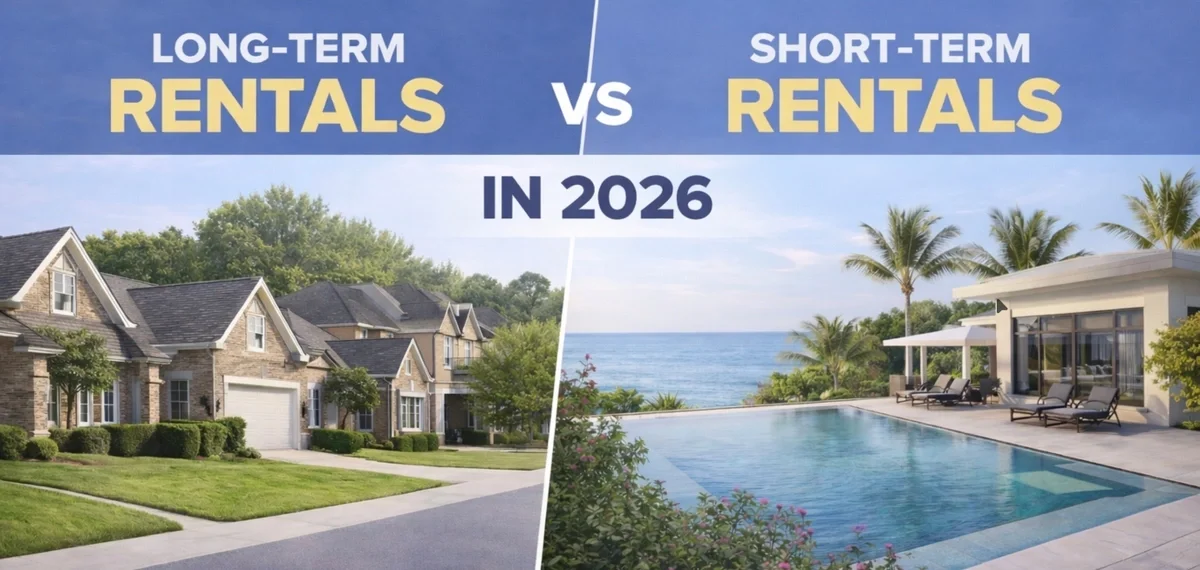
In 2026, the question isn’t just whether to invest in real estate.
It’s whether short-term rentals or long-term rentals actually make sense in today’s market.
With interest rates still elevated, many traditional rental properties no longer cash flow the way they used to.
At the same time, short-term rentals offer more upside but come with more complexity.
So the real question is:
Which strategy actually pencils in 2026?
This guide breaks down the real differences between STRs and LTRs, including ROI, tax advantages, and how interest rates are changing the math for investors.
Why 2026 Is a Different Investing Environment
- Interest rates remain elevated (6–7%)
- Monthly payments are significantly higher than pre-2022 levels
- Margins are tighter across most real estate deals
This has created a key shift:
👉 Long-term rentals are more sensitive to interest rates
👉 Short-term rentals are more sensitive to execution
Because LTR income is fixed, rising debt costs can quickly eliminate cash flow.
STRs, on the other hand, allow investors to adjust pricing and optimize revenue
Long-Term Rentals in 2026
Long-term rentals can still work but the margin for error is thinner than most buyers expect.
Pros of Long-Term Rentals
-
Predictable income
Fixed leases create stable forecastable cash flow. -
Operational simplicity
Fewer decisions, lower turnover, and easier third party management. -
Regulatory clarity
Long-term rentals face far fewer zoning and compliance issues in most markets.
Cons of Long-Term Rentals in 2026
High interest rates make deals harder to pencil.
With interest rates still elevated, many long-term rental deals simply do not pencil at today’s prices. Cap rates have not expanded enough to offset financing costs especially in higher cost markets. What I keep seeing is deals that worked at 3% to 4% interest rates failing at 6% to 7%. Buyers often compensate by underwriting appreciation instead of cash flow.
Price points matter more than ever.
Long-term rentals tend to perform best at lower price points where rent to price ratios are stronger, financing pressure is lower, and tenant demand is deeper.
As price points increase, long-term rental margins often collapse unless the deal is acquired well below market. That is becoming increasingly rare.
Limited tax leverage
Long-term rentals still benefit from depreciation but the ability to materially offset income is more limited especially for high income buyers looking for near term tax efficiency.
How To Get Started with Long-Term Rentals
If you are actively evaluating long-term rental opportunities and want to see inventory that is already structured for that strategy you can explore listings at Roofstock where properties are typically underwritten specifically for long-term rental use.
Short-Term Rentals in 2026
Short-term rentals have not become easier, but for the right buyers they have become more strategically differentiated.
Pros of Short Term Rentals
Revenue flexibility in a high-rate environment.
Short-term rentals are not locked into twelve month pricing. Strong operators can adjust nightly rates, optimize minimum stays, and capitalize on seasonal demand.
That flexibility matters more when debt is expensive.
Better performance at higher price points
One of the clearest patterns I see is this:
- Long-term rentals tend to outperform at lower price points.
- Short-term rentals tend to outperform at higher price points.
Larger homes with more bedrooms, better layouts, and meaningful amenities such as views pools, hot tubs, and proximity often struggle as long-term rentals but can perform extremely well as short-term rentals when demand supports it.
Many buyers misclassify these as bad deals when they are really just misaligned strategies.
Bonus depreciation advantages.
Short-term rentals can often qualify for accelerated and bonus depreciation which can materially improve after tax returns, especially for buyers with significant active income.
In 2026 this remains one of the most under-appreciated advantages of properly structured short-term rental investments. This always depends on personal tax situation but is a powerful tool to leverage.
Cons of Short Term Rentals
-
Income variability
Monthly swings are normal and liquidity matters. -
Execution risk
Short-term rentals reward operational competence. Passive expectations usually disappoint. -
Regulatory exposure
Market selection is critical and ignoring regulation is no longer survivable.
What continues to surprise me is how often short-term rental underperformance traces back not to regulation but to overestimating execution capability.
How To Get Started with Short-Term Rentals
If you are exploring short term rentals and want to evaluate deals using real demand data revenue modeling and downside scenarios you can start by exploring opportunities at Rabbu.com where short term rental performance is stress tested before buyers commit.
The Biggest Misconception About STR vs LTR
Most people think:
- LTR = safe
- STR = risky
But in 2026, the real difference is:
👉 LTRs have pricing risk (interest rates determine success)
👉 STRs have execution risk (operations determine success)
This is a critical shift.
Why STR Tax Benefits Are So Powerful
Short-term rentals have a unique advantage when it comes to taxes.
With the right setup, investors can:
- use bonus depreciation
- accelerate depreciation through cost segregation
- potentially offset W2 or active income
This is often referred to as the short-term rental tax advantage.
For high-income earners, this can significantly increase after-tax returns.
👉 This is one of the biggest reasons many investors choose STRs over LTRs in 2026.
The Real Difference in 2026
The distinction I think buyers should focus on now is simple:
Long-term rentals primarily carry pricing risk.
Short-term rentals primarily carry execution risk.
Neither is inherently safer. They are just different.
The strongest buyers I see match strategy to price point, underwrite downside first, and account for financing reality instead of nostalgia.
Real Example: $500K STR vs LTR Investment
Let’s look at a simplified comparison:
Long-Term Rental
- Purchase Price: $500K
- Rent: $2,500/month
- Annual Revenue: $30,000
With today’s interest rates, total annual expenses often approach or exceed this number.
👉 Result: Minimal or negative cash flow
Short-Term Rental
- Same property optimized for STR
- Average nightly rate: $300
- Occupancy: 60%
- Annual Revenue: ~$65,000+
Even after higher expenses:
👉 Result: Significantly higher income potential
Key takeaway:
The same property can perform very differently depending on strategy.
Where to Find STR and LTR Deals
If you’re evaluating opportunities:
Short-Term Rentals
Explore STR-specific investment tools:
- Browse properties: https://rabbu.com/airbnbs-for-sale
- Analyze markets: https://rabbu.com/market_finder
- Estimate revenue: https://rabbu.com/airbnb-calculator
Long-Term Rentals
If you’re focused on traditional rentals:
- Explore listings on https://www.roofstock.com
So Which Is Better in 2026?
In 2026, the difference between STRs and LTRs isn’t about passive vs active.
It’s about what actually works in today’s environment.
- Elevated interest rates make LTRs harder to cash flow
- STRs offer higher upside and stronger tax advantages
- But they require better execution
Neither strategy is inherently better.
But one is more adaptable.
And right now, adaptability matters.