Most investors waste 3-6 months researching whether to convert a traditional property, piecing together income projections from unreliable sources while missing time-sensitive deals in competitive markets—only to find out there are marketplaces like Rabbu that allow you to buy existing Airbnbs with existing cashflow. The fundamental question isn't which strategy is "better"—it's which approach aligns with your capital position, timeline expectations, and operational capabilities.
This guide breaks down the real financial differences between buying turnkey Airbnb properties and starting from scratch, covering upfront costs, cash flow timelines, financing options, regulatory risks, and the operational complexity that most investors underestimate until they're managing their first property.
The Old Way vs The New Way: Why STR Investment Analysis Has Been Broken Until Now
Buying an existing Airbnb offers immediate cash flow with established bookings and verified income data, while converting a traditional property gives you control over design and potentially higher returns if you purchase below market value. The best choice depends on your capital availability, timeline expectations, and risk tolerance. Existing properties minimize startup uncertainty but command premium prices, whereas conversions require more upfront work but can deliver stronger long-term returns when executed properly.
The Fragmented Traditional Process
Until recently, evaluating whether to start an Airbnb from scratch meant piecing together information from a dozen disconnected sources. You'd browse Zillow for properties that weren't designed as rentals, manually research zoning regulations buried in municipal websites, and guess at revenue potential using incomplete data from platforms that charged $50-100 monthly for market insights. After weeks of research, you'd still face uncertainty about actual profitability because no single platform connected property listings with verified income data, STR-specific financing options, and regulatory compliance information.
On top of that, there was no dedicated marketplace to find and buy turnkey Airbnb properties. Even if you knew that was the route you wanted to take, where would you find an Airbnb for sale that was already operational with 12-24 months of income and booking history? There was no place to source these types of short-term rental properties until Rabbu opened its Airbnb marketplace.
The financing process added another layer of complexity. Traditional lenders either rejected STR investments outright or undervalued projected rental income by 50-70%, forcing you to qualify based solely on W-2 earnings that ignored your property's actual cash flow potential.
How Rabbu Eliminates the Complexity
Rabbu's integrated platform replaces this fragmented research process with a streamlined workflow that connects market identification, exclusive property listings (both turnkey & conversion potential), income projections, and specialized financing in one place. Instead of subscribing to multiple data platforms and hunting across generic real estate sites, you access Rabbu's Market Finder to identify top-performing STR markets based on occupancy rates, average daily rates, regulatory environment, and ROI potential.
The Rabbu marketplace features both active STR properties with verified historical income and prospective homes with data-backed revenue projections. You'll find exclusive listings not available on Zillow or Realtor.com, including “off-market” deals from sellers who specifically want STR-savvy buyers. Each property tagged with “Actual Financials” displays actual performance metrics so you can compare buying a turnkey operation against converting a traditional home using real numbers rather than optimistic assumptions.
The Best STR Deals Never Hit Zillow
Browse exclusive listings for turnkey Airbnbs with actual income data.
Search Exclusive ListingsCompare Cash Flow When You Buy an Existing Airbnb vs Start From Scratch
The core financial decision between buying an existing Airbnb and starting your own comes down to immediate cash flow versus long-term value creation. An active STR property generates revenue from day one because you inherit existing bookings, established reviews, and proven market demand that translates to predictable monthly income within weeks of closing. Converting a traditional property requires 2-4 months of setup time with zero revenue while you furnish, photograph, list, and build your review base to compete effectively in search rankings.
This immediate income advantage comes at a cost premium. Sellers of successful Airbnb businesses typically price properties 15-30% above comparable non-rental homes because they're selling both real estate and an operating business with demonstrated profitability.
Purchase Price and Furnishing Budget
Buying an existing Airbnb means paying for the property, the business, and all furnishings in one transaction. A $400,000 mountain cabin operating as a successful STR might sell for $460,000-$520,000 because the seller factors in their furniture investment, setup costs, and the intangible value of 50+ five-star reviews and Super Host status.
Converting a traditional home separates costs into distinct phases. That same $400,000 cabin purchased as a standard residential property requires an additional $20,000-$35,000 furnishing budget depending on your design choices and quality standards:
-
Furniture and bedding: Beds, sofas, dining tables, outdoor seating ($12,000-$20,000)
-
Kitchen supplies: Cookware, dishes, utensils, small appliances ($1,500-$3,000)
-
Linens and towels: Multiple sets for quick turnovers ($1,000-$2,000)
-
Technology and entertainment: Smart TVs, WiFi equipment, streaming devices ($800-$1,500)
-
Decor and amenities: Artwork, rugs, games, outdoor equipment ($2,000-$5,000)
-
Initial supplies: Cleaning products, toiletries, paper goods ($500-$1,000)
Rabbu's Investor Return Calculator factors setup costs into your ROI projections, showing exactly how the lower purchase price of a conversion property compares against the all-inclusive pricing of an existing STR once you account for furnishing expenses.
Revenue Ramp Up Timeline
Assuming the seller transfers their Airbnb account, a turnkey Airbnb generates income immediately because you inherit the seller's booking calendar, review history, and search ranking position. Properties with 30+ reviews and Super Host status appear prominently in search results from day one of your ownership. You might close on the property and receive $8,000-$12,000 in bookings during your first month as the new owner, assuming you maintain the listing's quality standards and pricing strategy.
Short-term rental conversion properties face a 60-120 day revenue ramp-up period while building credibility with Airbnb's algorithm and potential guests. Your first month typically generates 20-40% of potential revenue as early adopters book despite having zero reviews. Month two improves to 40-60% of potential as you accumulate 5-10 reviews. By month three or four, you'll reach 70-85% of optimal performance once you've crossed the 15-20 review threshold that signals trustworthiness to most travelers.
Net Operating Income and Cash On Cash Return
The revenue timing difference significantly impacts your first-year returns, even though long-term performance may equalize. Consider two identical mountain cabins in the same neighborhood, both capable of generating $75,000 annually at full performance:
Existing STR Scenario:
-
Purchase price: $480,000 (includes $30,000 business premium)
-
Down payment (25%): $120,000
-
First year revenue: $72,000 (immediate full performance)
-
Operating expenses: $28,800 (40% of revenue)
-
NOI: $43,200
-
Annual debt service: $28,800
-
Cash flow: $14,400
-
Cash-on-cash return: 12%
Conversion Scenario:
-
Purchase price: $400,000
-
Furnishing and setup: $28,000
-
Total investment: $428,000
-
Down payment (25%): $107,000
-
First year revenue: $52,500 (70% of potential due to ramp-up)
-
Operating expenses: $21,000 (40% of revenue)
-
NOI: $31,500
-
Annual debt service: $25,600
-
Cash flow: $5,900
-
Cash-on-cash return: 5.5%
Year one heavily favors the existing property despite the higher purchase price. However, by year two when both properties operate at full capacity, the conversion property's lower debt service creates superior returns at approximately 14.5% cash-on-cash versus 12% for the existing property, assuming both generate $75,000 annually.
Find the Right Airbnb Investment Property
Search exclusive listings for both turnkey and potential Airbnb properties in one place.
Explore Airbnbs for SalePros and Cons: Buying a Turnkey Airbnb vs Converting a Traditional Home
Benefits of Buying an Active STR Property
Purchasing an established Airbnb eliminates the guesswork that makes most new investors nervous about STR investing. You're buying verified performance data including actual booking history, real guest reviews, and proven revenue numbers that demonstrate market demand for that specific property. Rabbu's marketplace of active STR properties displays historical income data directly on listing pages (look for the “Actual Financials” tag), letting you evaluate investments based on facts rather than projections.
Financing becomes significantly easier when you can show lenders 12-24 months of actual STR income. DSCR lenders calculate your debt service coverage ratio using verified revenue, resulting in faster approvals and better terms than projections for unproven properties.
You also inherit operational systems that took the previous owner months to develop. Guest communication templates, cleaning schedules, vendor relationships, pricing strategies, and house manuals all transfer with the property.
Tradeoffs with Turnkey Airbnb Investments
The business premium you pay for an existing STR directly reduces your potential ROI compared to building that business yourself. A 20-30% premium on purchase price might translate to 2-4 percentage points lower cash-on-cash returns over the property's lifecycle, particularly if you're a capable operator who would have built an equally successful listing through your own efforts.
You're also inheriting the previous owner's design choices, which may not align with current market preferences or your vision for the property. Renovating an existing STR means disrupting an operating business because you'll lose bookings during renovation periods and risk damaging your review score if guests encounter construction.
Benefits of Converting a Property to STR
Starting with a traditional property gives you complete creative control to design an STR that perfectly matches your target demographic and local market demand. You can analyze Rabbu's market data to identify which amenities command premium rates in your area and build your property around high-value features from day one.
The lower acquisition cost creates more room for value-add improvements that compound your returns. You might purchase a dated property at $350,000, invest $40,000 in strategic renovations, and create a property that competes with $450,000 listings while your total investment remains at $390,000.
Tradeoffs with STR Conversions
The 2-4 month setup period with zero revenue tests most investors' patience and cash reserves. You're making mortgage payments, covering utilities, paying for furnishings, and investing time in the property without any offsetting income.
New listings face regulatory uncertainty that established STRs have already navigated. You might complete your entire setup process only to discover permit delays, neighbor complaints, or HOA restrictions that existing properties grandfathered past.
Upfront Costs and Financing Options for Each Strategy
Financing a short-term rental investment works fundamentally differently than buying a primary residence or even a traditional rental property. Lenders evaluate short-term rentals as operating businesses rather than simple real estate, which creates both challenges and opportunities depending on whether you're buying an existing property or starting from scratch.
DSCR Loans for Buying Active Airbnb Properties
Debt Service Coverage Ratio loans qualify you based on your property's income potential rather than your personal W-2 earnings or tax returns. The lender calculates whether your projected rental income covers the mortgage payment, property taxes, insurance, and HOA fees. If the property generates enough to cover its own debt obligations (typically 1.0-1.25x), you qualify regardless of your personal financial situation.
For existing STR properties, DSCR underwriting becomes straightforward because you're providing actual historical income rather than projections. The lender reviews 12-24 months of rental statements from Airbnb and VRBO, verifies the income through bank deposits, and calculates your DSCR using proven numbers. A property generating $6,000 monthly with total debt obligations of $4,500 shows a 1.33 DSCR, well above most lenders' minimum requirements.
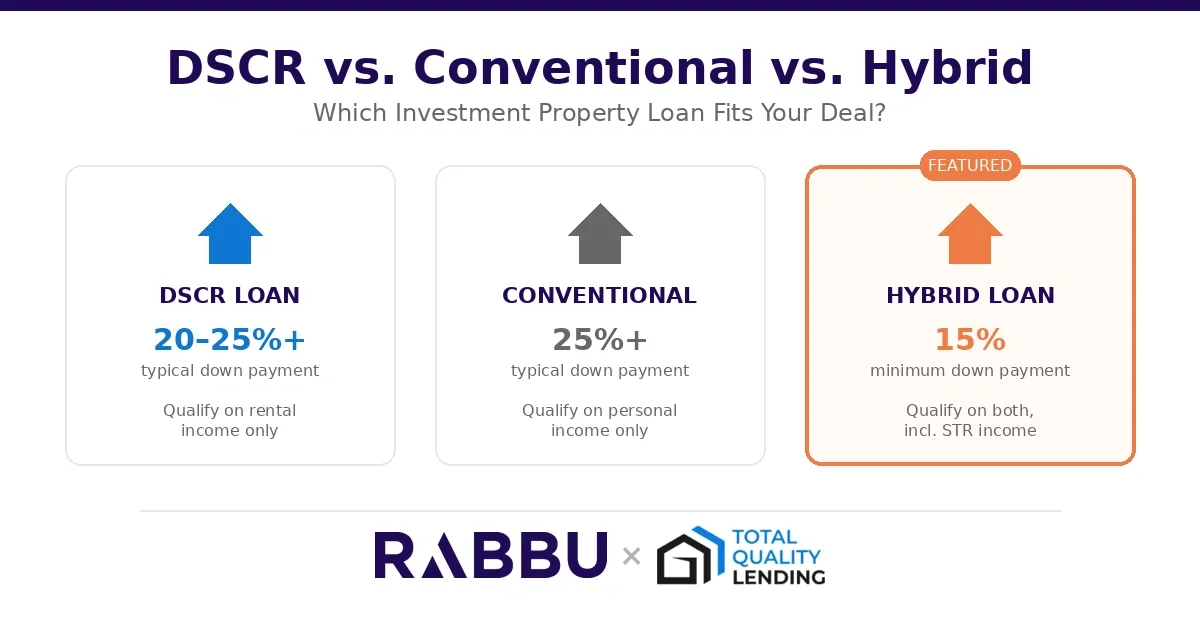
Rabbu's lending network specializes in DSCR products designed specifically for STR investors, with programs offering down payments starting at 15-20% for strong DSCR properties, interest rates typically 0.5-1.5% higher than conventional loans, no income documentation required, and closing timelines of 15-30 days versus 45-60 for conventional mortgages.
Portfolio and Commercial Loans for Scaling STR Investments
Investors acquiring multiple properties simultaneously or purchasing high-value assets often benefit from portfolio loan products that bundle multiple properties into one financing package. Portfolio loans evaluate your entire portfolio's performance rather than underwriting each property individually, creating efficiencies that accelerate acquisition velocity.
Portfolio loans work well when you're buying 2-5 properties in the same market or from the same seller, allowing you to negotiate bulk pricing while securing financing that recognizes the diversification benefits of multiple assets. Lenders typically require stronger overall financial profiles but offer more flexible terms than conventional products.
HELOC and Personal Capital for Starting Your Own Airbnb
Converting a traditional property to an STR requires funding the furnishing and setup phase that DSCR lenders won't finance until the property generates income. Many investors use home equity lines of credit against their primary residence or existing rental properties to fund the $25,000-$40,000 in furnishings, renovations, and startup costs.
HELOCs offer several advantages for STR conversions:
-
Interest-only payments during the draw period minimize monthly costs during your revenue ramp-up
-
Flexible access to capital as you need it rather than taking a lump sum upfront
-
Potentially tax-deductible interest if structured properly
-
Quick approval and funding compared to refinancing or taking out additional mortgages
The main risk with HELOCs is using your primary residence as collateral for an investment property. If your STR conversion fails to perform as projected, you're still obligated to repay the HELOC even though it's secured by your home rather than the investment property.
Find a Lender that Specializes in Short-Term Rentals
Connect with lenders who actually understand short-term rental cash flow and offer DSCR loans, portfolio financing, and investor-friendly terms.
Get Matched with STR LendersRegulatory and Zoning Risks That Can Kill Returns
Short-term rental regulations vary dramatically by municipality, with some cities actively encouraging STR investment while others have effectively banned new listings through permit caps, occupancy restrictions, and minimum stay requirements. Regulatory differences create vastly different risk profiles for buying existing properties versus starting new ones.
Existing Listings and Grandfather Clauses
Many cities that have restricted or banned new STR permits have grandfathered existing licensed properties, creating a two-tier market where permitted properties operate legally while new conversions face prohibition. In markets like San Francisco, New Orleans, and certain Colorado mountain towns, purchasing an existing permitted STR might be your only legal entry path because new permits are no longer issued.
This regulatory scarcity adds significant value to existing STR properties beyond their operational performance. A property with a transferable STR permit in a capped market might command a 30-50% premium over comparable homes without permits because buyers are purchasing both real estate and a scarce regulatory right to operate commercially.
New Permitting Requirements for First Time Hosts
Starting a new short-term rental in regulated markets means navigating permit applications, safety inspections, business licenses, and tax registrations that can take 2-6 months and cost $500-$5,000 depending on jurisdiction. Some cities require conditional use permits with neighbor notification and public hearings, fire safety inspections with sprinkler systems meeting commercial standards, parking requirements that may not be feasible on your property, occupancy limits that restrict your guest capacity below what the property could physically accommodate, and annual license renewals with fees ranging from $200-$1,500.
Permit applications sometimes get denied entirely based on neighbor objections, parking inadequacy, or zoning interpretations that weren't clear until you applied. This regulatory risk doesn't exist with established properties that already cleared the hurdles.
Short-Term Rental Caps and 90 Day Rules
Several major markets have implemented permit caps that limit the total number of STR licenses issued, creating waiting lists that can extend for months or years. Other cities like London, Amsterdam, and Paris have implemented 90-day annual limits on short-term rentals, restricting how many nights per year you can rent your property on Airbnb. A property that could generate $60,000 annually with unlimited STR use might only produce $15,000-$20,000 under a 90-day cap, making the investment financially unviable.
Operational Workload: Hospitality Skills, Time, and Tech
Running an Airbnb is fundamentally a hospitality business, not a passive real estate investment. The operational complexity differs significantly between inheriting an established system and building operations from scratch, affecting both your time commitment and the likelihood of maintaining strong performance.
Turnover Management and Cleaning
Every guest checkout triggers a 3-5 hour turnover window where your property must be completely cleaned, inspected, restocked, and prepared for the next arrival. Existing STR properties come with established cleaning teams who know the property, understand your standards, and have refined their systems over dozens of turnovers.
Starting from scratch means finding reliable cleaners, training them on your property, developing checklists, establishing communication protocols, and managing the inevitable mistakes during the first 10-15 turnovers. Many new investors cycle through 2-3 cleaning companies before finding reliable partners, losing money on poor cleaning reviews and guest complaints during this trial-and-error period.
Guest Communication Automation
Successful STR operators respond to inquiries within minutes, send pre-arrival instructions automatically, check in with guests during their stay, and request reviews after checkout. Existing properties come with communication workflows already built, including templated messages, automated sequences, and proven response strategies that maintain high review scores.
New operators face a steep learning curve on guest communication timing, tone, and content. Communication missteps directly impact review scores, which affects your search ranking and booking conversion rate for months afterward.
Remote Monitoring and Security
Smart home technology enables remote STR management through automated locks, security cameras, noise monitors, and temperature controls that prevent unauthorized parties and property damage. Existing STR properties typically have systems already installed and integrated, with the previous owner providing access credentials and training.
Converting a traditional home to an STR means purchasing and installing smart locks for keyless entry, noise monitoring devices to detect parties, exterior security cameras for package monitoring, smart thermostats to prevent excessive energy use, and WiFi mesh systems to ensure strong connectivity throughout the property. Beyond the $1,000-$1,500 hardware cost, you're investing 10-15 hours learning how to configure, monitor, and troubleshoot the systems.
Market Selection Where to Buy Airbnb Property for Maximum Yield
Location determines 60-70% of your STR investment success, making market selection your most important decision regardless of whether you're buying an existing property or starting from scratch. Different market types offer distinct advantages depending on your investment goals, operational preferences, and risk tolerance.
High ADR Vacation Markets
Premium vacation destinations like Smoky Mountains, Lake Tahoe, Scottsdale, and coastal Florida markets command average daily rates of $300-$600+ because travelers are willing to pay for unique experiences and desirable locations. Rabbu's market data shows that high-ADR markets typically feature strong seasonality with 60-80% of annual revenue concentrated in 4-6 peak months, weekend-heavy demand where Friday-Sunday nights book at 2-3x midweek rates, longer average stays of 3-4 nights compared to 1-2 nights in urban markets, and higher occupancy volatility where peak season might hit 90%+ while shoulder season drops to 30-40%.
Buying an existing STR in high-ADR markets provides immediate validation that the property can command premium rates, while conversions carry more risk if your property lacks the amenities that drive high ADRs in the area.
Urban Short Stay Hubs
Cities like Nashville, Austin, Denver, and San Diego generate consistent year-round demand from business travelers, conference attendees, and tourists seeking walkable urban experiences. Urban markets typically show lower ADRs of $150-$250 but higher occupancy rates of 70-85% annually, shorter average stays of 1-3 nights with frequent turnovers, more stable seasonality with only 20-30% revenue variance between peak and low months, and higher operational intensity due to frequent guest turnovers and cleaning cycles.
Urban STRs work well for investors who prioritize consistent cash flow over peak earning potential and can manage the intensive turnover logistics that 120-180 bookings per year requires.
Emerging Secondary Cities
Markets like Chattanooga, Boise, Asheville, and Bend represent the highest growth potential but also the highest uncertainty. Smaller cities are experiencing STR demand growth of 20-40% annually as remote work and travel pattern shifts drive visitors to less-crowded destinations.
Rabbu's Market Finder identifies emerging markets by analyzing year-over-year ADR growth exceeding 10-15%, new listing growth rates below 15%, occupancy trends showing consistent improvement over 24+ months, and regulatory environment that remains open to new STRs. Emerging markets favor conversions over existing properties because you can enter at lower price points before the market fully matures.
Due Diligence Checklist Before You Buy an Existing Airbnb Property
Buying an existing STR requires evaluating both real estate fundamentals and business operations, creating a more complex due diligence process than purchasing a traditional investment property. Missing critical issues during this evaluation period can cost you tens of thousands in unexpected expenses or lost revenue.
Verify Historical Income Statements
Sellers will provide revenue summaries showing their property's performance, but you can't rely on documents alone. Request direct access to their Airbnb and VRBO accounts to verify actual booking history showing nightly rates, occupancy patterns, and cancellation rates, guest reviews and ratings to assess whether performance is sustainable or declining, response rate and time metrics that affect search ranking, and Superhost status and when it was last achieved or lost.
Cross-reference platform reports against bank statements to confirm the seller actually received the income they're claiming. Rabbu's marketplace of active STR properties displays actual historical income imported directly from booking platforms, eliminating the risk of seller misrepresentation.
Inspect Furnishings and Amenities
The furniture and amenities included in the sale directly affect your startup costs and near-term capital requirements. During your property inspection, evaluate furniture condition and remaining lifespan, appliance age and functionality, linens and small wares inventory, and amenity functionality including hot tubs, fire pits, and game rooms.
Request an itemized inventory of everything included in the sale with approximate purchase dates and replacement costs. Properties marketed as fully furnished turnkey sometimes include worn-out furniture that's barely functional, forcing you to spend $10,000-$20,000 on replacements during your first few months when you expected zero furnishing costs.
Analyze Seasonality and Occupancy Trends
Every STR market exhibits seasonality, but the degree of variation dramatically affects your cash flow management and annual returns. Use Rabbu's market data tools to analyze monthly occupancy patterns showing peak, shoulder, and low seasons, ADR fluctuations that might show $400 summer nights dropping to $150 in winter, booking lead time trends indicating whether you'll have revenue visibility 2-3 months out or just 2-3 weeks, and competitive supply changes showing whether new listings are entering the market and affecting occupancy.
Properties in highly seasonal markets might generate 70% of annual revenue in 16-20 peak weeks, requiring careful cash flow management to cover expenses during 30-week low seasons.
Step By Step Guide: Using Rabbu to Find and Buy a Cash-Flowing Airbnb
The fastest path to STR investment success is buying a property that's already proven profitable, and Rabbu's integrated platform streamlines every step from market identification to closing. This systematic approach eliminates the trial-and-error that costs new investors months of time and thousands in mistakes.
Step 1: Identify Top Markets with Rabbu's Market Finder
Start by navigating to Rabbu's Market Finder and filtering for markets that match your investment criteria. Sort results by ROI score to identify locations offering the best combination of strong returns, reasonable competition, and favorable regulations. Focus on markets showing occupancy rates above 65%, average daily rates that support your return requirements, and at least 20-30 active comparable listings.
Step 2: Browse Active Airbnb Properties in the Marketplace
Once you've identified your target market, search Rabbu's marketplace and filter specifically for Active Airbnb properties with the Actual Financials tag to find turnkey investments with verified income history. Set your price range filters and sort results by gross yield or cash-on-cash return to identify properties offering the best financial performance. Active Airbnb listings typically receive multiple offers within 48-72 hours of hitting the market.
Step 3: Analyze Returns with Rabbu's Airbnb Calculator
Input your target property's details into Rabbu's Calculator to generate comprehensive financial projections. The calculator analyzes comparable properties in the area, applies market-specific occupancy and ADR data, and produces annual revenue estimates based on actual local performance. Refine the comparable set by filtering for properties with 5+ reviews and 4.9+ ratings to ensure you're modeling against successful listings rather than underperforming ones.
Step 4: Secure STR-Friendly Financing Through Rabbu's Network
Connect with Rabbu's DSCR lending partners who specialize in income-producing STR properties. Lenders qualify you based on the property's verified cash flow rather than your personal W-2 income, enabling faster approvals and better terms than conventional mortgages. Submit your property details and income projections from the Rabbu Calculator to receive loan quotes from 2-4 specialized lenders within 24-48 hours. They’ll finance up to 85% of the purchase price with closing in as little as 15-30 days.
The Best STR Deals Never Hit Zillow
Browse exclusive listings for turnkey Airbnbs with actual income data.
Search Exclusive ListingsStep-By-Step Guide to Starting Your Own Airbnb From Scratch Using Rabbu's Tools
Converting a traditional single family property into a profitable STR requires a systematic approach to market research, financial modeling, property preparation, and launch execution. Rabbu's tools provide the data and insights you need at each stage to maximize your chances of success while minimizing costly mistakes.
Step 1: Research Local Demand Using Rabbu's Market Data
Access market analysis including occupancy rates, ADR trends, and seasonality patterns through Rabbu's market finder. Analyze bedroom mix performance and amenity impacts to guide property selection and improvements. Understanding what drives bookings in your specific market helps you make informed decisions about which features to prioritize during your setup phase. The best STR markets combine high occupancy, strong ROI, and healthy gross yield relative to home prices.
Step 2: Browse Rabbu’s Listings for Properties With Airbnb Potential
If you’re searching for properties with strong STR potential in Rabbu’s Marketplace, start by adding filters like Airbnb Potential, Former Airbnb, and Agent Pick. If the results feel too limited, expand your search using the Public Listings tag to increase volume. To stay ahead of other investors, use Save Search to set up instant email alerts for new matching listings—just make sure you’re logged into your free Rabbu account. When you find a promising property, simply click Contact Agent to connect with a vetted STR specialist and take the next step.
Step 3: Calculate Revenue Potential with Rabbu's Projection Tools
Use Rabbu's Airbnb Calculator to model income based on comparable active listings. Adjust for planned amenities and improvements, then factor setup costs into ROI calculations. Stress-test your projections by reducing occupancy assumptions by 10-15% to see how the investment performs if the market softens or your ramp-up takes longer than expected.
Step 4: Budget Furnishings and Renovations
Cover complete setup costs and design considerations using market data on amenity impacts. Review comparable properties in your target market to understand which furnishings and amenities correlate with higher nightly rates and better review scores. Allocate your budget toward features that will differentiate your property and justify premium pricing rather than generic furnishings that don't move the needle on bookings.
Step 5: Secure DSCR Financing to Fund the Property Purchase
Maximize your buying power by using DSCR (Debt Service Coverage Ratio) loans built specifically for short-term rentals. These loans qualify you based on projected property income, making them ideal for scaling an STR portfolio while keeping personal debt low. To make pre-qualification easy, use Rabbu’s Find a Lender tool, enter the property location, set your timeline and target price. Rabbu automatically matches you with 1–3 lenders who fit your criteria. With options as low as 15% down and faster closing timelines, DSCR loans give you far more leverage and flexibility than traditional financing.
Step 6: Launch and Optimize Using Market Insights
Detail listing creation, photography, and initial pricing strategy based on Rabbu's market data. Professional photography is non-negotiable because listings with high-quality images receive 2-3x more bookings than those with amateur photos. Price your property competitively during your first 30-60 days to generate your initial reviews quickly, then gradually increase rates as your review count and rating improve.
Don't Let Financing Kill Your Deal
Most banks don't understand short-term rentals. These lenders do.
Find a LenderPros and Cons Summary: Is Owning an Airbnb Worth It in Your Situation?
The decision between buying an existing Airbnb or starting your own comes down to your specific situation, resources, and investment goals. Neither approach is universally better, but one will likely fit your circumstances more effectively than the other.
Cash Flow Potential vs Capital Risk
Existing properties deliver immediate cash flow but require larger upfront capital investments due to business premiums of 15-30% above comparable residential properties. Conversions offer higher potential returns over 3-5 years but demand patience during the 2-4 month ramp-up period with zero revenue. If you have limited cash reserves or need immediate income to cover mortgage payments, existing properties reduce financial stress during your first year. If you have adequate reserves and can tolerate delayed gratification, conversions typically generate superior long-term returns.
Lifestyle Flexibility vs Time Commitment
Existing properties come with established systems, vendor relationships, and operational workflows that enable remote management from day one. Conversions require hands-on involvement during the setup phase and a steeper learning curve as you build operational systems from scratch. First-time STR investors often underestimate the time commitment required to furnish, photograph, list, and optimize a new property while simultaneously learning guest communication, cleaning coordination, and dynamic pricing strategies.
Exit Strategies and Resale Value
Existing STR properties with strong performance histories and established reviews maintain their value better during market downturns because they're proven income-producing assets. Conversions carry more resale risk if you haven't built a strong review base or if your market becomes oversaturated before you establish your property's reputation. However, conversions offer more flexibility to pivot to long-term rentals if STR regulations change because you haven't paid a premium for STR-specific business value.
Build a Data Driven STR Portfolio Faster With Rabbu
The difference between struggling with fragmented research tools and building a profitable STR portfolio comes down to using an integrated platform designed specifically for short-term rental investors. Rabbu connects market intelligence, exclusive property listings, financial modeling tools, and specialized financing in one place.
Why Rabbu Eliminates Traditional STR Investment Friction
Traditional STR investing required subscribing to multiple data platforms, manually researching properties across generic real estate sites, building financial models from scratch, and cold-calling lenders who didn't understand vacation rental underwriting. Rabbu replaces this fragmented process with an integrated workflow where each tool builds on the previous step.
From Market Research to Closing in One Platform
Start with Market Finder to identify top-performing STR markets, browse the marketplace for verified active properties or high-potential conversions, use the Calculator to model returns with market-specific data, and connect with specialized lenders who understand STR cash flow patterns. This integrated approach eliminates the weeks of research and guesswork that traditionally separated property identification from closed deals.
Browse our marketplace of Airbnb for sale and start building your STR portfolio with properties that have proven income histories and data-backed projections.
Find the Right Airbnb Investment Property
Search exclusive listings for both turnkey and potential Airbnb properties in one place.
Explore Airbnbs for SaleFrequently Asked Questions About Buying or Starting an Airbnb
What is the six year rule for capital gains on an Airbnb property?
The six year rule allows you to treat your former primary residence as your main home for capital gains purposes for up to six years after moving out, potentially avoiding capital gains tax if you sell within this period. This rule applies specifically to properties that were your primary residence before converting to investment use.
How many reviews does an Airbnb property need to rank well in search results?
New Airbnb listings typically need at least ten to fifteen positive reviews to compete effectively in search rankings, which usually takes two to four months of consistent bookings to achieve. Properties with fewer than ten reviews appear lower in search results and convert bookings at 40-60% lower rates than established listings with 20+ reviews.
How do I project income if the Airbnb listing is new and has no historical data?
Use Rabbu's Airbnb Calculator to analyze comparable properties in the same area, filtering for high-performing listings with 5+ guest reviews and 4.9+ ratings to get accurate revenue projections based on actual market performance. The calculator applies market-specific occupancy rates, seasonal patterns, and amenity-based pricing premiums to generate month-by-month revenue estimates for your specific property.
How does Rabbu verify the income data for active STR properties?
Rabbu's marketplace features Active Airbnb listings with an Actual Financials tag that indicates 12 months of actual historical financials inputted by the seller or listing agent. Actual historical operating income is always going to be more reliable than projections or estimates.
Can I buy an Airbnb investment property with less than twenty percent down?
Through Rabbu's DSCR lending partners, qualified investors can secure financing with as little as 15% down for income-producing STR properties, based on the property's cash flow rather than personal W-2 income. Some specialized programs offer 10-15% down payment options for properties with strong DSCR ratios above 1.35, though interest rates increase by 0.5-1.0% compared to standard 20-25% down payment programs.
Don't Let Financing Kill Your Deal
Most banks don't understand short-term rentals. These lenders do.
Find a Lender