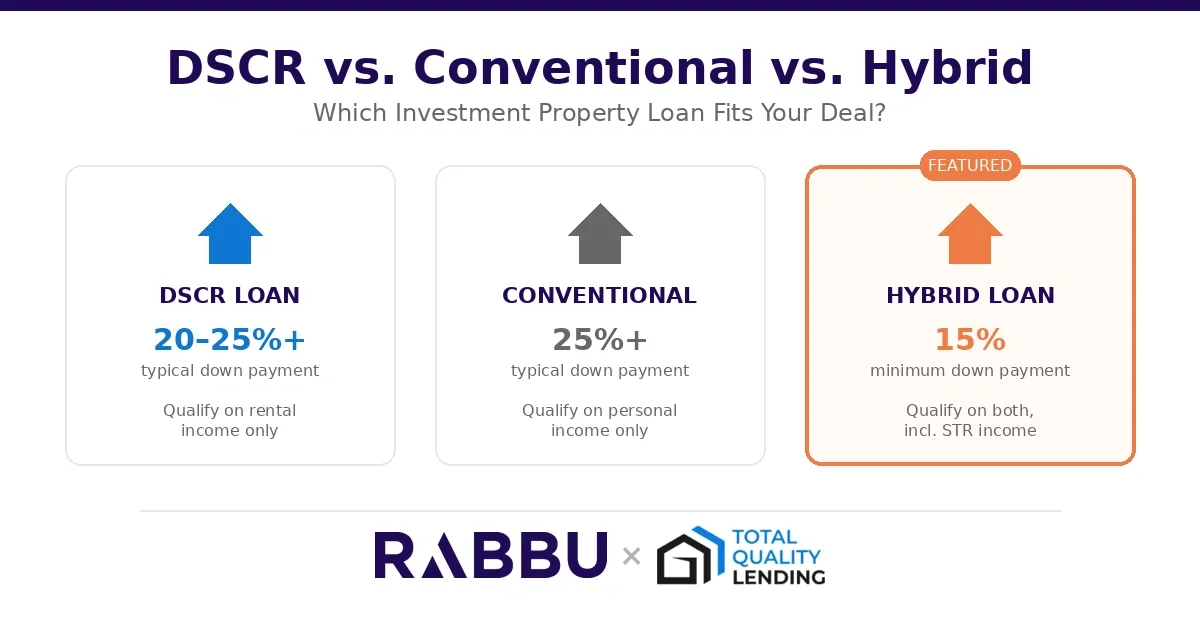

Conventional lenders reject profitable short-term rental deals every day because they don't understand vacation rental cash flow—discounting your $6,200 monthly Airbnb income to $2,400 based on long-term rental comparables, or ignoring it entirely. The result: artificially low loan approvals, massive down payment requirements, and lost opportunities on properties that would generate 15-20% cash-on-cash returns.
Debt Service Coverage Ratio (DSCR) loans, bank statement programs, and STR-specialized lenders solve this problem by qualifying you based on property income potential rather than personal tax returns—letting you close deals in 21 days instead of 60 while scaling past the 10-property conventional lending cap. This guide breaks down every financing option available for short-term rentals, shows you exactly how to match loan products to your investment strategy, and connects you with lenders who actually understand the vacation rental business model.
Best Financing Options for Short Term Rental Properties
The best way to finance a short-term rental property depends on your financial situation and investment strategy, but DSCR loans typically offer the most practical solution for dedicated STR investors because they qualify you based on property income rather than personal tax returns.
Bank statement loans work well for self-employed investors who want to document income without tax return scrutiny, while home equity products let you tap existing real estate assets for down payments. Traditional conventional mortgages only make sense if you plan to occupy the property part-time, and hard money loans serve as temporary bridges for quick purchases before refinancing into permanent financing.
Each financing option serves different investor profiles and property types. The loan product you choose determines whether you close deals in 21 days or struggle through 60-day conventional processes that weren't designed for vacation rental cash flow patterns. Rabbu’s lender network specializes in STR-specific financing and can help you get pre-approved with the lowest rates.
DSCR Loan for Airbnbs
DSCR (Debt Service Coverage Ratio) loans qualify you based on your property's projected income rather than your personal W-2 earnings or tax returns. Lenders calculate whether the property generates enough monthly revenue to cover its mortgage payment, property taxes, insurance, and HOA fees—typically requiring a DSCR of 1.0 to 1.25 depending on the program.
This financing structure works well for short-term rentals because lenders use actual Airbnb market data from your target area to project income, rather than discounting STR revenue by 25-50% like conventional banks do. You might show $75,000 on your tax returns but the property generates $6,200 monthly—the lender only cares about that $6,200 figure.
Key advantages for STR investors:
-
No income documentation required – No W-2s, pay stubs, or tax returns needed for qualification
-
Unlimited portfolio scaling – No 10-property Fannie Mae cap that stops conventional financing
-
Self-employed friendly – Business deductions don't hurt qualification since lenders ignore personal income
-
Fast closing timelines – Close in 21-30 days versus 45-60 for conventional mortgages
-
Property-by-property underwriting – Each acquisition stands on its own cash flow merits
DSCR loans typically require 20-25% down payment with interest rates running 0.5-1.5% higher than conventional investment property loans (currently 6.75-8.25% range). The rate premium pays for qualification flexibility and closing speed that conventional products can't match. Rabbu’s lender network helps you find DSCR-friendly financing using actual STR revenue data to strengthen your approval.
Find a Lender that Specializes in Short-Term Rentals
Connect with lenders who actually understand short-term rental cash flow and offer DSCR loans, portfolio financing, and investor-friendly terms.
Get Matched with STR LendersBank Statement Loans
Bank statement loans work for self-employed investors who want to document income but avoid tax return scrutiny that shows artificially low earnings due to legitimate business deductions. Lenders analyze 12-24 months of business or personal bank deposits, then calculate qualifying income using either a 50% expense factor or your actual documented expenses if lower.
For example, if your bank statements show $18,000 monthly deposits over the past year, the lender calculates $9,000 monthly qualifying income ($18,000 × 50%). Combined with your property's projected STR income, this often provides enough to qualify for properties that conventional underwriting would reject.
Programs typically require 15-20% down payment with rates between 7.0-8.5% and close in 30-35 days. They work well for investors who have strong cash flow but optimize their tax strategy to minimize reported income. Rabbu’s lender network offers bank-statement loan options designed for self-employed STR investors with complex income.
Conventional Investment Mortgage
Conventional mortgages for investment properties follow Fannie Mae and Freddie Mac guidelines, requiring strong personal income documentation, debt-to-income ratios under 43%, and two years of tax returns showing stable earnings. Loans offer the lowest interest rates (currently 6.0-7.0% for investment properties) but create significant qualification barriers for STR investors.
The fundamental problem: conventional underwriting either ignores your projected Airbnb income entirely or discounts it by 25-50% compared to long-term rental comparables. Your property might generate $5,400 monthly from vacation rentals, but the underwriter only recognizes $2,700 based on annual lease comparables—forcing you to qualify based almost entirely on W-2 income.
Conventional loans work best for your first investment property if you have strong employment income and haven't optimized your tax strategy yet. Once you're self-employed or building a portfolio, DSCR products become far more practical.
Home Equity Loans and HELOCs
Home equity loans and home equity lines of credit (HELOCs) let you borrow against equity in your primary residence or other properties to fund STR down payments, renovations, or all-cash purchases. Products don't require qualification based on the new property's income—just sufficient equity in your existing real estate and ability to service the additional debt.
Home equity loans provide a lump sum at a fixed interest rate, functioning like a second mortgage with predictable monthly payments over 10-30 years. HELOCs work like credit cards secured by your home, offering a revolving credit line with variable rates where you only pay interest on what you borrow.
The strategic advantage: you can make all-cash offers on STR properties (strengthening your negotiating position), then refinance into permanent DSCR financing after closing. This approach works particularly well in competitive markets where sellers favor cash buyers, or when you're purchasing properties that need renovation before they'll qualify for traditional financing.
The risk: you're leveraging your primary residence to fund investment property purchases. If the STR underperforms or you face unexpected expenses, you've put your home at risk to secure the investment property loan.
Cash-Out Refinance
Cash-out refinancing replaces your existing mortgage with a larger loan, letting you extract equity from properties you already own to fund new STR acquisitions. Unlike home equity loans that create a second lien, cash-out refinances pay off your current mortgage and provide additional cash at closing.
This strategy works when you have significant equity in a primary residence or existing rental property, current interest rates are competitive with your existing mortgage rate, and you want to consolidate debt while accessing capital for STR investments. You're essentially recycling equity from appreciated properties into new acquisitions without selling.
The trade-off: you're increasing your debt load on the refinanced property and extending the payoff timeline if you're refinancing into a new 30-year term. Run the numbers carefully to verify the new property's cash flow justifies the increased debt service on your existing asset. Work with Rabbu’s refinancing partners to lower your rate, extend your term, or pull cash out to fund your next STR deal.
Portfolio and Blanket Loans
Portfolio loans come from lenders who keep mortgages on their own books rather than selling them to Fannie Mae or Freddie Mac. This means they can write their own underwriting guidelines, offering flexibility for situations conventional lenders reject—like rural properties, non-warrantable condos, or borrowers with unique income structures.
Blanket loans cover multiple properties under a single mortgage, useful for investors acquiring several STRs simultaneously or consolidating existing properties into one loan with better terms. They work particularly well when you're buying multiple units in the same development or scaling quickly in one market.
Portfolio and blanket loans typically offer customized terms negotiated based on your overall financial profile and relationship with the lender. Rates and down payments vary widely—anywhere from 6.5-9.0% depending on your situation—but the flexibility often justifies slightly higher costs for properties that wouldn't qualify through conventional channels. Secure a portfolio loan through Rabbu’s lender network to simplify financing and accelerate the growth of your STR business.
Bridge Loans and Hard Money
Bridge loans and hard money loans provide short-term financing (typically 6-24 months) based primarily on the property's value rather than your income or credit profile. Products work for quick closings on time-sensitive deals or properties needing major renovation before they'll qualify for permanent financing.
Interest rates run high—often 9-15%—with points and fees adding 2-5% of the loan amount to your upfront costs. You're essentially paying a premium for speed (close in 7-14 days) and flexibility (lenders will finance properties conventional banks reject).
The typical strategy: use bridge financing to acquire and renovate a distressed property, get it cash-flowing as an STR, then refinance into permanent DSCR or conventional financing once the property is stabilized and generating documented income. This approach works well for value-add investors who can handle the carrying costs during the renovation and lease-up period.
Partnerships and Private Money
Private money loans come from individuals rather than institutional lenders—often friends, family members, or other investors who want real estate exposure without direct property management. You negotiate terms directly with the lender, typically offering 6-10% interest rates secured by the property as collateral.
Partnerships involve co-investing with other people who contribute capital in exchange for equity ownership and profit sharing. Common structures include 50/50 equity splits where one partner provides capital and the other manages operations, or 70/30 arrangements where the capital partner receives preferred returns before profits split.
Arrangements work well for newer investors who have expertise and time but limited capital, or experienced operators who want to scale faster than their personal capital allows. The key: establish clear operating agreements covering decision-making authority, profit distribution, exit strategies, and what happens if the property underperforms or partners disagree.
Don't Let Financing Kill Your Deal
Most banks don't understand short-term rentals. These lenders do.
Find a LenderHow Lenders Calculate Airbnb Income and DSCR
DSCR lenders evaluate short-term rental income fundamentally differently than conventional underwriters. Instead of requiring two years of tax returns showing actual rental income history, they use projected income based on comparable STR performance in your target market—often pulling data from platforms like Rabbu to estimate what your property will realistically generate.
The calculation works like this: the lender identifies 5-10 comparable properties within a mile radius that match your property's bedroom count, amenities, and property type. They analyze average daily rates, occupancy percentages, and seasonal patterns to project your annual gross income, then subtract estimated operating expenses (typically 25-40% depending on management structure) to arrive at net operating income.
DSCR formula: Monthly Net Operating Income ÷ Monthly Debt Obligations (P+I+T+I+HOA)
A DSCR of 1.0 means the property's income exactly covers its debt obligations. Most lenders require 1.0-1.25 minimum, with ratios above 1.35 qualifying for tier-one pricing with the lowest available rates. Higher DSCR properties carry less risk for lenders since they have more cash flow cushion if occupancy drops or expenses increase.
The advantage for STR investors: lenders recognize the full income potential of vacation rentals rather than discounting them to long-term rental levels. Your property might generate $72,000 annually from Airbnb versus $28,800 as a long-term rental—DSCR underwriting uses that $72,000 figure while conventional lenders would use $28,800 or less.
Factors lenders consider beyond DSCR:
-
Seasonal income patterns – Properties in ski towns or beach markets with 3-4 month peak seasons face more scrutiny than year-round destinations
-
Local STR regulations – Markets with clear permitting processes and stable regulations get better terms than cities considering STR bans
-
Property condition and amenities – Updated properties with pools, hot tubs, or unique features justify higher income projections
-
Experience level – First-time STR investors sometimes face higher down payment requirements than operators with existing properties
-
Market saturation – Areas with exploding STR inventory may see lenders discount projected income due to increasing competition
Use Rabbu's Airbnb Calculator to model your target property's DSCR before making offers. This helps you focus on properties that will easily qualify for financing rather than stretching to buy something that barely meets lender requirements.
Down Payment and Credit Requirements by Loan Type
Different loan products carry different qualification standards. Understanding requirements upfront helps you target the right financing for your situation rather than wasting time applying for programs you won't qualify for.
|
Loan Type |
Down Payment |
Credit Score |
Cash Reserves |
Income Documentation |
|
DSCR Loan |
15-25% (15% for high DSCR) |
620-680 minimum |
6-12 months PITI |
None required |
|
Bank Statement |
15-20% |
680+ preferred |
6-9 months PITI |
12-24 months statements |
|
Conventional Investment |
20-25% |
680-700+ |
6 months PITI |
2 years tax returns, W-2s |
|
Portfolio Loan |
15-30% (negotiable) |
660+ (flexible) |
Varies by lender |
Varies by lender |
|
Hard Money/Bridge |
10-25% |
600+ (flexible) |
3-6 months PITI |
Minimal to none |
|
Home Equity/HELOC |
N/A (uses existing equity) |
680-700+ |
Varies |
Recent pay stubs, tax returns |
PITI = Principal, Interest, Taxes, Insurance (monthly housing payment)
The down payment percentages above represent typical ranges, but individual lenders vary. Some specialized DSCR programs offer 10-15% down for properties with DSCR ratios above 1.5, while others require 30% down for first-time STR investors or properties in markets they consider higher risk.
Cash reserves matter more than many investors realize. Lenders want proof you can cover 6-12 months of mortgage payments beyond your down payment and closing costs—demonstrating financial cushion if the property experiences seasonal vacancies or unexpected repairs. Strong reserves often unlock better rates and terms even if other aspects of your profile are marginal.
Credit score requirements have some flexibility, particularly with DSCR and portfolio lenders who care more about property cash flow than personal credit history. Scores below 660 typically trigger higher rates or require compensating factors like larger down payments or higher DSCR ratios. Rabbu’s lender network will work with credit scores as low as 620 and require as little as 15% down.
5 Steps to Choose the Right Short Term Rental Loan
Selecting the optimal financing for your STR investment requires matching loan products to your specific situation rather than just chasing the lowest advertised rate. Follow this framework to identify which program accelerates your goals while minimizing qualification friction.
Step 1: Define Your Investment Strategy and Hold Period
Your intended hold period and exit strategy determine which loan terms make sense. If you're buying a property to renovate and sell within 18 months, a bridge loan with a 12-month term and 9% interest rate might cost less than paying 2 points to buy down a 30-year DSCR loan to 7.25%.
Conversely, if you're building a long-term portfolio you'll hold for 10+ years, paying slightly higher rates for DSCR loans that let you scale past 10 properties makes strategic sense even though conventional financing offers lower rates initially.
Questions to answer before choosing financing:
-
Are you buying and holding long-term or planning to sell within 3-5 years?
-
Is this your only investment property or the first of many?
-
Do you plan to manage the STR yourself or hire professional management?
-
Will you use the property personally or operate it full-time as a rental?
-
Are you buying turnkey properties or value-add fixer-uppers?
Your answers determine whether you prioritize lowest rates (conventional), fastest closing (bridge/hard money), easiest qualification (DSCR), or unlimited scaling potential (portfolio/DSCR).
Step 2: Estimate Net Operating Income With Rabbu
Accurate income projections form the foundation of STR financing decisions. Overly optimistic estimates lead to buying properties that don't cash flow as expected, while conservative projections might cause you to pass on deals that would actually perform well.
Rabbu's Airbnb Calculator generates data-backed projections using actual market performance from comparable properties in your target area. Input the property address and details to see month-by-month revenue estimates, operating expense breakdowns, and net operating income calculations that account for seasonal variations.
Projections serve two purposes: they help you evaluate whether a property meets your cash flow requirements, and they strengthen your loan application by demonstrating you've done thorough market analysis rather than guessing at rental income. Many investors print Calculator results to include with financing applications—lenders appreciate seeing third-party validated data.
Pay particular attention to the inputs that go into DSCR calculation in your results. Properties showing 1.35+ DSCR qualify easily with tier-one pricing, while anything below 1.15 might struggle to get approved or face higher rates to compensate for lower cash flow coverage.
Step 3: Match Loan Products to Cash Flow Goals
Different loan structures impact your monthly cash flow differently even at similar interest rates. A 30-year amortization provides lower monthly payments but higher total interest costs compared to 20-year terms, while interest-only periods during the first 5-10 years maximize cash flow at the expense of building equity.
Run the numbers on how each loan product affects your monthly cash-on-cash returns. A DSCR loan at 7.5% with 25% down might generate better monthly cash flow than a conventional loan at 6.5% requiring extensive income documentation that delays your closing by 30 days and costs you a month of peak season revenue.
Cash flow priorities to consider:
-
Maximum monthly cash flow – Choose longer amortization (30 years) or interest-only options even if total interest costs are higher
-
Fastest debt paydown – Select shorter terms (15-20 years) or make extra principal payments to build equity faster
-
Lowest total interest cost – Prioritize lowest rates and shortest terms you can afford while maintaining adequate cash flow cushion
-
Portfolio scaling velocity – Choose DSCR or portfolio loans that let you acquire multiple properties quickly rather than optimizing individual deal terms
Your cash flow goals determine which loan structure makes sense, not just which one offers the lowest rate on a rate sheet.
Step 4: Compare True Cost of Capital and ROI
The lowest interest rate doesn't always equal the lowest total cost or best return on investment. A conventional loan at 6.5% requiring 25% down and 60 days to close might generate lower ROI than a DSCR loan at 7.5% with 20% down closing in 21 days—especially if the faster closing lets you capture peak season revenue the conventional loan would miss.
Calculate total cost of capital including:
-
Interest rate and total interest paid over your hold period
-
Origination fees, points, and closing costs
-
Opportunity cost of larger down payments (what else could that capital earn?)
-
Time value of money from delayed closings (lost rental income during extended underwriting)
-
Prepayment penalties if you plan to refinance or sell within 1-3 years
A loan with 1 point in fees and 7.25% interest might cost less over 3 years than a "no fee" loan at 7.75% if you're planning to refinance or sell relatively quickly. Run the break-even analysis to see when lower rates offset higher upfront costs.
Step 5: Get Pre-Qualified With STR-Friendly Lenders
Pre-qualification from specialized short-term rental lenders strengthens your negotiating position and accelerates closings once you find the right property. Unlike pre-approvals that require full documentation and credit checks, pre-qualification gives you a preliminary assessment of loan amount and terms you'll likely qualify for based on basic financial information.
Connect with Rabbu's network of STR-specialized lenders to get pre-qualified with 2-3 different lenders offering various loan products. This takes 15-20 minutes of your time and gives you multiple options to compare when you're ready to make offers.
Working with lenders who understand short-term rental cash flow dynamics means you're not educating them about DSCR calculations or explaining why your property will generate $4,800 monthly instead of $1,800. They speak your language and structure deals around vacation rental business models rather than forcing you into residential mortgage boxes that don't fit.
Find a Lender that Specializes in Short-Term Rentals
Connect with lenders who actually understand short-term rental cash flow and offer DSCR loans, portfolio financing, and investor-friendly terms.
Get Matched with STR LendersTips to Get Approved Quickly and Secure the Lowest Rate
Even with specialized STR lenders, certain strategies improve your approval odds and help you secure better terms. These tactics work particularly well when you're competing against other qualified buyers or pushing the boundaries of a lender's standard guidelines.
Improve Credit and Lower DTI
Your credit score directly impacts interest rates and approval odds. Every 20-point increase in score can lower your rate by 0.125-0.25%, which translates to $30-60 monthly savings on a $300,000 loan—$10,800-21,600 over a 30-year term.
Quick credit improvements before applying:
-
Pay down credit card balances below 30% utilization (below 10% is ideal)
-
Don't apply for new credit cards or loans within 90 days of your mortgage application
-
Dispute any errors on your credit report that are dragging down your score
-
Become an authorized user on someone else's account with perfect payment history
-
Pay off small collections or charge-offs under $500 that are easy to resolve
Debt-to-income ratio matters less for DSCR loans than conventional mortgages, but it still affects your overall borrowing capacity. If you're close to qualifying, paying down $5,000-10,000 in credit card or auto loan debt before applying might make the difference between approval and rejection.
Document Projected STR Income Persuasively
The strength of your income projections determines whether lenders approve your DSCR loan at favorable terms or require higher down payments and rates to compensate for uncertainty. Professional, data-backed analysis carries far more weight than hand-waving about "great Airbnb potential."
Build a compelling income projection package:
-
Use Rabbu's Calculator to generate projections based on actual comparable properties
-
Include screenshots of 5-10 similar listings showing their rates, reviews, and booking calendars
-
Reference specific market data about occupancy rates and ADR trends in your target neighborhood
-
Account for seasonal variations rather than extrapolating peak season income across all 12 months
-
Include conservative expense estimates (management, cleaning, utilities, supplies, maintenance)
Lenders trust investors who demonstrate they've done thorough market research and understand the business model. Arriving with detailed projections signals you're a serious operator, not someone gambling on rental income they haven't properly analyzed.
Build Reserve and Seasoning Buffers
Cash reserves beyond your down payment and closing costs demonstrate financial stability and reduce lender risk. Most DSCR lenders require proof of 6-12 months PITI in liquid reserves—meaning you have $30,000-60,000 sitting in bank accounts after closing on a property with $5,000 monthly debt obligations.
Reserves don't have to be idle cash earning nothing. Many lenders accept checking and savings accounts, money market accounts and CDs, liquid investment accounts (stocks, bonds, mutual funds), and retirement accounts like 401(k)s or IRAs (though some lenders discount by 30-40%).
Seasoning requirements apply when you're using recently acquired funds for your down payment. If you just received a $50,000 gift or transferred money from another account, lenders typically want to see funds "seasoned" in your account for 60-90 days before closing. Plan ahead to avoid delays from sourcing recently deposited funds.
Shop Multiple Short Term Rental Lenders
Interest rates, fees, and terms vary significantly between lenders even for identical loan products. One DSCR lender might quote 7.25% with 1 point while another offers 7.5% with no points—the break-even analysis determines which costs less over your hold period.
Compare at least 3-4 lenders on factors like:
-
Interest rate and APR (total cost of borrowing)
-
Origination fees and points
-
Prepayment penalties (many DSCR loans have 1-3 year penalties)
-
Closing timeline guarantees (some lenders consistently close faster than others)
-
Geographic lending footprint (not all lenders operate in every state)
-
Minimum and maximum loan amounts
-
Property type restrictions (some won't finance condos, rural properties, or properties on large acreage)
Rabbu's lender network connects you with pre-vetted STR financing specialists who compete for your business. Getting multiple quotes takes the same time as talking to one lender but gives you leverage to negotiate better terms and confidence you're getting competitive pricing.
Common Financing Pitfalls That Hurt Cash Flow
Even experienced investors make financing mistakes that reduce returns or derail deals entirely. Avoid common pitfalls that cost STR investors thousands in lost cash flow and missed opportunities.
Ignoring Local STR Regulations
The best financing terms mean nothing if you can't legally operate your property as a short-term rental. Many cities have zoning restrictions, permit requirements, occupancy limits, or minimum stay requirements that affect your ability to run an Airbnb—and lenders increasingly verify regulatory compliance before approving loans.
Before applying for financing, research your target market's STR regulations. Does the city require STR permits or business licenses? Are there zoning restrictions limiting STRs to certain areas? Do HOAs prohibit or restrict short-term rentals? Are there occupancy taxes or registration requirements? Has the city recently passed or proposed STR bans or severe restrictions?
Some lenders won't finance properties in markets with uncertain regulatory environments, while others require proof of permits before closing. Discovering regulatory issues after you're under contract creates expensive delays or forces you to walk away from deals.
Underestimating Seasonality in DSCR
Many investors make projections using peak season income without adequately accounting for shoulder seasons and off-peak periods. Your property might generate $8,000 monthly during summer but only $2,500 during winter—averaging those into $5,250 monthly projections creates cash flow problems when reality doesn't match your pro forma.
Lenders typically calculate DSCR using annual income divided by 12 months, but you need cash reserves to cover the low months. A property with 1.25 DSCR annually might drop to 0.6 DSCR during three winter months, requiring $4,000-6,000 monthly from reserves to cover the shortfall.
Protect yourself from seasonal cash flow gaps:
-
Use Rabbu’s market data tool to understand seasonality trends in your market
-
Model monthly income variations using Rabbu's Calculator which shows seasonal patterns
-
Maintain larger cash reserves (12+ months) for highly seasonal markets
-
Consider dynamic pricing strategies that boost shoulder season occupancy
-
Plan for low-season property maintenance and improvements when revenue drops
-
Set aside peak season profits to cover off-peak months rather than spending them
Properties that survive long-term are those whose owners plan for worst-case scenarios, not those who assume peak season performance continues year-round.
Over-Leverage From Short-Term Rental Loans
Maximum leverage isn't always optimal leverage. Putting 20% down instead of 25% might boost your cash-on-cash return on paper, but it also reduces your monthly cash flow cushion and leaves less room for error if occupancy drops or expenses spike.
Higher leverage magnifies both gains and losses. A property that appreciates 20% generates 100% return on a 20% down payment but only 80% return on a 25% down payment—but that same property dropping 10% in value wipes out 50% of your equity at 20% down versus only 40% at 25% down.
Consider factors when choosing down payment amounts:
-
Properties in volatile or unproven markets justify larger down payments for safety
-
First-time STR investors benefit from lower leverage until they understand operating costs
-
Markets with strong historical performance support higher leverage with more confidence
-
Your total portfolio leverage matters more than individual property leverage
A conservative approach: target 25-30% down on your first 2-3 properties while you learn the business, then increase leverage to 20% once you've proven your operating model and understand true costs.
Closing Delays From Incomplete Docs
Even fast-closing DSCR loans get delayed when investors don't prepare documentation upfront. Common issues that extend closing timelines include unclear property title, missing HOA documents, incomplete property insurance quotes, and unsigned operating agreements for LLCs.
Prepare items before starting your loan application:
-
2-3 months of bank statements showing adequate reserves
-
Property insurance quotes from 2-3 carriers
-
LLC operating agreement if purchasing in an entity
-
Proof of STR permits or confirmation permits are available in your target area
-
Signed purchase contract with clear closing timeline
-
Appraisal ordered immediately upon going under contract
Investors who close in 15-21 days have everything ready before applying. Those who scramble to gather documents during underwriting consistently miss closing dates and risk losing deals to better-prepared competitors.
Don't Let Financing Kill Your Deal
Most banks don't understand short-term rentals. These lenders do.
Find a LenderPutting the Numbers Together With Rabbu's Revenue Data
Accurate income projections separate successful STR investors from those who overpay for underperforming properties. The difference between projected $6,500 monthly income and actual $4,200 monthly income turns a profitable investment into a cash flow drain—and the gap usually stems from using generic rental data instead of STR-specific market analysis.
Rabbu's Airbnb marketplace solves this problem by providing historical income data and profitability projections for both turnkey STR listings and prospective properties. Every listing displays either verified revenue from actual bookings or data-backed projections based on comparable properties in the immediate area.
When you're evaluating properties on Rabbu, you see month-by-month revenue patterns showing seasonal variations and peak periods, occupancy rates compared to market averages and top-performing properties, average daily rates broken down by season and property type, operating expense estimates including management and cleaning, net operating income and cash-on-cash return projections at different down payment levels.
Data serves two critical purposes: it helps you identify properties that will actually generate the returns you need, and it provides documentation lenders trust when underwriting your DSCR loan application. Many of Rabbu's lender partners use Rabbu's market data directly in their underwriting process.
When you apply for financing on a property you found through Rabbu, the lender already has confidence in the income projections because they're based on the same third-party data source the lender would use independently. The result: faster approvals, more accurate loan terms, and fewer surprises after closing when your actual income closely matches the projections you used to evaluate the deal.
Why Investors Choose Rabbu's Lender Network to Finance Their Airbnb Properties
Finding lenders who understand short-term rental investments used to require weeks of research, dozens of phone calls, and gambling on whether advertised programs actually delivered on their promises. Rabbu eliminates this friction by connecting investors with pre-vetted STR financing specialists who have collectively financed over $10 billion in short-term rental loans.
These lenders aren't generic mortgage brokers who occasionally do investment property loans—they're specialists who structure programs specifically for STR cash flow patterns.
Down Payments as Low as 15%
While most DSCR programs require 20-25% down, Rabbu's lender partners offer programs with down payments as low as 15% for properties with strong cash flow metrics. This means you're financing up to 85% of the purchase price, preserving capital for additional acquisitions or property improvements that boost rental income.
Lower down payment programs typically require DSCR ratios above 1.35 to compensate for higher loan-to-value ratios, but for properties in strong markets with proven income potential, this creates opportunities to deploy your capital across multiple properties instead of tying it up in one.
Quick Closing Process
Speed matters in competitive STR markets where properties receive multiple offers within 48 hours of listing. Rabbu's lender partners close loans in as little as 30 days once you're approved, with some specialized programs closing even faster at 15-21 days for straightforward transactions.
This velocity advantage helps you compete against cash buyers and investors with existing lending relationships. Sellers take your offers seriously when you can demonstrate financing that closes on schedule rather than conventional mortgages that frequently extend 45-60 days.
Competitive Rates
Rabbu's lenders compete for your business, which keeps rates competitive. Instead of accepting the first quote you receive, you compare multiple offers and choose the best combination of rate, terms, and closing speed for your situation.
Current DSCR rates through Rabbu's lender network typically range from 6.75-8.25% depending on your credit profile, down payment, and property cash flow metrics. While rates run 0.5-1.5% higher than conventional mortgages, the qualification flexibility and closing speed often generate better returns than lower-rate products that take twice as long to close.
High Quality Reputable Lenders
Every lender in Rabbu's network has been vetted for licensing compliance, track record of closing deals on time, transparent fee structures, and positive reviews from other STR investors. You're not gambling on unknown lenders found through Google searches—you're working with established financing partners who have proven expertise in vacation rental lending.
Vetting protects you from common lending pitfalls like bait-and-switch rate advertising, hidden fees discovered at closing, and lenders who promise fast timelines but consistently miss closing dates.
No W-2s or Tax Returns Required
DSCR loans through Rabbu's lender partners qualify you based on property cash flow rather than personal income documentation. This means no W-2s, no pay stubs, no tax returns, and no employment verification letters—just bank statements showing adequate reserves and property analysis demonstrating cash flow coverage.
For self-employed investors, business owners, and anyone who's optimized their tax strategy to minimize reported income, this qualification structure removes the biggest barrier to financing investment properties.
Less Property Restrictions
Many conventional lenders reject properties on large acreage, non-warrantable condos, rural locations, or unique property types that don't fit their standard underwriting boxes. Rabbu's lender partners have more flexible guidelines and will finance properties other lenders turn down—as long as the STR income potential justifies the loan.
Flexibility opens up investment opportunities in emerging markets, unique properties with exceptional income potential, and value-add situations where the property doesn't fit conventional molds but generates strong cash flow as a vacation rental.
Find a Lender that Specializes in Short-Term Rentals
Connect with lenders who actually understand short-term rental cash flow and offer DSCR loans, portfolio financing, and investor-friendly terms.
Get Matched with STR LendersFAQs About Short Term Rental Financing
Can I qualify for a short term rental loan if I'm self employed?
Yes, many of Rabbu's lenders offer bank statement programs that don't require tax returns or W-2s. They analyze 12-24 months of business or personal bank deposits to calculate qualifying income, or you can use DSCR loans that ignore personal income entirely and qualify based on property cash flow.
Can I use projected Airbnb income to qualify for a mortgage for short term rental property?
Yes — many lenders allow you to qualify using projected Airbnb or short-term rental income rather than traditional long-term lease data. To do this, they typically require a market analysis or third-party report that includes comparable property data and verified income estimates. This approach is common with DSCR (Debt Service Coverage Ratio) loans, which focus on a property’s earning potential instead of your personal income or tax returns.
What happens if my DSCR falls below 1.0 during the offseason for my vacation rental loans?
Most DSCR loans are based on annualized property income rather than short-term fluctuations, so seasonal dips don’t automatically cause issues. However, if your DSCR stays below 1.0 for an extended period, your lender may review performance more closely. A consistently low ratio can affect refinancing eligibility or trigger additional documentation requirements, especially if you plan to expand your portfolio or access equity.
Can I refinance a conventional mortgage into a DSCR loan for better short term rental financing terms?
Yes. Refinancing from a conventional mortgage into a DSCR loan is a common move for short-term rental investors who want to qualify based on property income instead of personal income. This strategy can unlock better leverage, improve loan flexibility, and free up your personal debt-to-income ratio—making it easier to qualify for additional properties. The lenders in our network can help you refinance your STR property.
Can I finance multiple properties simultaneously?
Absolutely. Many lenders in our partner network work directly with investors who are building short-term rental portfolios. These programs often allow you to finance multiple properties at once—sometimes under a blanket or portfolio loan structure—simplifying management and helping you scale faster.
Don't Let Financing Kill Your Deal
Most banks don't understand short-term rentals. These lenders do.
Find a Lender