
For years, short-term rental owners have been told the same advice over and over:
“Get off Airbnb. Direct bookings are free.”
On the surface, it makes sense. Why pay a roughly 15% OTA commission when you can control the guest relationship and avoid platform fees?
But for most operators, especially those under 50 units, this advice is not just misleading. It is expensive.
In reality, “direct bookings are free” may be the most costly myth in hospitality.
This is why.
Airbnb (and other OTA) Fees Are Not Money Set on Fire
Many operators look at Airbnb’s commission as margin lost.
What they are really paying for is certainty.
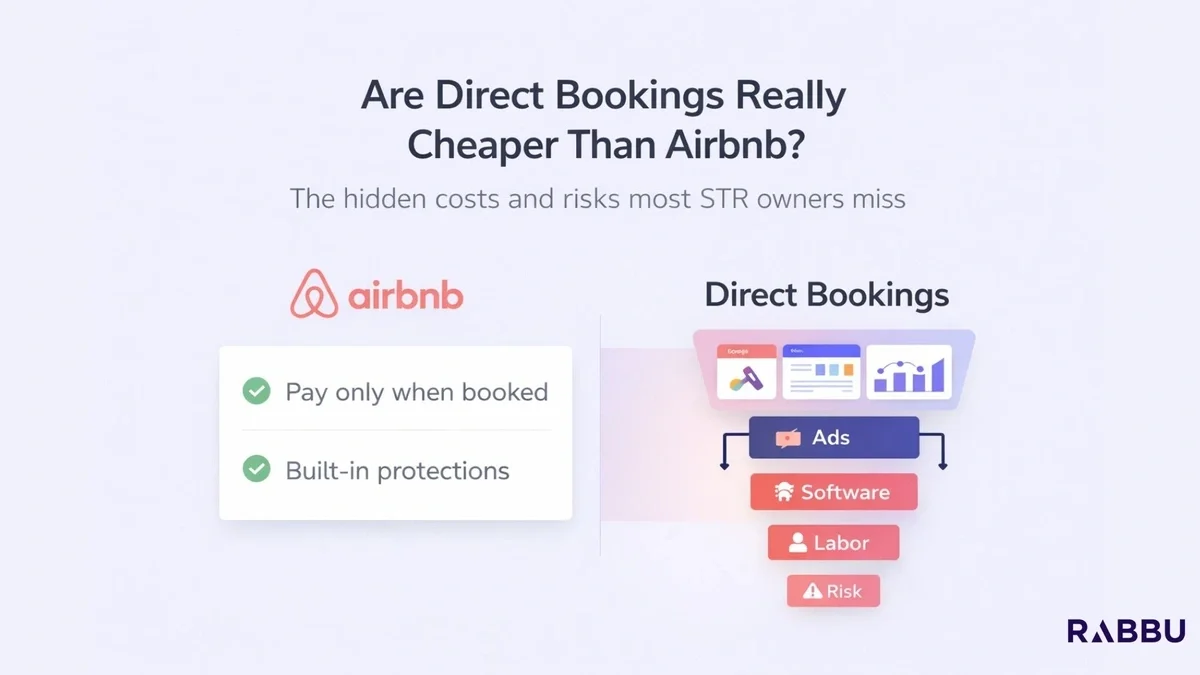
Airbnb only earns a fee when it delivers revenue. There is no upfront spend, no guaranteed monthly cost, and no payroll required just to generate demand. If bookings slow, costs slow with them.
That is very different from direct bookings.
The Fully Loaded Cost of Direct Bookings
When operators push hard into direct bookings before they have scale, they are not eliminating costs. They are replacing visible fees with hidden ones.
Payment processing alone typically costs around 3% per transaction.
Then comes traffic acquisition. Google ads, Meta ads, SEO work, content creation, email tools, and retargeting software all cost money whether bookings happen or not.
Add in the software stack required to support direct bookings. Booking engines, PMS integrations, channel management, fraud prevention, and analytics tools are rarely free and often scale poorly for small operators.
Finally, there is labor. Someone has to manage marketing, handle guest communication, resolve disputes, and maintain the site. For many operators, that someone is the owner. Those hours rarely show up in CAC calculations but they absolutely impact returns.
When larger operators have run the math at scale, a consistent pattern emerges. For most operators under roughly 50 units, the true fully loaded customer acquisition cost of a direct booking often lands closer to 12%.
That is before factoring in risk.
The Risk Side of Direct Bookings
Cost is only part of the equation. Direct bookings also introduce real operational risk that OTAs absorb on your behalf.
- Payment disputes and chargebacks are handled directly by the operator. Fraud risk increases. Revenue can be clawed back after checkout.
- Liability exposure also increases. OTAs provide meaningful insurance layers and structured dispute processes. With direct bookings, operators must source and manage this protection themselves, and gaps are common.
- Edge cases like overstays and guest disputes are rare, but when they happen, they are expensive. OTAs provide clearer enforcement frameworks and documentation that many small operators struggle to replicate.
Finally, there is revenue volatility. Airbnb delivers consistent exposure and proven conversion. Direct bookings depend on traffic sources that can fluctuate or stop working entirely.
The Price of Certainty
When you compare a roughly 12% fully loaded CAC for direct bookings to a roughly 15% OTA fee, the difference is not waste.
It is the price of certainty.
You are paying Airbnb to deliver demand, convert traffic, handle disputes, provide insurance layers, and eliminate upfront risk. For most operators early in their growth, that tradeoff makes sense.
When Direct Bookings Actually Make Sense
Direct bookings are not bad. They are earned.
They become powerful when an operator has brand strength, organic traffic, repeat guests, and enough scale to spread technology and labor costs efficiently.
At that point, direct bookings improve margins and reduce dependency. Before that, they often reduce clarity and increase risk.
What This Means for STR Investors
If you are evaluating a short-term rental as an investment, the wrong question is “How many direct bookings does this property get?”
The right question is “What is the fully loaded CAC, risk profile, and certainty of revenue?”
This is where most pro formas fall apart.
At Rabbu, we help investors evaluate properties based on real performance inputs, not assumptions. Our tools show projected revenue, comparable performance, and market demand so you can underwrite deals with eyes wide open.
If a deal only works with aggressive direct booking assumptions, that is a risk worth understanding before you buy.
Use Rabbu to compare markets, analyze revenue potential, and pressure test assumptions before you commit capital. Whether a property leans on Airbnb, direct bookings, or a mix of both, clarity beats optimism every time.
The strongest short term rental investments are built on certainty, not channel vanity.