
Finding profitable short-term rentals for sale used to mean spending weeks piecing together zoning laws from city websites, guessing at revenue from incomplete Airbnb data, and working with agents who'd never heard of a DSCR loan. Most investors either gave up after their third dead-end property or bought something that looked promising but never generated the cash flow they expected.
This guide shows you exactly how to identify high-performing STR markets, analyze properties with verified income data, connect with specialized professionals who understand vacation rental financing, and close deals faster than investors using traditional real estate platforms. You'll learn the systematic workflow that separates investors building profitable portfolios from those still stuck researching their first property.
The Old Way vs. The New Way of Finding Short-Term Rental Properties
You can find properties with short-term rental potential through real estate websites like Zillow and Apartments.com. The real challenge for investors isn't just locating any short-term rental—it's finding properties with verified income data, accurate revenue projections, and connections to professionals who actually understand the STR market.
Why Traditional Methods Fall Short
Traditional real estate platforms show you properties, but they won't tell you whether a house will actually make money as an Airbnb. Zillow and Realtor.com list homes for sale without any insight into occupancy rates, average nightly rates, or local STR regulations that could kill your investment. You're stuck manually researching zoning laws, calling city offices about permits, and guessing at revenue based on incomplete information scattered across a dozen different websites.
Most real estate agents don't specialize in short-term rentals either. They might help you buy a house, but they can't tell you if it'll generate $4,500 or $1,800 monthly as an Airbnb—and that difference determines whether your investment succeeds or tanks.
How Rabbu Streamlines STR Investment Discovery
Rabbu’s Airbnb Marketplace consolidates what used to take weeks of fragmented research into a single platform. You get exclusive STR listings with verifiable historical income, prospective properties with data-backed projections, integrated analysis tools that calculate returns in real-time, and direct connections to agents and lenders who specialize in short-term rentals. Instead of piecing together information from ten different sources, you access everything in one place.
Find the Right Airbnb Investment Property
Search exclusive listings for both turnkey and potential Airbnb properties in one place.
Explore Airbnbs for SaleClarify Your Short-Term Rental Strategy
Before you start searching, define what success looks like for your investment. Are you seeking immediate monthly cash flow, long-term property appreciation, or portfolio diversification? Your answer shapes which properties you target and which markets you prioritize.
Turnkey Airbnb vs. Conversion Properties
Turnkey Airbnb properties are already operating as short-term rentals when you buy them. They come furnished, permitted, and often with established guest reviews and booking history—you take over an existing operation and start collecting rental income immediately, sometimes within days of closing.
Conversion properties are traditional homes you transform into short-term rentals after purchase. You handle furnishing, permitting, photography, and listing creation yourself. This approach typically offers lower purchase prices and higher potential ROI since you're adding value through the conversion process, but it requires more upfront capital for furnishings and 2-4 months before you generate your first booking.
Turnkey advantages:
-
Immediate cash flow: Revenue starts from existing bookings on day one
-
Verified performance data: Historical income reduces investment risk
-
Established reputation: Guest reviews provide social proof
-
Better financing terms: Lenders view proven income favorably
Conversion advantages:
-
Lower entry cost: Purchase prices below turnkey property values
-
Design control: Complete customization for target guests
-
Tax deductions: Write off furnishing and improvement expenses
-
Market optimization: Tailor amenities to specific guest demographics
You can find both turnkey short-term rentals for sale and STR conversion opportunities on Rabbu’s marketplace. We’ll cover how to search for each property type in the sections that follow.
Hold Period vs. Cash Flow Goals
Your investment timeline significantly impacts property selection. If you're planning to hold the property for 3-5 years, you might prioritize markets with strong appreciation potential even if current cash flow is modest. Markets like Boise or Austin have shown 8-12% annual appreciation, meaning a $400,000 property could be worth $530,000+ in five years—even if monthly cash flow only reaches $800-1,200.
Investors focused on immediate cash flow typically target markets with established STR demand, occupancy rates above 70%, and strong average daily rates relative to purchase prices. Monthly cash flow from day one ranges from $2,000-4,000 in strong markets, though appreciation may be slower.
Exit Options After the Short-Term Rental Period
Understanding your exit strategy helps you choose properties with maximum flexibility. Most STR investments offer three primary exit paths: selling the property as a turnkey Airbnb operation (often at a premium due to established income), converting to a traditional long-term rental if regulations change, or continuing STR operations indefinitely as part of a long-term portfolio.
Properties in strong rental markets give you optionality—if short-term rental regulations tighten, you can pivot to long-term rentals without losing the entire investment thesis.
Check Local Rules and Zoning Early
Local regulations determine whether you can legally operate a short-term rental at all. Some cities ban STRs entirely, others cap the number of nights you can rent annually, and many require specific permits that take months to obtain. Investing in a property where STRs are prohibited turns a potentially profitable investment into a financial disaster.
STR Permits and Occupancy Limits
Most cities with active STR markets require permits or licenses before you can accept your first guest. Charleston, South Carolina limits STR permits to specific zones and caps the total number issued citywide—you might buy a property only to discover all available permits are already allocated. Nashville requires a permit for non-owner-occupied STRs and limits rentals to 3% of dwelling units in any census tract.
Guest occupancy limits also vary dramatically by location. Some cities restrict STRs to two guests per bedroom plus two additional guests, while others use square footage formulas or impose blanket caps regardless of home size. A five-bedroom home that can only legally host six guests generates far less income than one that can host twelve.
HOA and Condo Restrictions
Homeowner associations and condo boards can ban short-term rentals even in cities where STRs are otherwise legal. Many HOAs prohibit rentals under 30 days in their covenants, conditions, and restrictions (CC&Rs), and private rules supersede city ordinances. Condo buildings frequently restrict STRs to protect long-term resident quality of life, and some impose rental caps limiting the percentage of units that can be rented at any given time.
Always request and review HOA documents before making an offer. Look specifically for language about "short-term rentals," "vacation rentals," or "minimum lease terms." If documents are vague, get written confirmation from the HOA board about their STR policy—verbal assurances won't protect you if the board later enforces restrictions.
Short-Term Residential Rental Taxes
STR income creates tax obligations beyond standard property taxes. Most jurisdictions require you to collect and remit occupancy taxes (also called lodging taxes or transient occupancy taxes) from guests, typically ranging from 8-15% of the nightly rate. Platforms like Airbnb automatically collect these taxes on your behalf in certain markets, while in others you're responsible for manual collection and quarterly remittance.
You might also need business licenses to operate legally. Cities like Los Angeles require STR operators to obtain a business tax registration certificate and pay annual fees. Failure to comply can result in fines, back taxes, and forced closure of your listing.
Most STR-related expenses are tax-deductible, including mortgage interest, property taxes, utilities, cleaning, supplies, management fees, and depreciation. Many investors find that STR tax advantages offset the additional compliance burden, especially when working with accountants who specialize in short-term rental taxation.
Identify Top STR Markets with Rabbu's Market Finder
Random property selection leads to random results. Data-driven market selection dramatically improves your odds of finding consistently profitable short-term rentals. Rabbu's Market Finder analyzes hundreds of U.S. markets based on occupancy rates, average daily rates, regulatory environment, and ROI potential—helping you focus your search on locations where STR investments actually perform.
Sorting by ROI and Market Health Indicators
Start by filtering markets based on ROI scores, which combine revenue potential with purchase price affordability. Markets with ROI scores above 8% typically offer strong cash-on-cash returns, while scores above 12% indicate exceptional investment opportunities. Look for markets with at least 20-30 active Airbnb listings—this indicates healthy demand without oversaturation.
Compare occupancy consistency across seasons. Markets with 60%+ occupancy year-round provide more predictable cash flow than locations with 85% occupancy in summer but 30% in winter. Gross yield (annual revenue divided by purchase price) helps you compare markets with vastly different price points—a $300,000 property generating $45,000 annually (15% gross yield) often outperforms a $600,000 property generating $72,000 (12% gross yield) when you factor in financing costs.
Narrow your focus to 2-3 markets that align with your investment criteria. If you prioritize cash flow over appreciation, target markets with high occupancy and strong average daily rates relative to property prices. If you're building long-term wealth, consider markets with moderate current cash flow but strong population growth and economic development indicators.
Understanding Market Data and Seasonality
Rabbu's market maps show concentration of high-performing properties within each market, helping you identify the most profitable neighborhoods and property types. A market might show strong overall performance, yet 80% of revenue comes from waterfront properties or downtown locations—information that dramatically impacts your property search strategy.
Seasonal patterns reveal cash flow timing and reserve requirements. Markets like Destin, Florida generate 70% of annual revenue during May-August, meaning you'll need larger cash reserves to cover off-season expenses. Year-round markets like Phoenix or San Diego provide more consistent monthly income, reducing the capital buffer required.
Review top-performing property types in your target markets. Are studios and one-bedrooms dominating, or do families book larger homes? This insight prevents you from buying a five-bedroom house in a market where couples primarily book weekend getaways.
Browse High-Performing Listings in Rabbu Marketplace
Rabbu's Airbnb Marketplace gives you access to two distinct property categories: Active Airbnb properties already generating income, and Airbnb Potential properties in strong markets that you can convert into profitable short-term rentals.
Active Airbnb Properties with Proven Cash Flow
Active listings are turnkey Airbnb investments currently operating and accepting bookings. Properties include verifiable historical revenue data—actual income generated over the past 12-24 months, not projections or estimates. You can request to see real occupancy rates, average daily rates, seasonal booking patterns, and guest review scores before closing.
Many listings are exclusive to Rabbu's marketplace. Sellers choose Rabbu because they want buyers who understand STR valuation and won't lowball based on comparable sales of non-income-producing properties.
Properties with the Active Airbnb tag typically command premium prices because sellers know exactly what their properties earn. You're paying for certainty and immediate income rather than hoping your conversion succeeds. Many of the properties with the Active Airbnb tag will also have the Actual Financials tag, which means the revenue figures shown are actual historical financials inputted by the seller or listing agent.
Airbnb Potential Properties for Value-Add Investors
Properties tagged with Airbnb Potential are traditional homes in strong short-term rental markets that aren't currently operating as Airbnbs. Properties offer lower entry prices and higher ROI potential through forced appreciation—you create value by converting the property into a high-performing STR.
Each listing shows projected annual revenue based on comparable properties in the area, estimated gross yield and cash-on-cash returns, and amenity breakdowns that impact nightly rates. Rabbu's data engine analyzes similar properties within a half-mile radius to generate realistic income projections, accounting for seasonal variations and property-specific features.
Expect to invest 2-4 months and $15,000-40,000 in furnishings, photography, and initial marketing before you generate your first booking. Budget for this gap when analyzing conversion opportunities—the lower purchase price only creates value if you have capital and time to execute the conversion properly.
Accurate financial analysis separates successful STR investors from those who lose money on properties that "seemed like good deals." Rabbu's integrated tools let you project income and evaluate investment performance before making offers, using actual market data rather than wishful thinking.
Investor Return Calculator Integration
Revenue projections mean nothing without return calculations that factor in your actual costs. Rabbu's return calculator (located on every property listing detail page) integrates with revenue projections to calculate cap rate (net operating income divided by purchase price), cash-on-cash return (annual cash flow divided by total cash invested), and overall ROI accounting for appreciation, principal paydown, and tax benefits.
Input your purchase price, expected down payment, mortgage terms, and estimated operating expenses. Operating expenses typically include:
-
Property management: 20-30% of revenue
-
Cleaning: 10-15% of revenue
-
Utilities: 3-5% of revenue
-
Supplies and amenities: 2-4% of revenue
-
Maintenance reserves: 5-8% of revenue
-
Insurance: 1-2% of revenue
-
Property taxes: Varies by location
Compare properties across different markets. A $350,000 property generating $50,000 annually with $28,000 in expenses produces $22,000 NOI (6.3% cap rate). A $500,000 property generating $65,000 with $38,000 in expenses produces $27,000 NOI (5.4% cap rate). Despite higher absolute income, the second property offers lower returns—the kind of insight that prevents costly mistakes.
The Best STR Deals Never Hit Zillow
Browse exclusive listings for turnkey Airbnbs with actual income data.
Search Exclusive ListingsTop Platforms to Find Short-Term Rentals
While Rabbu's Marketplace specializes in investment-grade STR properties with verified performance data, understanding the broader landscape helps you identify opportunities across multiple channels.
Rabbu Marketplace (Recommended)
Rabbu offers the only marketplace specifically designed for STR investors rather than travelers or general homebuyers. Every listing includes 12-months of historical income data or data-backed projections, integrated return calculations showing cap rate and cash-on-cash returns, regulatory status and permit information, and connections to STR-specialized agents and lenders.
The platform eliminates weeks of manual research by consolidating market analysis, property search, financial modeling, and professional connections in one place.
Sublet.com
Sublet.com specializes in furnished rentals and sublets, often with 1-6 month lease terms. While not exclusively short-term rentals in the Airbnb sense, the platform reveals demand for medium-term furnished housing—a niche many investors overlook.
Corporate relocations, travel nurses, and temporary workers drive demand for 30-90 day stays that fall between traditional STRs and long-term leases. Properties serving this market often achieve higher occupancy with less turnover than nightly rentals.
Zillow and HotPads
Zillow and HotPads primarily serve long-term renters and homebuyers. The short-term rental data is extremely limited, and you won't find income projections or STR-specific analysis tools. These platforms really only work to source potential STR conversion opportunities, not turnkey STRs. It’s also worth noting that this approach is typically better suited for experienced investors and not first-time buyers.
Furnished Finder
Furnished Finder connects property owners with travel nurses, traveling professionals, and others seeking 1-6 month furnished accommodations. The platform reveals demand for medium-term rentals in healthcare-heavy markets—often more stable and less seasonal than traditional vacation rentals.
Properties marketed to travel nurses typically achieve 80-90% occupancy year-round with less guest turnover and lower operational intensity than nightly Airbnb rentals.
Step-By-Step Search Workflow for Investors
Systematic property evaluation prevents emotional decisions and helps you focus on investments that meet your specific criteria. This workflow assumes you've already identified target markets using Rabbu's Market Finder.
Step 1. Set Budget and Desired Nightly Rate
Calculate your maximum purchase price based on available capital and financing capacity. If you're using a DSCR loan with 20% down, $100,000 in investable capital supports a $500,000 purchase price. Factor in closing costs (2-3%), furnishing expenses for conversions ($15,000-40,000), and operating reserves (6-12 months of expenses).
Work backward from your cash flow goals to determine required nightly rates. If you want $2,500 monthly cash flow, your property generates approximately $4,500-5,000 monthly revenue (accounting for 30-40% operating expenses and 10% vacancy). At 70% occupancy, that requires an average daily rate of $210-240.
Step 2. Save and Monitor Short-Term Property Listings
Create watchlists in Rabbu's marketplace for properties meeting your criteria. Set up automated email alerts for new matching properties in your target markets—speed matters in competitive markets where the best deals receive multiple offers within 48 hours.
Monitor properties listed for 30+ days. Listings often present negotiation opportunities, especially if the seller is motivated or the property is overpriced relative to income potential.
Step 3. Analyze Revenue and Seasonality Data
Use Rabbu's market data to project annual income potential and seasonal variations for each property you're seriously considering. Don't rely on seller-provided income claims without verification—some sellers inflate numbers or cherry-pick their best months.
Compare the property's projected performance against top performers in the same neighborhood. If similar properties generate $55,000 annually and your target property projects $42,000, understand why—is it poorly furnished, lacking amenities, or just underpriced?
Step 4. Verify Regulations Before Contacting Seller
Double-check local STR laws and permit requirements to avoid wasting time on restricted properties. Call the city's planning or zoning department directly—don't rely solely on online information that might be outdated. Ask specifically about permit availability, occupancy limits, parking requirements, and any pending regulatory changes.
If the property is in an HOA or condo building, request the CC&Rs and confirm STR policies in writing before making an offer.
Step 5. Schedule Walkthrough or Virtual Tour
Evaluate property condition and STR suitability through inspections with STR-experienced agents. Look beyond standard home inspection items to assess STR-specific factors:
-
Noise insulation between rooms
-
Parking adequacy for guest vehicles
-
Outdoor space quality and privacy
-
Proximity to attractions or amenities
-
Neighborhood character and safety
Properties in residential neighborhoods face different operational challenges than locations in resort areas—consider whether neighbors will complain about guest traffic and whether the property "feels" like a vacation destination.
Step 6. Make the Offer or Sign the Agreement
Navigate purchase negotiations with STR intentions disclosed upfront. Some sellers prefer buyers who will continue operating their property as a successful Airbnb, while others worry about neighborhood impacts and prefer owner-occupants.
Leverage cash flow analysis in negotiations—if the property generates $48,000 annually but is priced like a $300,000 residential home, you can justify a premium offer based on the income stream's value. Conversely, if the seller wants $450,000 but comparable STRs only generate $38,000 annually, your financial analysis supports a lower offer.
Include contingencies for permit verification, HOA approval (if required), and satisfactory review of historical income documentation for turnkey properties.
Don't Let Financing Kill Your Deal
Most banks don't understand short-term rentals. These lenders do.
Find a LenderConnect with STR-Specialized Professionals
Working with professionals who understand short-term rental investments accelerates your success and helps you avoid costly mistakes that generalist agents and lenders don't anticipate.
Finding STR-Focused Buyer Agents
Generic real estate agents help you buy houses, but STR-specialized agents help you buy income-producing businesses. Rabbu's Find an Agent tool connects you with agents who have:
-
Local STR regulation expertise: Navigate complex permit processes and identify compliant opportunities
-
Income validation skills: Verify seller claims and identify properties with genuine performance potential
-
Market intelligence: Access off-market deals from other STR operators looking to exit
-
Negotiation leverage: Justify offers based on income multiples and cap rates
Standard agent commissions apply (typically 2.5-3% of purchase price paid by the seller), but the expertise and deal access often save you multiples of the commission in avoided mistakes and better property selection.
DSCR and STR-Friendly Financing Options
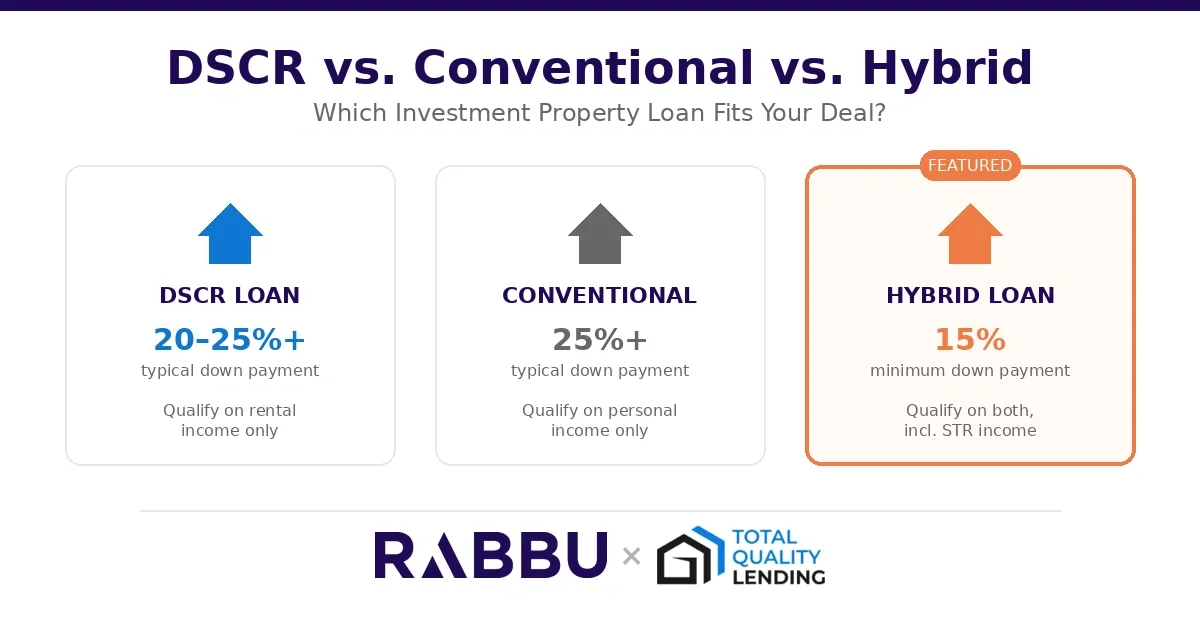
Traditional mortgage lenders qualify you based on W-2 income and ignore your property's earning potential. STR-specialized lenders offer loan products designed specifically for investment properties and short-term rental operations.
DSCR (Debt Service Coverage Ratio) loans qualify you based on the property's projected income rather than your personal finances. If the property generates enough rent to cover its mortgage payment (typically a DSCR of 1.0-1.25), you qualify—regardless of your W-2 income, tax returns, or employment status.
Down payments typically range from 15-25%, with interest rates 0.5-1.5% higher than conventional mortgages. The trade-off—slightly higher rates for dramatically easier qualification and faster closing—makes sense for most STR investors.
Rabbu's lender network includes specialists offering DSCR programs, bank statement loans for self-employed investors, portfolio loans for multiple properties, and conventional investment loans for W-2 employees.
Calculate Income, Expenses, and Furnishing Budget
Purchase price represents just one component of your total investment. Accurate financial analysis requires modeling all income sources and expense categories to determine true profitability.
Revenue Projection Tools and Metrics
Occupancy rates and average daily rates drive your revenue projections, but metrics vary dramatically by season, property type, and management quality. Use Rabbu's revenue calculator to forecast income using verified comparable data, factor in seasonal variations and market-specific performance patterns, and model top-performer potential with optimized pricing strategies.
Compare your projections against multiple performance scenarios:
|
Metric |
Conservative |
Moderate |
Optimistic |
|
Occupancy Rate |
60% |
70% |
80% |
|
Average Daily Rate |
$175 |
$200 |
$225 |
|
Annual Revenue |
$38,325 |
$51,100 |
$65,700 |
|
Gross Yield (on $350K) |
10.9% |
14.6% |
18.8% |
This range helps you understand both your likely outcome and your worst-case scenario if you struggle to achieve market-average performance.
Cleaning, Platform Fees, and Utility Costs
Operating expenses typically consume 30-45% of gross revenue, though this varies based on property type, location, and management approach. Self-managed properties save 20-30% in management fees but require significant time investment for guest communication, cleaning coordination, and maintenance oversight. Most investors starting their first STR self-manage to understand operations, then transition to professional management as they scale.
Furnishings, Insurance, and Reserves
Conversion properties require complete furnishing before you can accept your first guest. Budget $8,000-15,000 for a well-furnished one-bedroom, $15,000-25,000 for a three-bedroom, and $25,000-40,000 for a five-bedroom property.
STR-specific insurance costs $1,200-2,500 annually depending on property value and coverage limits. Standard homeowner's insurance excludes commercial rental activity, so you'll need specialized coverage that protects against guest damage, liability claims, and loss of income.
Maintain operating reserves covering 6-12 months of expenses for unexpected repairs, seasonal occupancy drops, or regulatory changes that temporarily impact your ability to rent.
Spot and Avoid Rental or Listing Scams
Fraudulent listings and investment scams target both travelers and investors in the STR space. Protect yourself by recognizing red flags and following verification protocols.
Common Red Flags and Verification Steps
Scammers often advertise properties they don't own, collect deposits or full payments upfront, then disappear. Warning signs include prices dramatically below market rates, sellers who refuse video calls or in-person meetings, requests for payment via wire transfer or cryptocurrency, pressure to "act fast" before someone else buys, and reluctance to provide verifiable ownership documentation.
Verification steps for every property:
-
Confirm ownership through county assessor websites
-
Verify STR permit status by calling local government
-
Check historical performance by requesting login access to Airbnb/Vrbo dashboards for turnkey properties
-
Validate agent credentials through state regulatory websites
-
Review financing pre-approval to confirm lender legitimacy
Never send money before verifying ownership and permit status. Legitimate sellers understand due diligence and welcome verification—those who resist or create urgency are often running scams.
Time Your Search Around Seasonality for Better ROI
Strategic timing affects both purchase prices and your property's initial performance after acquisition.
Off-Season Bargains and Peak-Season Premiums
Sellers listing properties during slow seasons often face less competition and more negotiating pressure. A beach property listed in November might sit for months while a similar property listed in March receives multiple offers within days—buyers shopping in spring are thinking about summer revenue.
Properties acquired in off-seasons give you time to furnish, photograph, and optimize listings before peak season begins. Buy a ski resort property in May, spend June-August perfecting your setup, and launch in September ready to capture premium winter rates.
Conversely, properties acquired during peak seasons can generate immediate cash flow but often command premium prices. Sellers know buyers are motivated by the imminent high season and price accordingly.
Final Checklist Before You Sign or Submit an Offer
Essential verification steps prevent costly surprises after closing and ensure you're buying the investment you think you're buying.
Documentation, Funding, and Insurance Ready
Confirm every critical element is in place before committing to any short-term rental property purchase:
-
STR permit verification: Property has valid permit or can obtain one
-
Regulatory compliance: Local laws allow STR operation at this address
-
HOA approval: CC&Rs allow short-term rentals (if applicable)
-
Historical income validation: Reviewed actual platform statements for turnkey properties
-
Revenue projections: Generated using Rabbu's Calculator with verified comparable data
-
Return calculations: Modeled cap rate, cash-on-cash return, and DSCR
-
Financing pre-approval: Confirmed with STR-specialized lender
-
Insurance quotes: Obtained STR-specific coverage quotes
-
Agent specialization: Verified agent has STR investment experience
-
Furnishing budget: Allocated capital for conversion properties
-
Operating reserves: Confirmed 6-12 months expense coverage available
Find a Lender that Specializes in Short-Term Rentals
Connect with lenders who actually understand short-term rental cash flow and offer DSCR loans, portfolio financing, and investor-friendly terms.
Get Matched with STR LendersBuild a Cash-Flowing Portfolio With Rabbu
The difference between struggling to find your first profitable short-term rental and building a portfolio of high-performing properties comes down to using integrated tools rather than piecing together information from disconnected sources.
Integrated Platform Advantages
Rabbu's platform streamlines the entire STR investment lifecycle from initial market identification through closing. Start with Market Finder to identify top-performing locations based on occupancy, average daily rate, and ROI data. Browse exclusive listings in the Marketplace with actual historical income or data-backed projections. Analyze returns using the integrated Calculator that factors in your specific financing and expense assumptions. Connect with STR-specialized lenders who understand vacation rental underwriting. Partner with agents who have local market expertise and regulatory knowledge.
This integrated approach eliminates weeks of manual research and dramatically reduces the risk of missing critical information that impacts profitability. Find your next short-term rental property on Rabbu’s marketplace.
STR Concierge Service
Investors who prefer a done-for-you approach can work with Rabbu's concierge partners who provide 1-on-1 guidance from market selection through closing. Dedicated advisors help you identify optimal markets based on your specific goals, source and evaluate properties that meet your criteria, coordinate with agents and lenders throughout the transaction, and ensure all regulatory and operational elements are addressed.
Concierge services work particularly well for out-of-state investors, busy professionals who can't dedicate time to property search, and first-time STR investors who want expert guidance through their initial acquisition.
FAQs About Finding Short-Term Rentals
Can I manage a short-term rental property remotely?
Remote management is entirely possible using property management companies, automated systems for guest communication and pricing, and local service providers for cleaning and maintenance. Many successful STR investors never visit their properties after the initial acquisition and furnishing.
How do I get insurance for an Airbnb investment property?
Contact insurers who offer short-term rental coverage or specialized STR insurance policies through Rabbu's partner network, as standard homeowner's insurance typically excludes commercial rental activity. STR-specific policies cover guest damage, liability claims, and loss of rental income during repairs or regulatory shutdowns.
How long does it take to recoup furnishing costs for a short-term rental?
Most investors recover furnishing expenses within 12-18 months through higher nightly rates that furnished properties command over unfurnished rentals. High-demand vacation markets typically recoup costs faster than secondary markets.
What is the 80/20 rule for Airbnb properties?
The 80/20 rule suggests that 80% of your bookings will come from 20% of your marketing efforts, emphasizing the importance of optimizing listings and guest experience for maximum revenue. In practice, this means focusing on professional photography, detailed descriptions, competitive pricing, and exceptional guest communication rather than spreading effort across dozens of minor optimizations.
How does Rabbu's marketplace differ from other platforms?
Rabbu specializes exclusively in STR investments with free access to real-time data, exclusive listings, integrated analysis tools, and connections to STR-specialized professionals—creating a comprehensive investment platform rather than just a listing site. Traditional platforms like Zillow show properties but provide no income data, regulatory guidance, or STR-specific financial analysis.
Find the Right Airbnb Investment Property
Search exclusive listings for both turnkey and potential Airbnb properties in one place.
Explore Airbnbs for Sale